

Boost Engagement: Custom Push Notifications for Canadian Apps
Discover how custom push notifications for Canadian businesses can defeat app fatigue, boost retention, and drive sales. A guide to mobile marketing strategy.
Published Updated
Why Read This?
This article reveals how ditching generic alerts for personalized, custom push notifications can dramatically boost engagement and sales for Canadian apps. Learn why relevant, timely messages are crucial to combat app fatigue, prevent uninstalls, and transform your app into an intelligent, proactive engagement tool.
A customer in Vancouver opens her favourite retail app, browses a new line of rain jackets, but gets distracted and closes it. Thirty minutes later, her phone buzzes. It's a notification from the app. Is it the generic "20% Off Everything!" broadcast sent to every user in the country? No. This one reads: "Still looking for the perfect rainy day companion? The jacket you viewed is in stock in your size, and we offer free same-day delivery in Vancouver." This isn't just marketing; it's a personalized service. This is the pivotal difference between a notification that gets swiped away and one that drives a sale, and it's a distinction many Canadian businesses are still struggling to master.
The reality is that the generic, one-size-fits-all approach to mobile communication is dead. In a market saturated with apps and digital noise, simply having a mobile presence is no longer enough. The battle for customer engagement in Canada is won and lost in these micro-moments of relevance. For businesses investing heavily in mobile app development, the frighteningly high rates of app uninstalls and dormant users represent a significant drain on ROI. The solution lies in transforming your app from a passive digital storefront into a proactive, intelligent engagement tool, with custom push notifications as its primary voice.
The Strategic Shift: Why Your Mobile Marketing Strategy in Canada Needs a Rethink
For years, the playbook was simple: build an app, get downloads, and send promotions. This volume-based approach has led to a phenomenon known as "app fatigue." Canadian consumers, while highly mobile-savvy, are increasingly protective of their screen real estate and attention. They have little patience for apps that clutter their notification tray with irrelevant offers. A poorly timed, untargeted notification is more than just ineffective; it’s a primary catalyst for users disabling notifications or, worse, uninstalling your app entirely.
This challenge is compounded by the unique characteristics of the Canadian market. With vast geographical distances and diverse regional consumer habits, a message that resonates in Toronto may fall flat in Calgary or Halifax. Furthermore, strict privacy regulations like the Personal Information Protection and Electronic Documents Act (PIPEDA) and Canada's Anti-Spam Legislation (CASL) mean businesses must earn the right to communicate. Blasting your entire user base not only yields poor results but also risks significant legal and reputational damage. The path to sustainable business growth in Canada requires a more nuanced, respectful, and intelligent mobile strategy.
From Generic Blasts to Meaningful Conversations: The Power of Personalization
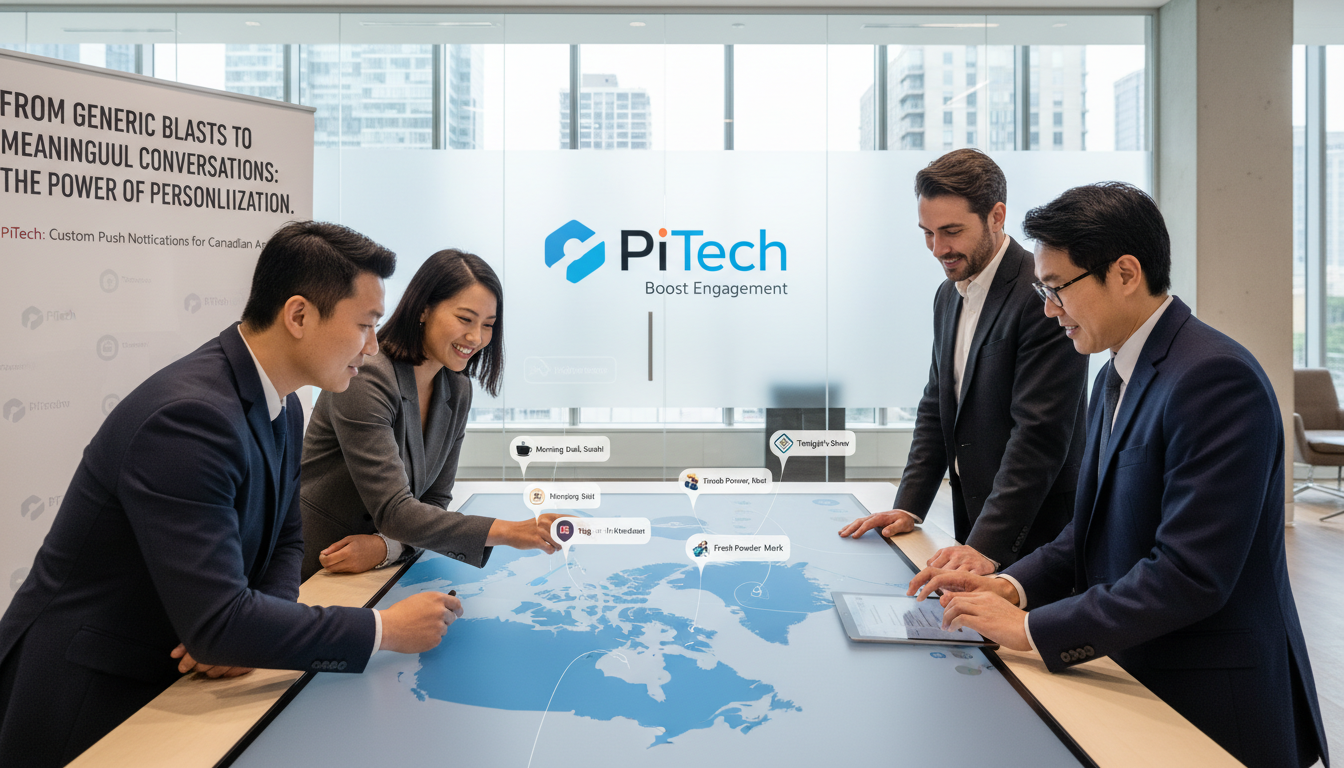
The antidote to app fatigue is radical relevance. This means moving away from the "broadcast" model and adopting a "dialogue" model, where each communication feels like a one-to-one conversation. This is the core principle behind effective custom push notifications in Canada. It's not about inventing new features; it's about leveraging user data intelligently and ethically to deliver value at every touchpoint.
Understanding User Segmentation: The Foundation of Effective Notifications
Segmentation is the first step away from generic messaging. Instead of a single user list, you create dynamic groups based on shared attributes and behaviours. This allows you to tailor your communication strategy with a level of precision that a broadcast simply cannot match. A robust segmentation strategy goes far beyond basic demographics.
For a Canadian business, this could involve:
* Geographic Segmentation: Sending a "Snow Blower Sale" notification to users in Winnipeg in October, while sending a "Patio Furniture Clearance" message to users in Victoria.
* Demographic Segmentation: Targeting a new line of university-branded apparel to users aged 18-22 in cities with major universities.
* Purchase History Segmentation: Alerting customers who previously bought premium coffee beans when a new single-origin roast arrives.
* App Usage Segmentation: Re-engaging users who haven't opened the app in 30 days with a special "We Miss You" offer, separate from your active user base.
Leveraging Behavioural Triggers for Hyper-Relevant Messaging
While segmentation groups users, behavioural triggers react to individual actions in real-time. This is where marketing automation becomes indispensable. By setting up triggers based on specific user activities (or inactivities), your app can send perfectly timed and contextual messages that feel helpful, not intrusive.
Consider these powerful examples:
* Cart Abandonment: A user adds items to their cart but doesn't check out. An hour later, a push notification reminds them: "Your items are waiting! Complete your purchase now."
* Wishlist Price Drop: A user saves a product to their wishlist. When that item goes on sale, they receive an immediate alert: "Good news! The price just dropped on an item in your wishlist."
* Post-Purchase Follow-up: A week after a customer receives their online order, a notification asks for a product review or offers tips on how to use their new purchase, fostering post-sale engagement.
* In-App Feature Engagement: A user explores a new feature for the first time. A follow-up notification can offer more tips or highlight advanced functionality, improving user onboarding and adoption.
The Impact of Location and Time-Based Targeting in the Canadian Market
Geofencing and time-zone awareness are critical components of a sophisticated mobile marketing strategy in Canada. A notification sent at 9:00 AM Eastern Time is an unwelcome interruption for a user in British Columbia who is just waking up. A properly architected system automatically adjusts send times to the user's local time zone.
Moreover, geofencing unlocks powerful proximity marketing capabilities. Imagine:
* A user who has opted-in walks within 500 meters of your Toronto retail store. They receive a notification: "You're nearby! Pop in and get a free coffee with any purchase today."
* A attendee at a conference in Montreal receives a notification from the event app with a schedule reminder for the next keynote speaker in their specific conference track.
* A travelling user's banking app sends a helpful alert: "Welcome to Alberta! Did you know you can use our partner ATMs here with no fees?"
These hyper-contextual messages demonstrate that your app understands the user's immediate environment and needs, transforming the app from a simple tool into a genuine assistant.
Architecting a High-Impact Custom Push Notification Strategy

Having the technology is only half the battle. A successful strategy requires a thoughtful approach to content, lifecycle marketing, and measurement. It’s about building a system that consistently delivers the right message, to the right person, at the right time, through the right channel.
The Anatomy of a High-Converting Push Notification
Every notification is a bid for your user's attention. To make it count, each message should be meticulously crafted. The most effective notifications share several key elements:
* Clarity and Brevity: The message must be instantly understandable. Get straight to the point and communicate the value proposition clearly.
* Personalization: Use the user's name, reference past behaviour, or mention their location. "John, your order has shipped!" is far more effective than "Your order status has been updated."
* Urgency and Scarcity (Used Sparingly): Phrases like "Limited stock," "Offer ends tonight," or "2 seats left" can motivate immediate action, but overuse will diminish their impact and annoy users.
* A Clear Call-to-Action (CTA): What do you want the user to do? "Shop Now," "Read More," "Track Your Package," or "Claim Your Reward" guides them to the next step.
* Rich Content: When possible, use images, GIFs, or interactive buttons (on supported platforms) to make your notification stand out and provide more context directly on the lock screen.
Using Push Notifications for the Full Customer Lifecycle
Many businesses make the mistake of using push notifications exclusively for promotions and sales. While important, this narrow focus misses enormous opportunities to build deeper, long-lasting relationships and improve app retention in Canada. A holistic strategy engages users at every stage of their journey.
* Onboarding: Welcome new users with a series of helpful tips on how to get the most out of your app. For example: "Tip 1: Set up your profile to get personalized recommendations."
* Activation: Encourage users to take a key first action. A food delivery app might send: "Ready for your first order? Get $10 off to get you started."
* Engagement: Provide ongoing value beyond sales. A fitness app could send workout reminders or motivational messages. A media app can alert users to breaking news stories relevant to their interests.
* Re-engagement: Target dormant users with compelling reasons to return. This could be a special offer, an announcement of new features, or a summary of what they've missed.
* Support and Transactional Updates: The most opened and valued notifications are often transactional. "Your package is out for delivery," "Your flight is on time," or "Your support ticket has been updated" build trust and reduce customer support inquiries.
Measuring What Matters: Key Performance Indicators for App Retention
To optimize your strategy, you must measure its impact. While metrics like delivery rate and open rate are foundational, they don't tell the whole story. To truly gauge the success of your custom push notifications, you need to track metrics that tie directly to business goals.
Key KPIs include:
* Click-Through Rate (CTR): What percentage of users who saw the notification clicked on it? This measures message relevance and appeal.
* Conversion Rate: Of the users who clicked, how many completed the desired action (e.g., made a purchase, read the article, used the feature)?
* Retention Rate: Compare the retention rates of users who receive personalized notifications versus a control group that doesn't. This is the ultimate measure of engagement success.
* App Uninstalls/Notification Opt-outs: Monitor these metrics closely after sending a campaign. A spike indicates your message was irrelevant or too frequent.
* Revenue Per Notification: For e-commerce apps, track the direct revenue generated from specific push campaigns to calculate ROI.
Navigating the Legal Landscape: PIPEDA and CASL Compliance for Mobile Marketing
In Canada, user trust and legal compliance are not optional; they are prerequisites for a successful mobile strategy. Both PIPEDA and CASL place strict requirements on how businesses collect, use, and communicate with user data. Failure to comply can result in hefty fines and severe damage to your brand's reputation.
The Golden Rule of Consent: Explicit Opt-Ins Explained
Under CASL, you must have express, provable consent before sending commercial electronic messages, which includes push notifications with a marketing purpose. When a user first installs your app, the operating system (iOS or Android) will prompt them to allow notifications. This is a crucial first step. However, for CASL compliance, it's best practice to go further. Explain why a user should opt-in. Instead of just showing the system prompt, present a pre-permission screen within your app that clearly outlines the value exchange: "Allow notifications to receive order updates, exclusive deals, and personalized alerts."
Data Handling and Privacy Best Practices for Canadian Apps
PIPEDA governs how private sector organizations handle personal information. When you use data for personalization, you are handling personal information. Key principles to follow include:
* Transparency: Your privacy policy must clearly state what data you are collecting and how you are using it for personalization.
* Purpose Limitation: Only collect the data you need for the purposes you've identified. Don't collect location data 24/7 if you only need it for proximity marketing when the app is active.
* Security: You are responsible for safeguarding the user data you collect. A data breach can be catastrophic for trust and legal standing.
* User Control: Make it easy for users to manage their notification preferences within your app's settings. Allow them to opt out of promotional messages while still receiving essential transactional alerts.
Partnering with a knowledgeable technology provider who understands the intricacies of Canadian privacy law is essential to building a compliant and effective notification system.
Practical Business Takeaways: Actionable Steps to Implement Your Custom Push Notification Strategy
Embarking on a journey to implement a world-class push notification system can feel daunting. However, by breaking it down into manageable steps, any Canadian business can begin to unlock this powerful engagement channel.
- Audit Your Current Mobile Engagement: Start by analyzing your existing data. What are your current app open rates, session lengths, and retention cohorts? Where are users dropping off? Understanding your baseline is critical for measuring improvement.
- Define Your Core Business Goals: What are you trying to achieve? Increase sales by 15%? Improve 30-day retention by 20%? Reduce cart abandonment by 10%? Your push strategy must be aligned with these top-level business objectives.
- Map the Customer Journey: Identify key moments in the user lifecycle where a timely, relevant notification could add value. Think onboarding, first purchase, post-purchase, and re-engagement.
- Invest in the Right Technology Stack: Your existing app infrastructure may not support the advanced segmentation and automation required. You'll need a robust backend capable of tracking user behaviour, integrating with your CRM, and managing a sophisticated messaging engine.
- Start Small, Test, and Iterate: Don't try to build the entire system at once. Begin with one or two high-impact campaigns, like cart abandonment or a welcome series. Use A/B testing to refine your messaging, timing, and offers. Analyze the results and apply those learnings to your next campaign.
How PiTech's Custom App Development and Automation Services Drive Engagement
Successfully implementing a strategy for custom push notifications is fundamentally a technology and strategy challenge. It requires a seamless fusion of a well-built mobile application, a powerful backend data-processing engine, and a deep understanding of marketing automation principles. This is precisely where PiTech provides unparalleled value to Canadian businesses.
Developing the Backend Infrastructure for Advanced Segmentation
Generic push notification services offer basic segmentation. True personalization, however, requires a custom-built backend. PiTech’s mobile app development services focus on creating this critical infrastructure from the ground up. We design and build systems that can ingest data from multiple sources, such as your CRM, e-commerce platform, and in-app user behaviour, to create the rich, dynamic user profiles necessary for hyper-targeting. This robust foundation is what allows your business to move beyond simple demographics and into the realm of real-time behavioural messaging.
Integrating Marketing Automation for Seamless Cross-Channel Journeys
Push notifications are powerful, but they are even more effective as part of an integrated, cross-channel strategy. PiTech specializes in marketing automation solutions that connect your mobile app to your email marketing, SMS, and even your digital advertising efforts. Imagine a workflow where an abandoned cart triggers a push notification first, followed by an email with product recommendations 24 hours later if the user still hasn't converted. This orchestrated approach ensures a persistent, non-intrusive customer dialogue that maximizes conversion opportunities.
Leveraging AI for Predictive Personalization and Optimization
The future of personalization is predictive. PiTech's expertise in AI automation allows us to build systems that learn and adapt. By implementing machine learning models, we can help you unlock capabilities like:
* Predictive Churn: Identify users who are at high risk of churning and proactively target them with a retention campaign.
* Optimal Send-Time: Move beyond simple time-zone awareness to determine the specific time of day each individual user is most likely to engage with a notification.
* Personalized Recommendations: Use AI to power product recommendations within your push messages, increasing their relevance and CTR.
A Strategic Partnership for Canadian Business Growth
PiTech is more than just a developer; we are a strategic partner invested in your success. We combine our technical expertise in mobile app development services with a deep understanding of the Canadian market and its unique challenges and opportunities. We work with you to define your goals, navigate compliance, build the right technology stack, and execute a data-driven strategy that delivers measurable results, enhancing customer engagement in Canada and driving tangible business growth.
Conclusion: The Future of Customer Engagement is Personal and Proactive
The days of passive mobile apps and generic marketing broadcasts are over. For Canadian businesses aiming to thrive in a competitive digital economy, the path forward is clear. It requires a fundamental shift towards proactive, personalized, and value-driven communication. Custom push notifications are not merely a feature; they are the cornerstone of a modern mobile engagement strategy. When executed correctly, they transform your app from a silent application into a dynamic, responsive partner in your customer's daily life.
By leveraging deep segmentation, behavioural triggers, and intelligent automation, you can cut through the noise, build genuine loyalty, and drive the actions that matter most to your bottom line. This level of sophistication requires a deliberate investment in both strategy and technology. By partnering with an expert like PiTech, you can build a compliant, powerful, and scalable mobile marketing engine that fuels app retention and secures your position as a leader in the Canadian market. The conversation with your customer is waiting to happen; it’s time to make it personal.
Ready to Transform Your Business?
Let PiTech help you implement these strategies with proven technology solutions.
Get StartedRelated articles
- Personalized Push Notifications: The Key to App Retention CanadaStruggling with low mobile app engagement? Personalized push notifications are key for app user retention in Canada's competitive market. Learn how to stop churn.
- Custom Loyalty Program App in Canada: Your Retention EdgeTired of generic rewards? Discover how a custom loyalty program app in Canada can drive retention, unlock deep customer insights, and give your business a real edge.
- Custom Mobile App for Retail Canada: The Ultimate GuideTired of generic solutions? Discover how a custom mobile app for retail in Canada can drive sales, build loyalty, and create unique in-store experiences.
- Boost Online Retail: Custom Chatbot Development Canada GuideDiscover how custom chatbot development in Canada is revolutionizing e-commerce CX. This guide covers AI automation, integration, and strategies to boost sales.