

Personalized Push Notifications: The Key to App Retention Canada
Struggling with low mobile app engagement? Personalized push notifications are key for app user retention in Canada's competitive market. Learn how to stop churn.
Published
Why Read This?
This article reveals how generic push notifications are causing Canadian apps to lose users despite high acquisition costs. It makes a compelling case for personalized push notifications as the essential strategy to boost app retention, engagement, and sales in Canada's competitive digital landscape.
Table of Contents
23 sections
Table of Contents
23 sections
It’s Tuesday morning in Calgary. Your phone buzzes. It’s a notification from that retail app you downloaded last month. Notification A: “🔥 HUGE SALE! 50% OFF EVERYTHING! Shop Now! 🔥” You roll your eyes; it’s the third generic “huge sale” alert this week from three different apps. You swipe it away, annoyed. A minute later, another buzz. Notification B: “Hi Sarah, the blue running jacket you viewed is back in stock in your size. Plus, take an extra 15% off today only.” Now, that’s different. It’s not just a message; it's a solution to a problem you actually had. Which notification is more likely to lead to an app open, a sale, and a positive brand feeling? The answer is obvious, yet a shocking number of Canadian apps still rely on the first approach, effectively training their users to ignore them.
This simple scenario cuts to the heart of a billion-dollar problem facing Canadian businesses: the massive gap between user acquisition and user retention. It’s no longer enough to build a functional app and pay to get it downloaded. In a market where users are overwhelmed with digital noise, the battle is won or lost in the moments after the install. The key to victory is not shouting louder, but speaking more intelligently. This is the strategic imperative behind personalized push notifications, a tool that has evolved from a simple alert system into the most powerful engine for driving sustainable mobile app engagement in Canada.
Strategic Context: The High-Stakes Game of Mobile App Engagement in Canada
The Canadian digital landscape is mature and fiercely competitive. Smartphone penetration is among the highest in the world, and consumers have become discerning, even ruthless, in how they manage their digital lives. For app owners and marketers, this presents a challenging reality often referred to as the "leaky bucket" problem. You can spend thousands on Google and Meta ads to pour users into the top of your funnel, but if they churn out just as quickly, your marketing spend evaporates with nothing to show for it.
Industry data consistently shows that the average mobile app loses over 75% of its daily active users within the first three days, and that number climbs past 90% within a month. This isn't a sign of bad apps; it's a sign of a broken communication model. Generic, one-size-fits-all communication fails because it ignores the fundamental rule of modern marketing: value is defined by the recipient, not the sender.
This is where a strategic shift is necessary. Engagement is not a feature you can bolt onto your app. It's the outcome of a continuous, value-driven dialogue with your users. Personalized push notifications are the primary channel for this dialogue. They allow you to move beyond broadcasting generic marketing messages and start delivering timely, contextual, and deeply relevant information that makes the user’s life easier, better, or more interesting. For Canadian businesses, mastering this discipline is no longer optional; it’s the definitive factor separating apps that thrive from those that are merely uninstalled.
Beyond the Buzzword: Unpacking True Personalization in App Notifications
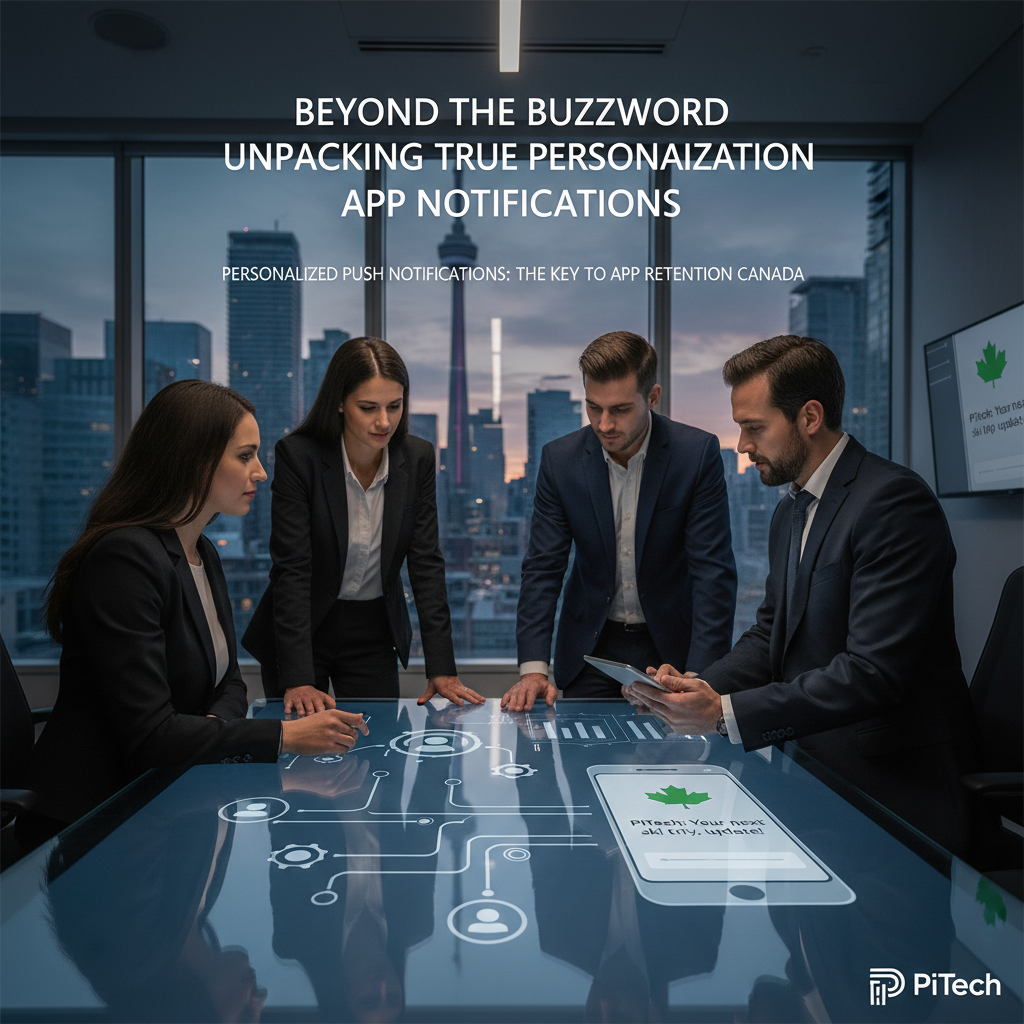
The term "personalization" is often overused, sometimes referring to something as basic as including a user's first name. True personalization goes miles deeper. It’s about leveraging data to understand a user's context, intent, and history to deliver a message that feels like it was crafted just for them, at the exact moment they need it.
From Generic Blasts to One-to-One Conversations
The fundamental shift is from a one-to-many broadcast model to a one-to-one conversational model. A generic blast is a sledgehammer; it hits everyone the same way and hopes for the best. A personalized notification is a scalpel; it’s precise, targeted, and designed for a specific purpose with a specific user.
* Generic: "Don't forget to complete your order!"
* Personalized: "Your cart with the Arc'teryx Beta AR Jacket expires in 1 hour. Complete your purchase now for free shipping to Vancouver."
* Generic: "New content has been added!"
* Personalized: "A new episode of 'The Crown,' a show in your watchlist, is now available to stream."
* Generic: "Check out our new features."
* Personalized: "You can now track your portfolio's performance against the S&P/TSX Composite Index, a feature you requested."
The difference is profound. The personalized messages acknowledge the user's past actions, location, and interests. They provide immediate value and a clear, compelling reason to re-engage with the app. This builds a sense of being understood and valued, which is the bedrock of customer loyalty and a superior user experience app.
The Four Pillars of Effective Mobile App Personalization
To move beyond just using a first name, your app marketing strategy must be built on a foundation of robust segmentation. Effective personalization typically rests on four key pillars of data:
- Demographic Personalization: This is the most basic level, using attributes like age, gender, and language. While limited, it can be useful for tailoring imagery or messaging tone. For example, a financial app in Canada might send different retirement planning tips to a user in their 20s versus one in their 50s, using French or English based on their device settings.
- Geographic Personalization: This involves using a user's location to send relevant, timely alerts. For a national retailer, this could mean alerting a user in Toronto about a store-specific event at the Eaton Centre. For a weather app, it means sending a hyper-local severe weather alert for their specific postal code, not just a province-wide warning. Geofencing can also trigger notifications when a user enters or leaves a specific area, like a reminder to pick up an online order when they are near the store.
- Behavioral Personalization: This is where personalization becomes truly powerful. It’s based on how a user interacts with your app: what features they use, what content they view, what items they add to a cart, how frequently they log in, or even what features they don't use. A music streaming app might send a notification about a new album from an artist the user frequently listens to. A productivity app could send a reminder to a user who hasn't completed their daily checklist.
- Transactional Personalization: This pillar is based on a user's purchase history or key conversion events. E-commerce apps excel here, with notifications about order status, delivery updates, and recommended products based on past purchases. A travel app could alert a user about a price drop for a flight route they have previously booked, creating immense value and driving repeat business.
The Technology Stack Powering Intelligent Notifications
Delivering this level of personalization is not magic; it requires a well-architected technology stack. At its core, this system needs to collect data, segment users, trigger messages, and measure results. Key components include:
* Analytics Platform: Tools like Google Analytics for Firebase, Mixpanel, or Amplitude are essential for tracking user behavior within the app. This is the source of the behavioral and transactional data that fuels personalization.
* Mobile Marketing Automation Platform: Services like Braze, OneSignal, or Airship provide the infrastructure to manage user segments, build notification campaigns, A/B test messages, and automate sending based on complex triggers.
* Robust Backend & APIs: The app’s own backend infrastructure must be solid. It needs to seamlessly integrate with analytics and marketing platforms. A custom mobile app development approach is often superior here, as it ensures these integrations are designed into the app's architecture from the start, not shoehorned in later.
The Direct Link: How Personalized Push Notifications Canada Can Drastically Improve App User Retention

User retention is the ultimate measure of an app’s health and long-term viability. Acquiring a new user can cost five times more than retaining an existing one. Personalized notifications are not just a "nice-to-have" feature; they are a direct and measurable driver of app user retention in Canada.
Combating Notification Fatigue and Reducing App Churn
Notification fatigue is real. When users are bombarded with irrelevant alerts, they do one of two things: they disable notifications for the app, or they uninstall it completely. In either case, you have lost your most direct line of communication. Research shows that personalized push notifications can have open rates that are 4 to 7 times higher than generic broadcasts.
By sending fewer, more relevant messages, you respect the user's attention. Instead of being a source of annoyance, your app becomes a source of value. This simple act of respect significantly reduces the likelihood that a user will churn. When a user knows that a notification from your app will likely be useful, they are far less likely to opt out, preserving your ability to re-engage them in the future.
Creating Habit-Forming Loops with Timely, Relevant Triggers
Successful apps often become part of a user's daily or weekly routine. Personalized notifications are instrumental in creating these habits. By understanding user behavior, you can send triggers that encourage repeat engagement and form a positive feedback loop.
Consider a fitness app. A user who logs a run every morning at 7 AM but misses a day could receive a gentle, encouraging notification around 7:15 AM: "Ready to hit the pavement? Let's keep your streak going!" Similarly, a language-learning app could remind a user to complete their 5-minute daily lesson during their typical commute time. These timely nudges, based on established patterns, help embed the app into the user’s life, transforming sporadic use into a consistent habit.
Increasing Customer Lifetime Value (CLTV) Through Sustained Engagement
A retained user is a valuable user. The longer a user remains active, the more opportunities they have to convert, whether that means making a purchase, subscribing to a service, or viewing ads. By using personalized push notifications to keep users engaged, you directly increase their Customer Lifetime Value (CLTV).
For an e-commerce app, a notification about a price drop on a wish-listed item can lead to an immediate sale. A notification about a restock of a previously purchased item can drive a repeat purchase. A well-timed message about loyalty points nearing expiration can trigger a visit and another transaction. Each of these personalized interactions contributes to revenue and strengthens the customer relationship, ensuring they continue to generate value for your business over the long term.
A Practical Blueprint for Implementing a Winning App Marketing Strategy
Knowing that personalization is important is one thing; executing it effectively is another. A successful strategy requires a methodical approach that combines data, creativity, and continuous optimization.
Step 1: Laying the Foundation with Robust Data Collection and Segmentation
You can't personalize what you don't know. The first step is to establish a system for collecting meaningful user data. This goes beyond simple demographics. Your analytics should track key in-app events: screens viewed, buttons clicked, items added to a cart, videos watched, articles read, and features used.
Crucially, you must obtain proper consent. When a user first launches your app, your push notification permission prompt should explain the value they will receive, not just ask for a generic "yes." Instead of "Allow notifications?", try "Allow us to send personalized alerts about your orders and exclusive offers?"
Once data is flowing, the real work of segmentation begins. Move beyond simple buckets like "all users." Create dynamic segments based on behavior:
* New Users: Haven't completed onboarding.
* Active Shoppers: Viewed more than 5 product pages this week.
* Cart Abandoners: Added an item to cart in the last 24 hours but did not purchase.
* Dormant Users: Haven't opened the app in 14 days.
* Power Users: Use a specific advanced feature daily.
Step 2: Crafting Compelling Messages That Add Value, Not Noise
With your segments defined, you can start crafting messages. The goal of every notification should be to provide value. Ask yourself: "Does this message help my user, or does it just help me?"
* Be Clear and Concise: You have limited space. Get straight to the point.
* Use Rich Media: Incorporate images, GIFs, or videos where appropriate. A picture of the product on sale is far more effective than text alone.
* Leverage Urgency and Scarcity (Authentically): "Your size is almost sold out" is powerful if true. Fabricated urgency erodes trust.
* Deep Link Everything: When a user taps your notification, it must take them to the exact relevant screen in the app, not just the homepage. A tap on a product alert should open that product page. This removes friction and dramatically increases conversion.
* A/B Test Your Copy: Test different headlines, calls to action, and even the use of emojis to see what resonates most with each segment.
Step 3: Optimizing for Success with A/B Testing and Analytics
A personalized notification strategy is never "finished." It must be a living system that you constantly monitor and refine. Track key performance indicators (KPIs) for your campaigns:
* Opt-in Rate: What percentage of new users agree to receive notifications?
* Delivery Rate: Are your notifications technically reaching the devices?
* Open Rate: What percentage of delivered notifications are being tapped?
* Conversion Rate: Of those who opened the notification, how many completed the desired action (e.g., made a purchase, read the article)?
* Impact on Retention and Churn: Correlate your notification campaigns with user cohort retention rates. Are users who receive personalized messages sticking around longer than those who don't?
Use this data to double down on what works and eliminate what doesn't. Perhaps you discover that notifications sent at 7 PM have a higher open rate for your "Working Professionals" segment, or that notifications with images convert 50% better for your "Fashion Shoppers" segment. This continuous feedback loop is what transforms a good strategy into a great one.
Navigating the Canadian Regulatory Landscape: CASL and Push Notifications
For any business operating in Canada, a discussion about digital communication is incomplete without addressing Canada's Anti-Spam Legislation (CASL). While often associated with email, CASL's rules around sending "Commercial Electronic Messages" (CEMs) have implications for push notifications, making a compliant strategy essential for building trust and avoiding significant penalties.
Understanding Express vs. Implied Consent in a Mobile App Context
CASL is built on a consent-based model. To send a CEM, you generally need either express or implied consent.
* Implied Consent: In the context of an app, the act of a user downloading your app and accepting your terms of service (which should clearly state you will send notifications) can often establish implied consent under an "existing business relationship." This is especially true for transactional messages (e.g., "Your order has shipped").
* Express Consent: This is the gold standard. It involves a user taking a clear, positive action to opt-in to receive messages, such as checking a specific, un-pre-checked box. For purely marketing-focused notifications, seeking express consent is the safest and most transparent approach.
The key is clarity. Your initial permission prompt and your terms of service must be transparent about the types of messages you will send. Mixing transactional and marketing messages requires careful handling to ensure you are compliant.
Best Practices for CASL Compliance to Build Trust and Avoid Penalies
Building a CASL-compliant push notification strategy is not just about avoiding fines; it’s about demonstrating respect for your users.
- Clear Identification: Every notification, where possible, should make it clear that it is coming from your brand.
- Transparent Opt-in: Be upfront about the value and nature of the notifications when asking for permission.
- Easy Opt-out: Users must have a simple, persistent way to manage their notification preferences or opt-out entirely. This should be easily accessible within your app's settings menu.
- Separate Consents: Consider allowing users to choose the types of notifications they receive. Let them opt-in to "Special Offers" and "Account Updates" separately. This granular control increases user trust and reduces the chance of a total opt-out.
Turning Compliance into a Competitive Advantage
Instead of viewing CASL as a burden, smart Canadian businesses see it as an opportunity. By embracing a transparent, consent-driven communication strategy, you differentiate your brand. Users are increasingly privacy-conscious. An app that clearly respects their choices and provides granular control over communications is seen as more trustworthy. This trust is a valuable asset that translates directly into higher engagement, better retention, and long-term brand loyalty.
Practical Business Takeaways for Your Canadian App
To distill this strategy into actionable steps, here are the core principles every Canadian app owner should embrace:
* Start with Data, Not Assumptions: Implement robust analytics before you send a single message. Understand what your users are actually doing in your app.
* Segment Your Audience Mercilessly: Move beyond "all users." Create dynamic, behavior-based segments that allow for truly relevant messaging.
* Prioritize Value Over Volume: Every notification must answer the user's question: "What's in it for me?" If the answer is unclear, don't send the message.
* Respect the User and the Law: Build a CASL-compliant strategy from day one. Be transparent, seek clear consent, and make it easy to opt-out. This builds invaluable trust.
* Test, Measure, and Iterate Relentlessly: Your strategy is a hypothesis. Use A/B testing and performance metrics to constantly refine your messaging, timing, and segmentation.
* Integrate Deeply: Ensure your notifications are not a standalone feature. Deep link to the correct content and integrate with your core business systems for maximum impact.
PiTech's Perspective: Building an Engagement Engine, Not Just an App
Too often, we see businesses invest heavily in developing an app, only to treat user engagement as an afterthought. The push notification system is frequently a basic, out-of-the-box feature with little strategic thought given to how it will be used to retain the very users the business spent so much to acquire. This approach is fundamentally flawed and leads directly to the "leaky bucket" syndrome.
At PiTech, we believe that a successful mobile app is an engagement engine. This philosophy guides our custom mobile app development process. We don't just build features; we build systems designed to foster long-term user relationships. From the initial architecture, we plan for the deep integration of analytics and marketing automation tools. We design backend systems that can support sophisticated, real-time segmentation and personalization, ensuring your customer communication app is intelligent from day one.
Furthermore, the future of personalization lies in artificial intelligence. Our expertise in integrating AI and machine learning allows us to build apps that can move beyond simple rule-based triggers. We can develop systems that predict user churn, recommend products with uncanny accuracy, and even determine the optimal send time for a notification on a per-user basis. This is the level of sophistication required to win in today's market, and it requires a development partner who is also a strategic partner. As a team of expert Canadian app developers, we understand both the technology and the unique Canadian market context, including the nuances of CASL. We partner with businesses to build integrated digital platforms that don't just function, but grow.
Conclusion: From Annoyance to Asset
In the crowded Canadian app ecosystem, generic, untargeted push notifications have become a liability. They annoy users, damage brand perception, and accelerate churn. The path forward is not to abandon this powerful communication channel, but to reinvent it. By embracing a strategy of deep personalization, Canadian businesses can transform their notifications from an annoyance into their single most valuable asset for driving engagement and loyalty.
This is more than a marketing tactic; it's a fundamental shift in how you build a relationship with your customers. It requires a commitment to understanding user behavior, a dedication to providing real value, and the right technology foundation to execute flawlessly. For businesses ready to stop pouring money into a leaky bucket, personalized push notifications are the most effective tool available to improve app user retention in Canada, turning fleeting downloads into lasting, profitable customer relationships.
Ready to Transform Your Business?
Let PiTech help you implement these strategies with proven technology solutions.
Get StartedRelated articles
- Custom CPQ Software Canada: The Key to SaaS Sales EfficiencyDiscover how custom CPQ software in Canada solves B2B SaaS sales bottlenecks, eliminates quoting errors, and accelerates deal velocity for sustainable growth.
- Digital Marketing for Canadian SMBs: An Acquisition BlueprintStruggling with customer acquisition? Discover our definitive guide on digital marketing for Canadian SMBs. Learn to master SEO, paid ads, and more to boost sales.
- Custom Mobile App Development for Canadian Retail EngagementStruggling with customer loyalty? Learn how a custom mobile app for your Canadian retail business drives engagement, personalization, and sales, moving beyond generic solutions.
- Cloud-Native App Development Canada: Scale Your BusinessDiscover how cloud-native app development in Canada helps businesses build scalable, future-proof applications. Learn the benefits, key strategies, and how to start.