

Boost Online Retail: Custom Chatbot Development Canada Guide
Discover how custom chatbot development in Canada is revolutionizing e-commerce CX. This guide covers AI automation, integration, and strategies to boost sales.
Published
Why Read This?
This guide reveals why generic chatbots are costing Canadian online retailers millions and provides a clear roadmap for adopting custom AI chatbots. Learn how to leverage tailored solutions to significantly boost customer experience, drive sales, and achieve operational excellence in Canada's unique e-commerce market.
A customer lands on your Canadian e-commerce site, excited about a new winter jacket. They have a simple question: "Is the insulation ethically sourced?" They search for a chat bubble, find one, and ask. The bot responds, "I can help with order tracking, returns, or FAQs. Please select an option." Frustrated, the customer tries rephrasing, only to get the same robotic menu. That single unanswered question, that moment of friction, is often all it takes for a potential sale to evaporate. This isn't a hypothetical; it's a daily reality that costs Canadian retailers millions in lost revenue, a direct consequence of underestimating the power of intelligent customer interaction. The solution lies not in just any chatbot, but in strategic, custom chatbot development for Canada's unique market.
This article is your comprehensive guide to understanding how bespoke AI chatbots are moving from a "nice-to-have" novelty to an essential engine for growth, customer loyalty, and operational excellence in Canadian online retail. We will dissect the limitations of generic solutions, explore the architectural pillars of a high-performance custom chatbot, and provide a practical roadmap for implementation.
The New Battleground for Canadian E-commerce Growth: Customer Experience
The digital gold rush in Canadian retail is far from over. With e-commerce sales continuing their upward trajectory, the competitive landscape has become incredibly dense. Price and product selection are no longer the sole determinants of success; the new, decisive battleground is customer experience (CX). Today's shoppers, accustomed to the seamless, instant gratification of global tech giants, bring those same high expectations to every online store they visit, regardless of its size. They expect 24/7 availability, personalized interactions, and immediate answers.
This shift presents a significant challenge for Canadian e-commerce businesses. Operating in a bilingual country with a geographically dispersed population adds layers of complexity to customer service logistics. Staffing a human support team around the clock, in both English and French, is prohibitively expensive for many. During peak seasons like Black Friday or Boxing Day, support channels become overwhelmed, leading to slow response times, high cart abandonment rates, and lasting damage to brand reputation. This is precisely the strategic gap that AI-powered automation is built to fill, transforming CX from a cost center into a powerful competitive advantage.
Why Generic, Off-the-Shelf Chatbots Are Failing Your Canadian Customers

The initial promise of chatbots was alluring: instant, automated support at a fraction of the cost. This led many businesses to adopt simple, off-the-shelf chatbot plugins. However, a poorly implemented chatbot can cause more harm than good. These generic tools often create a frustrating "uncanny valley" of customer service, where the interaction is neither efficiently automated nor empathetically human. They feel clunky, unintelligent, and ultimately, unhelpful, souring a customer's perception of your brand.
For a Canadian retailer, the shortcomings of these one-size-fits-all solutions are magnified, as they fail to address the specific nuances of the market. They often lack sophisticated bilingual capabilities, cannot integrate deeply with specific inventory or shipping providers used in Canada, and are incapable of handling anything beyond the most basic, pre-programmed queries.
The Frustration of Rigid, Rule-Based Logic
Most generic chatbots operate on a simple, rule-based decision tree. If a customer uses a specific keyword, the bot provides a pre-written answer. This system breaks down the moment a customer asks a question in a slightly different way or combines multiple queries into one sentence. The bot gets stuck in a loop, asking the user to rephrase or presenting the same useless menu. This rigid logic lacks the ability to understand context, intent, or sentiment, leading to interactions that feel robotic and unproductive. An AI-powered custom chatbot, by contrast, uses Natural Language Processing (NLP) to understand what the user means, not just what they type.
The Critical Integration Gap: When Your Chatbot Is an Island
An effective e-commerce chatbot is not a standalone widget; it's a deeply integrated component of your entire digital ecosystem. A generic chatbot can't tell a customer if an item is in stock at their local Montreal store, provide a precise shipping estimate to a rural address in Alberta, or pull up their loyalty points from your CRM. It operates on an island, disconnected from the real-time data that makes it truly useful. This lack of integration forces customers to switch channels, requiring them to send an email or make a call to get the information the chatbot should have provided, completely defeating its purpose. True online store automation requires seamless data flow between the chatbot and your core business systems, something only custom development can reliably achieve.
The Core Pillars of Effective Custom Chatbot Development in Canada
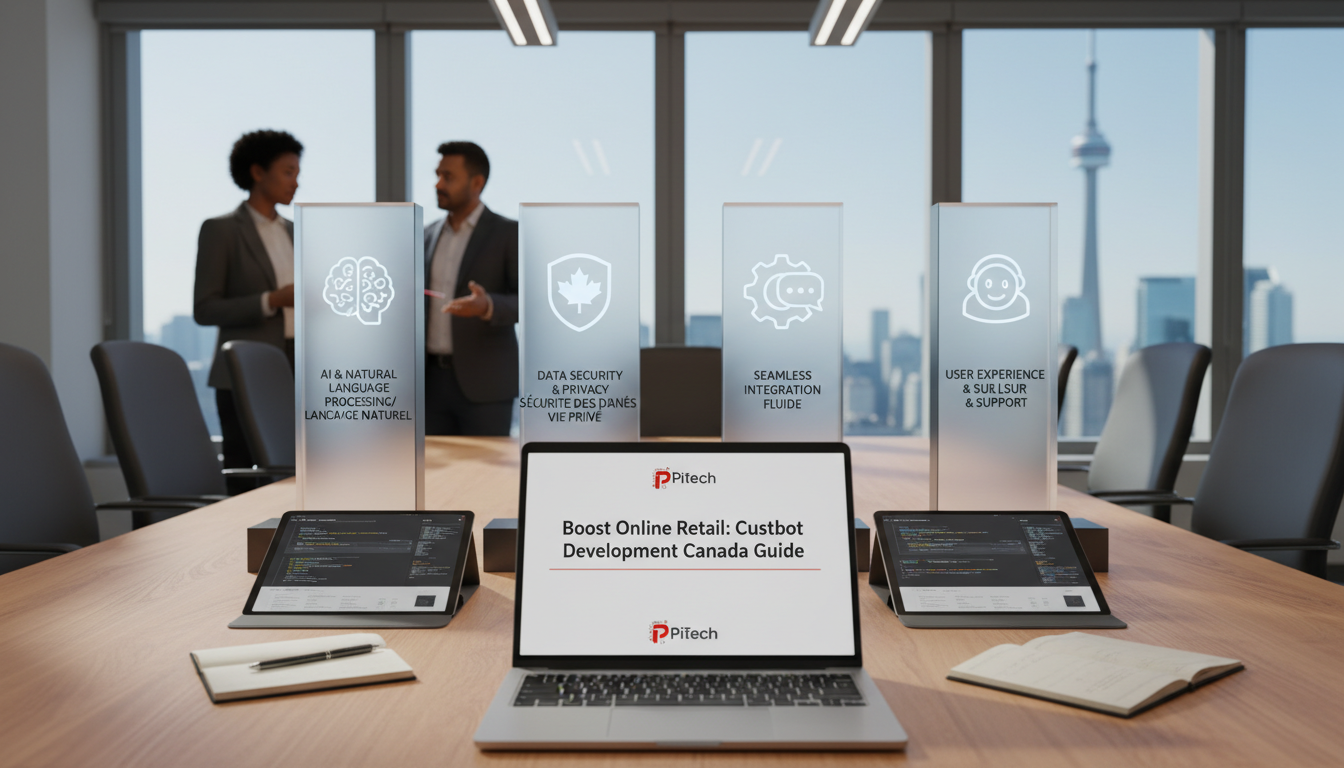
Building a high-performance AI chatbot that drives sales and delights customers requires a strategic approach grounded in customization and deep integration. This is where bespoke chatbot solutions diverge sharply from their generic counterparts. By tailoring the technology to your specific business goals, customer base, and technical infrastructure, you can create a powerful digital assistant that acts as a true extension of your brand. Let's explore the essential pillars for success in the Canadian e-commerce landscape.
Achieving Flawless Bilingual Support for English and French Shoppers
For any national retailer in Canada, providing service in both English and French is not just a courtesy; it's a legal and commercial necessity. A generic chatbot might offer a crude language-switching button, but it often relies on basic machine translation that can be inaccurate, unnatural, and miss cultural nuances. True custom development allows for the creation of a genuinely bilingual AI. This involves training the NLP models on distinct, high-quality datasets for both languages, ensuring the chatbot understands regional dialects, slang, and context in both English and French. A custom solution can automatically detect the user's language or remember their preference from past interactions, providing a seamless and respectful experience that builds trust with all Canadian shoppers.
Deep Integration with Your Tech Stack: Shopify, Magento, and Beyond
The real power of an AI chatbot for retail is unlocked through integration. A custom-developed solution can be architected to communicate directly with the APIs of your core systems.
* E-commerce Platforms (Shopify, Magento, WooCommerce): The chatbot can check real-time inventory levels, process returns, apply discount codes, and even help customers modify an existing order directly within the chat interface.
* Customer Relationship Management (CRM) Systems: By connecting to your CRM, the chatbot can personalize interactions based on a customer's purchase history, loyalty status, and past inquiries. It can greet a returning VIP customer by name and offer tailored recommendations.
* Inventory and Shipping Systems: Imagine a customer asking, "When will the blue medium sweater be back in stock, and can I get it shipped to Vancouver by Friday?" A deeply integrated chatbot can access inventory data to provide an ETA and then query your shipping provider's API to give a precise delivery estimate, turning a complex query into a simple, satisfying answer.
This level of connectivity transforms the chatbot from a simple Q&A tool into a dynamic, problem-solving concierge.
Leveraging Advanced NLP for Human-Like Conversational Commerce
Modern AI has moved far beyond simple keyword matching. Advanced Natural Language Processing (NLP) and Natural Language Understanding (NLU) are at the heart of effective custom chatbots. These technologies enable the bot to:
* Recognize Intent: Understand the user's goal even with typos, slang, or ambiguous phrasing. It knows that "where's my stuff?" means "I want to track my order."
* Manage Context: Remember previous parts of the conversation to have a more natural, flowing dialogue. If a user asks about a shoe's size and then says "what about in black?", the bot knows they are still asking about the same shoe.
* Analyze Sentiment: Detect if a customer is becoming frustrated or angry and, based on pre-defined rules, automatically escalate the conversation to a human agent for more empathetic support.
This cognitive ability allows for a more sophisticated form of "conversational commerce," where the chatbot can guide users through product discovery and purchase decisions in a natural, helpful way.
Proactive Engagement: From Cart Recovery to Personalized Recommendations
Why wait for the customer to ask a question? A truly intelligent, custom chatbot can engage proactively based on user behavior.
* Cart Abandonment Prevention: If a user has items in their cart and hesitates on the checkout page for more than 60 seconds, the chatbot can pop up and ask, "Hi there! Do you have any questions about shipping or payment before you complete your order?" This simple, timely intervention can significantly reduce abandonment rates.
* Personalized Upselling: When a customer adds a camera to their cart, the chatbot can suggest, "Great choice! Customers who bought this camera also love this memory card and carrying case. Would you like to add them?" This is intelligent upselling that feels helpful, not pushy.
* Proactive Support: If a user is repeatedly clicking between two similar products, the chatbot can offer to generate a side-by-side comparison chart, helping them make a decision.
This proactive capability turns the chatbot into an active sales assistant, constantly working to improve online sales and enhance the shopping experience.
Ensuring Data Privacy and Compliance with Canadian Regulations like PIPEDA
Handling customer data comes with immense responsibility. Canadian businesses must comply with the Personal Information Protection and Electronic Documents Act (PIPEDA), which governs how private sector organizations collect, use, and disclose personal information. A generic, US-based chatbot provider may not be fully compliant with these specific Canadian requirements. Custom chatbot development in Canada allows you to build data privacy controls directly into the architecture. You can control where data is stored (ensuring data residency within Canada if required), implement robust encryption, and design clear consent protocols, ensuring your automated CX strategy is both effective and fully compliant.
Quantifying the Impact: How Custom Chatbots Directly Improve Online Sales
Investing in bespoke chatbot solutions isn't just about modernizing your website; it's a strategic financial decision with a clear and measurable return on investment (ROI). By automating intelligently, personalizing at scale, and removing friction from the buying process, custom AI chatbots have a direct, positive impact on both the top and bottom lines of your e-commerce business.
Drastically Cutting Customer Service Operational Costs
The most immediate ROI comes from operational efficiency. Consider the cost of a 24/7 human support team, including salaries, benefits, training, and infrastructure, especially one that needs to be bilingual. A custom chatbot can handle up to 80% of routine, repetitive customer inquiries instantly and at any time of day. This includes questions about order status, return policies, shipping costs, and product specifications. By automating these high-volume, low-complexity tasks, you free up your valuable human agents to focus on complex, high-value interactions that require empathy and critical thinking, such as handling escalated complaints or providing detailed product consultations for high-ticket items. This leads to a more efficient, motivated support team and a dramatic reduction in operational overhead.
Boosting Conversion Rates Through Instant Answers and Sales Assistance
Friction is the enemy of conversion. Every unanswered question or moment of confusion is a potential exit point from your sales funnel. A custom chatbot acts as an ever-present guide, eliminating this friction. When a customer has a last-minute question about sizing, materials, or warranty, the chatbot provides an instant answer, removing the doubt that leads to cart abandonment. By integrating with your e-commerce platform, it can assist with the checkout process, help apply promo codes, and confirm order details, building confidence and guiding the user smoothly toward a completed purchase. This immediate assistance can lead to a measurable lift in your site-wide conversion rate.
Increasing Average Order Value with Intelligent Upselling and Cross-selling
A well-designed AI chatbot is a sophisticated sales tool. Unlike a static "You might also like" widget, a conversational chatbot can make recommendations in a more contextual and persuasive way. Based on the items in a customer's cart, their browsing history, and data from similar customers, the chatbot can make highly relevant suggestions. For example, after a customer adds a dress to their cart, the chatbot can suggest, "That's a beautiful choice! We have a pair of earrings and a handbag that perfectly complement that style. Would you like to take a look?" This personalized, conversational approach to upselling and cross-selling feels like helpful advice, not a hard sell, and is highly effective at increasing the average order value (AOV) per transaction.
Gathering Actionable Customer Insights for Smarter Business Decisions
Every interaction a customer has with your chatbot is a valuable data point. The chat logs become a goldmine of unfiltered, real-time voice-of-the-customer data. By analyzing these conversations, you can discover:
* Common Pain Points: Are many customers asking about the durability of a specific product? This could signal a need to improve the product description or the product itself.
* Product Gaps: Are you getting frequent requests for a product you don't carry? This is direct market feedback informing your merchandising strategy.
* Website Usability Issues: If many users are asking how to find the return policy, it might mean the link is not prominent enough on your site.
Custom chatbot development allows you to build sophisticated analytics dashboards that tag, categorize, and report on these insights, providing a direct feedback loop from your customers to your marketing, product, and web development teams.
Your Strategic Roadmap for Implementing a Custom AI Chatbot
Embarking on a custom chatbot development project can seem daunting, but a structured, strategic approach ensures a successful outcome that aligns with your business goals. By following a clear roadmap, you can de-risk the process and maximize your return on investment.
Step 1: Define Your Primary Business Objectives and KPIs
Before writing a single line of code, you must answer the most important question: "What problem are we trying to solve?" Your objectives must be specific and measurable. Are you aiming to reduce customer service response times by 50%? Decrease cart abandonment rates by 15%? Increase AOV by 10%? Or perhaps deflect 70% of tier-1 support queries? Defining these Key Performance Indicators (KPIs) from the outset will guide every decision in the development process and provide a clear benchmark for measuring success post-launch.
Step 2: Map Your Customer Journeys and Identify Key Interaction Points
Don't just place a chatbot on your homepage and hope for the best. Analyze your customer journey from discovery to post-purchase support. Where do customers typically get stuck? On which pages do they spend the most time before exiting? Key interaction points often include product detail pages (for specific questions), the shopping cart and checkout pages (for friction related to shipping and payment), and the support/FAQ section. By strategically placing the chatbot at these critical junctures with proactive, context-aware prompts, you can provide help exactly when and where it's needed most.
Step 3: Choose the Right Technology and Development Partner
This is a critical decision. You need a partner with proven expertise not only in AI and NLP but also in e-commerce integrations and the specific demands of the Canadian market. Look for a firm that takes a consultative approach, seeking to understand your business objectives before recommending a technical solution. They should have experience integrating with platforms like Shopify or Magento and a deep understanding of compliance requirements like PIPEDA. A good partner will guide you on the right tech stack and help you design a solution that is scalable, maintainable, and aligned with your long-term vision.
Step 4: Design the Conversation Flow and The Human Handoff Protocol
The user experience of the conversation itself is paramount. Work with your development partner to script conversation flows that are natural, helpful, and reflect your brand's voice. Crucially, you must design a seamless and elegant "human handoff" protocol. The chatbot must be able to recognize when a query is too complex, emotionally charged, or requires human intervention. At that point, it should seamlessly transfer the conversation, along with the entire chat history and customer context, to a live agent. This human-AI partnership ensures that the customer always gets the best possible support without frustrating repetition.
Step 5: Plan for Launch, Training, and Continuous Improvement
A chatbot is not a "set it and forget it" project. It's a dynamic tool that learns and improves over time. Your launch should be phased, perhaps starting with a beta on a few key pages. After launch, you must continuously monitor chat logs to identify where the bot is succeeding and where it's failing. This data is used to "retrain" the AI model, add new knowledge to its database, and refine its conversational flows. A successful chatbot implementation involves a commitment to ongoing optimization, ensuring it becomes smarter and more valuable to your customers and your business over time.
Partnering for Success: How PiTech's Approach to Custom AI Delivers Results
Choosing the right implementation partner is as critical as the technology itself. The success of a custom chatbot project hinges on a partner's ability to combine technical prowess with a deep understanding of your business strategy. At PiTech, our approach is rooted in delivering tangible business outcomes, not just lines of code. We specialize in creating bespoke AI-enabled business systems that serve as engines for growth.
Our expertise in custom software development means we don't force your needs into a pre-existing template. Instead, we architect a solution from the ground up, designed specifically for your brand voice, operational workflows, and technical environment. This includes building robust, secure integrations with your existing CRM, ERP, and e-commerce platforms, ensuring data flows seamlessly to create a truly unified and personalized customer experience. As a Canadian company, we have an intrinsic understanding of the market's requirements, from building genuinely bilingual AI models to ensuring strict compliance with data privacy regulations like PIPEDA.
We see AI automation not as a replacement for your team, but as a powerful tool to augment their capabilities. Our process involves working closely with your stakeholders to define clear KPIs, map customer journeys, and design intelligent conversation flows with robust human handoff protocols. We believe a chatbot is a living asset, and our commitment extends beyond launch to provide ongoing monitoring, training, and optimization to ensure the solution continuously evolves and delivers increasing value. This holistic, growth-focused digital execution is how we transform a technology project into a lasting competitive advantage for your e-commerce business.
The Future is Conversational: Securing Your E-commerce Advantage in Canada
The standards for online customer experience are being redefined. In the increasingly crowded Canadian e-commerce market, waiting for customers to find answers on their own is a strategy for obsolescence. The path to sustained growth and brand loyalty is paved with instant, personalized, and intelligent interactions. While generic, off-the-shelf bots often create more frustration than they solve, a well-executed strategy for custom chatbot development in Canada provides a definitive competitive edge.
By moving beyond simple FAQs and embracing deep integration, advanced NLP, and proactive engagement, you can transform your customer service from a reactive cost center into a proactive engine for sales. You can reduce operational overhead, boost conversion rates, increase average order values, and gain invaluable insights directly from your customers. This isn't about replacing the human touch; it's about augmenting it, freeing your team to build relationships while an intelligent AI assistant handles the rest. The future of Canadian retail is conversational, and the time to invest in that future is now.
Ready to revolutionize your Canadian e-commerce customer experience and boost sales with a custom AI chatbot? Contact PiTech for a free consultation to discuss a tailored solution that fits your unique business needs.
Ready to Transform Your Business?
Let PiTech help you implement these strategies with proven technology solutions.
Get StartedRelated articles
- AI Chatbot for E-commerce Canada: A Growth TransformationDiscover how AI-powered chatbots transform Canadian e-commerce by automating support, reducing costs, and boosting sales with 24/7 personalized customer experiences.
- Custom AI Recommendation Engine Canada: Boost Online SalesMove beyond generic plugins. Discover how a custom AI recommendation engine for Canadian e-commerce drives hyper-personalization, boosts online sales, and builds loyalty.
- Custom Mobile App Development for Canadian Retail EngagementStruggling with customer loyalty? Learn how a custom mobile app for your Canadian retail business drives engagement, personalization, and sales, moving beyond generic solutions.
- AI Product Recommendations Canada: The New Engine for E-commerceDiscover how AI product recommendations for Canada's e-commerce market can dramatically boost sales, AOV, and customer loyalty. Your guide to implementation.