

Boost Sales with Headless E-commerce: A Canadian Retail Guide
How headless e-commerce helps Canadian retailers boost sales with faster sites, better customer experience, and flexibility.
Published
Why Read This?
This article unveils how Canadian retailers can overcome crippling website performance, generic experiences, and lost sales by embracing headless e-commerce. Discover how this strategic shift directly boosts customer satisfaction, operational agility, and your bottom line, transforming your digital storefront from a liability into a powerful asset.
It’s 9:05 AM on Boxing Day, and the director of e-commerce for a popular Canadian apparel brand is staring at their analytics dashboard in horror. Traffic is spiking as expected, but the conversion rate has cratered. A flood of customer service emails confirms the problem: the site is agonizingly slow, images are failing to load, and the checkout page is timing out. The brand’s monolithic e-commerce platform, which seemed adequate during slower months, is buckling under the pressure of a truly Canadian sales event. This single day of poor performance will not only cost them hundreds of thousands in lost revenue but also damage the brand equity they've spent years building.
This scenario is not a hypothetical worst case; it represents a growing reality for Canadian retailers constrained by outdated technology. While your business has evolved, your customer expectations have skyrocketed, and your digital storefront has remained static, locked into a rigid, one-size-fits-all system. The promise of digital growth feels out of reach, hampered by slow load times, generic user experiences, and an inability to innovate at the speed of the market. There is, however, an architectural shift that addresses these issues at their core, offering a pathway not just to survival, but to market leadership.
This comprehensive guide is for Canadian retail leaders who suspect their current platform is a liability, not an asset. We will explore the strategic imperative behind headless e-commerce in Canada, moving beyond technical jargon to reveal how this approach directly translates into improved customer experience, greater operational agility, and most importantly, a significant boost to your bottom line. It’s time to stop letting your technology dictate your business strategy and start building the digital experiences your customers truly deserve.
Strategic Context: Why Traditional E-commerce is Holding Canadian Retail Back
For years, the standard for online retail was the monolithic e-commerce platform. Systems like Shopify, Magento, or BigCommerce offered an all-in-one solution: a single package containing the frontend (the customer-facing storefront) and the backend (the business logic, database, and admin panel). This model was revolutionary, democratizing e-commerce and allowing businesses of all sizes to get online quickly. However, what was once a simple solution has become a complex problem for ambitious Canadian retailers.
The fundamental issue with monolithic architecture is its inherent rigidity. The frontend and backend are tightly coupled, meaning any change to the customer experience, from a simple button redesign to a new promotional layout, requires complex coding within the entire system. This leads to slow development cycles, dependency on platform-specific developers, and a constant fear that one update might break another part of the site. Innovation grinds to a halt, not due to a lack of ideas, but because the technological foundation makes execution slow, expensive, and risky.
This limitation is particularly acute in the competitive Canadian market. Retailers face pressure from global giants like Amazon, who set the standard for speed and personalization. Furthermore, catering to a diverse, bilingual customer base requires a level of content and user experience flexibility that many templates simply cannot provide gracefully. As customers demand seamless omnichannel journeys, wanting to interact with brands on web, mobile apps, social media, and even in-store smart displays, the monolithic platform reveals its biggest weakness. It was built for one channel: the desktop website. Trying to force it to power every new touchpoint results in clunky, inconsistent experiences that erode customer trust and suppress sales.
What is Headless E-commerce and How Does It Work?
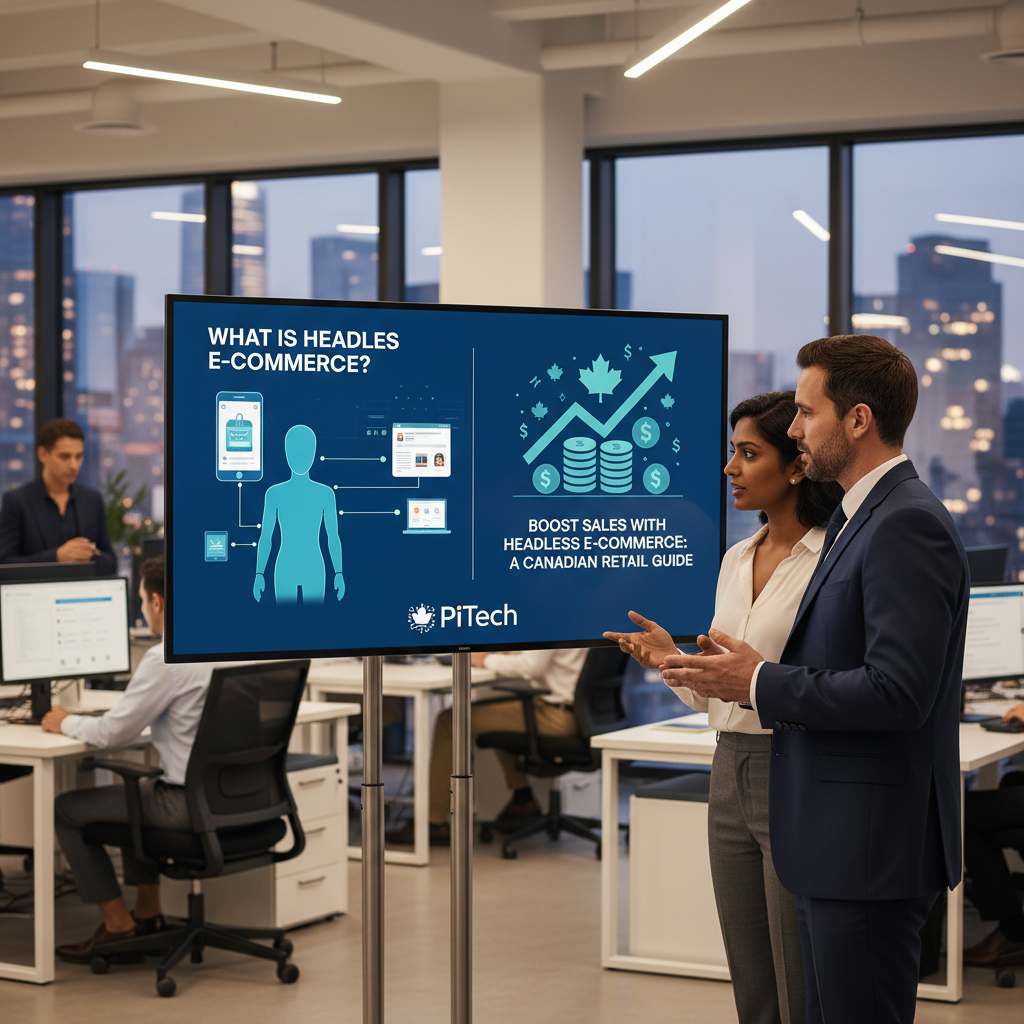
Headless e-commerce represents a fundamental rethinking of digital commerce architecture. Instead of a single, coupled system, it "decapitates" the frontend presentation layer from the backend commerce engine. This separation liberates businesses from the design and functional constraints of a traditional platform, allowing them to build completely custom experiences while still leveraging a powerful, scalable backend.
Decoupling the Frontend and Backend: A Simple Analogy
Imagine your traditional e-commerce platform as a department store. The store building itself (the frontend) is permanently attached to its warehouse and operational offices (the backend). You can redecorate the interior and move shelves around, but you can't change the building's physical structure, location, or how it fundamentally operates. If you want to open a small pop-up shop across town, you have to build an entirely new, separate warehouse and office to support it.
Headless architecture is different. Think of the backend as a central, highly efficient distribution center (your commerce engine, product data, and order management). This center has no physical storefront attached. Instead, it has a series of loading docks with standardized connections, known as Application Programming Interfaces (APIs). Now, you are free to build any kind of storefront you want, anywhere you want. You can build a stunning flagship website, a lightning-fast mobile app, a kiosk for an in-store experience, or even integrate product purchasing into a smart mirror. Each of these frontends (the "heads") simply connects to the central distribution center (the "headless" backend) via APIs to pull product information and send back order data. This gives you ultimate control over the customer experience without having to rebuild your core business logic each time.
The API-First Approach: Your E-commerce Integration Hub
The magic that makes this decoupling possible is the API-first design. In a headless model, every piece of functionality, from retrieving a product's price to processing a credit card payment, is made available through an API. This turns your e-commerce platform into a central hub of services that can be called upon by any frontend application. This is a crucial distinction from traditional platforms where APIs are often an afterthought.
For a Canadian retailer, this e-commerce API integration capability is a superpower. It allows you to seamlessly connect best-in-class tools for every part of your business, rather than being stuck with the mediocre built-in features of a single platform. You can integrate a sophisticated Product Information Management (PIM) system for handling complex catalogs, a powerful headless Content Management System (CMS) like Contentful or Strapi for managing bilingual content, your existing Enterprise Resource Planning (ERP) system, and Canadian-specific payment and shipping providers like Moneris or Canada Post. This "composable commerce" approach ensures every component of your tech stack is optimized for its specific job, creating a whole that is far greater than the sum of its parts.
Understanding the Modern Tech Stack: Jamstack, PWAs, and Microservices
Adopting a headless strategy opens the door to a world of modern web technologies that deliver superior performance and user experiences. One of the most prominent is the Jamstack architecture (JavaScript, APIs, and Markup). Instead of building pages on a server every time a user visits, Jamstack sites are often pre-built as static files and deployed globally on a Content Delivery Network (CDN). When a user in Vancouver accesses your site, they are served files from a server nearby, resulting in near-instantaneous load times. Any dynamic content, like inventory levels or personalized recommendations, is then pulled in via APIs.
This architecture is also a perfect foundation for Progressive Web Apps (PWAs). A PWA for e-commerce delivers an app-like experience directly in the web browser, complete with offline accessibility, push notifications, and the ability to be "installed" on a user's home screen. For retailers, this means higher engagement and conversion rates, especially on mobile, without the significant investment and friction associated with developing and marketing separate native iOS and Android apps. These technologies work in concert to deliver the fast, reliable, and engaging experiences that modern Canadian consumers now expect as standard.
How Headless E-commerce Directly Boosts Online Sales for Canadian Retailers

The decision to re-platform is a significant one, and the ultimate justification must be a clear return on investment. For Canadian retailers, headless e-commerce is not just a technological upgrade; it is a direct driver of revenue growth. The flexibility and performance it unlocks translate into tangible business outcomes that boost online sales in Canada and create a sustainable competitive advantage.
Achieving Sub-Second Load Times to Reduce Cart Abandonment
Website performance is no longer just a concern for your IT department; it is a critical sales metric. Studies consistently show a direct correlation between page load time and conversion rates. A delay of even one second can increase bounce rates and significantly lower sales. Traditional monolithic platforms, often bloated with plugins and inefficient code, struggle to deliver the sub-second load times that are now the gold standard. Their server-side rendering process creates a bottleneck, especially during high-traffic events like Black Friday or Boxing Day.
Headless architecture, particularly when combined with a Jamstack frontend, demolishes this bottleneck. By serving pre-rendered static files from a CDN, the initial page load is incredibly fast. This immediate visual feedback keeps users engaged and dramatically reduces the likelihood of them bouncing while waiting for the page to render. For Canadian retailers, whose customers are spread across vast distances, ensuring a fast experience for a shopper in Halifax as well as one in Calgary is paramount. The global nature of CDNs inherent to most headless deployments ensures consistent, lightning-fast performance nationwide, directly protecting revenue that would otherwise be lost to user frustration.
Crafting Unique Customer Experiences Beyond Template Constraints
Brand differentiation is key to rising above the noise in a crowded retail market. However, monolithic platforms force most businesses into a sea of sameness. While themes and templates offer some customization, they impose rigid structures on page layouts, user flows, and interactive elements. True innovation in customer experience (CX) becomes nearly impossible, as you are limited to the building blocks provided by the platform vendor. Your brand's unique story and value proposition get lost in a generic, cookie-cutter storefront.
Headless architecture provides complete e-commerce platform flexibility. By separating the presentation layer, you give your design and marketing teams a blank canvas. They can craft a user journey that is perfectly tailored to your products and your target audience, unconstrained by technical limitations. Want to create an immersive, content-rich editorial experience for a new product line? Or perhaps an interactive 3D product customizer? With headless, your frontend development team can use modern frameworks like React or Vue.js to build anything you can imagine. This freedom allows you to create a memorable, differentiated brand experience that fosters customer loyalty and drives higher conversions.
Omnichannel Selling: A Unified Brand Across Web, Mobile, and In-Store
Today's customer journey is not linear; it fluidly moves between channels. A customer might discover a product on Instagram, research it on their laptop, check inventory on their phone while on the go, and finally purchase it in-store. A monolithic platform makes delivering a consistent experience across these touchpoints incredibly challenging, as it was designed primarily for the web. Each new channel often requires a separate, siloed solution, leading to fragmented data and a disjointed customer experience.
Because a headless backend exposes all its data and functionality via APIs, it can serve as the single source of truth for every single customer touchpoint. Your website, your mobile PWA, your in-store kiosks, and even your customer service team's interface can all pull from the same live product, customer, and order data. This ensures a consistent, seamless experience no matter how the customer chooses to interact with your brand. For Canadian retailers with both a strong online presence and brick-and-mortar stores, this omnichannel capability is transformative, bridging the digital and physical worlds to create a truly unified retail ecosystem. This is a cornerstone of modern retail digital transformation.
Overcoming the Implementation Hurdles: A Realistic Look at Going Headless
While the benefits are compelling, transitioning to a headless architecture is a significant strategic project, not a simple software update. Acknowledging and planning for the potential challenges is crucial for a successful implementation. This requires a shift in mindset from "buying a solution" to "building a capability."
Assessing Technical Complexity and In-House Skill Gaps
The primary challenge of going headless is the increased technical complexity. You are no longer managing a single, all-in-one product. Instead, you are composing a solution from multiple best-in-class services: a headless commerce backend, a headless CMS, a separate frontend application, search providers, and more. This requires a development team with expertise in modern frontend frameworks (like React, Next.js, or Vue.js), API integration, and cloud-native infrastructure.
Many Canadian retailers may find they have a skill gap in these areas. Your existing team might be experts in managing your current monolithic platform, but they may lack the specific experience needed to build and maintain a custom frontend application. This is where the decision to upskill your current team, hire new talent, or engage an expert partner becomes critical. A thorough assessment of your internal capabilities against the project requirements is the essential first step before committing to a headless migration.
Calculating the True ROI: Upfront Costs vs. Long-Term Gains
A common misconception is that headless is always more expensive. While the initial investment in custom e-commerce development in Canada can be higher than simply paying for a monolithic platform subscription, this view is often short-sighted. The true Return on Investment (ROI) must be calculated over the long term, factoring in total cost of ownership (TCO) and opportunity cost.
Consider the hidden costs of a monolithic platform: expensive or restrictive apps for added functionality, high fees for specialized developers to customize themes, and the immense opportunity cost of slow innovation and lost sales due to poor performance. Headless architecture, while requiring upfront development, often leads to lower TCO over time. Development becomes more efficient, you can launch features and promotions faster, and the performance gains directly impact conversion rates. The most significant ROI comes from the business agility you gain, enabling you to outmaneuver competitors and adapt to new market opportunities without being held back by technology.
Choosing Your Tech Stack: The Best Platforms for the Canadian Market
The headless ecosystem is rich with options, and selecting the right components is key. Your choice of a headless commerce engine is foundational. Platforms like commercetools, Elastic Path, and BigCommerce (with its Open SaaS capabilities) are leaders in the space, offering robust APIs and enterprise-grade features. For businesses already on Shopify Plus or Magento (Adobe Commerce), both offer powerful headless capabilities, allowing for a potentially smoother migration path by retaining the familiar backend.
Beyond the commerce engine, you'll need to select a Headless CMS (like Contentful, Strapi, or Sanity) for content management, particularly for handling bilingual French and English content effectively. The choice of frontend framework, such as Next.js (for React) or Nuxt.js (for Vue), will largely depend on your development team's expertise and the specific experience you want to build. Evaluating these components based on your specific scale, complexity, and feature requirements is a crucial part of the strategic planning phase.
Practical Business Takeaways: Your Headless E-commerce Checklist
Transitioning to a headless architecture is a journey. For business leaders and e-commerce managers, focusing on the strategic steps is more important than getting lost in the technical weeds. Use this checklist as a high-level guide to navigate your path toward a headless future.
- Audit Your Current Platform's Pain Points: Begin by documenting every frustration and limitation of your current system. Quantify where possible. Are load times costing you sales? Are you unable to launch marketing campaigns quickly? Is your team spending more time on workarounds than on innovation? This audit builds the business case for change.
- Define Your Ideal Customer Experience: Forget about your current technical constraints for a moment. Map out the perfect journey for your customers. What content do they need? How should personalization work? What would a seamless omnichannel experience look like? This vision will become the blueprint for your new frontend.
- Evaluate Your Team's Technical Capabilities Honestly: Assess whether your in-house team possesses the necessary skills in modern JavaScript frameworks, API integration, and cloud infrastructure. Identify the gaps and create a plan to fill them, whether through training, hiring, or partnering with a specialized agency.
- Map Out Your Entire Ecosystem of Integrations: List every system that needs to connect to your e-commerce platform. This includes your ERP, PIM, CRM, 3PL, and especially Canadian-specific services like payment gateways (Moneris, Bambora) and shipping carriers. This map is critical for planning your API integration strategy.
- Develop a Phased Migration Strategy: A "big bang" switchover can be risky. Consider a phased approach. You might start by building a new, headless frontend for just your blog or a specific marketing landing page. Another common strategy is to run the new headless storefront in parallel with the old site for a specific region or customer segment before rolling it out fully.
- Find a True Technology Partner, Not Just a Vendor: Implementing a headless solution is a collaborative effort. You need a partner who provides more than just software. Look for a firm with deep strategic, design, and custom e-commerce development expertise. They should act as an extension of your team, guiding you through architectural decisions, managing the development process, and ensuring the final product aligns perfectly with your business goals.
PiTech's Role in Your Retail Digital Transformation
Navigating the complexities of a headless transition requires a partner with proven expertise in both strategy and execution. At PiTech, we specialize in helping Canadian businesses leverage technology for growth. We understand that adopting headless e-commerce in Canada is not just about writing code; it's about architecting a flexible, scalable foundation for your company's future. Our role is to be your guide and implementation partner through every stage of this transformative journey.
Our expertise in custom software development means we don't just connect pre-built blocks; we build the exact custom frontend experience your brand deserves, using modern frameworks like React and Next.js to ensure unparalleled performance and design freedom. Our deep experience with e-commerce API integration allows us to seamlessly connect your chosen headless commerce engine with your entire business ecosystem, from your ERP and PIM to Canadian payment and logistics providers, creating a truly unified commerce solution.
Furthermore, we see headless as a platform for continuous innovation. We can integrate AI-powered personalization engines for dynamic recommendations, develop high-performance PWAs for e-commerce that capture the mobile audience, and ensure your new site is meticulously optimized for SEO from day one. PiTech acts as the cohesive force that brings together a complex technical stack, managing the project from initial strategy and architectural design through to a successful launch and beyond, allowing you to focus on what you do best: running your retail business.
Conclusion: The Future of Canadian Retail is Flexible, Fast, and Headless
The Canadian retail landscape will only become more competitive. The expectations of your customers for fast, personalized, and seamless digital experiences will only continue to rise. Continuing to operate on a rigid, slow, monolithic platform is no longer a sustainable strategy; it's a competitive liability. The businesses that will thrive in the coming decade are those that embrace agility, speed, and customer-centricity at their technological core.
Adopting headless e-commerce in Canada is the single most powerful step you can take to future-proof your retail business. It decouples you from restrictive technology, empowers your marketing and design teams to create truly unique brand experiences, and delivers the raw performance needed to maximize conversions and boost online sales. While the journey requires careful planning and a strategic investment, the reward is an unparalleled level of flexibility and control over your digital destiny. You gain the ability to innovate faster, adapt to any new channel or technology, and ultimately, build a more resilient and profitable retail operation.
Ready to unlock unparalleled flexibility and drive sales with a headless e-commerce solution tailored for your Canadian business? The time to act is now.
Contact PiTech today for a free consultation to explore how our expertise in custom e-commerce development can transform your online retail presence and prepare you for the future of commerce.
Ready to Transform Your Business?
Let PiTech help you implement these strategies with proven technology solutions.
Get StartedRelated articles
- Custom Mobile App Development for Canadian Retail EngagementStruggling with customer loyalty? Learn how a custom mobile app for your Canadian retail business drives engagement, personalization, and sales, moving beyond generic solutions.
- Custom POS Integration Canada: The Retail Growth EngineFrustrated by data silos? Discover how custom POS integration in Canada unifies inventory, customer data, and sales channels to drive efficiency and growth.
- Custom AI Recommendation Engine Canada: Boost Online SalesMove beyond generic plugins. Discover how a custom AI recommendation engine for Canadian e-commerce drives hyper-personalization, boosts online sales, and builds loyalty.
- Custom Mobile App for Retail Canada: The Ultimate GuideTired of generic solutions? Discover how a custom mobile app for retail in Canada can drive sales, build loyalty, and create unique in-store experiences.