

Custom POS Integration Canada: The Retail Growth Engine
Frustrated by data silos? Discover how custom POS integration in Canada unifies inventory, customer data, and sales channels to drive efficiency and growth.
Published
Why Read This?
This article reveals how disconnected retail systems are costing Canadian businesses millions and damaging brand loyalty. It highlights custom POS integration as the strategic solution to create seamless, omnichannel customer experiences, drive growth, and future-proof your retail operations.
A customer in Toronto finds the perfect jacket on your website. The product page confidently states, "In Stock at our Yorkville location." Delighted, she makes the trip downtown, only to be told by a flustered store associate that the last one was sold an hour ago. The website hadn't updated yet. The associate can't easily check stock at other branches, nor can they offer to ship it from the warehouse seamlessly. The result is a lost sale, a frustrated customer, and a tangible crack in your brand's reputation. This scenario isn't a rare mishap; it's a direct symptom of a disconnected retail technology stack, a problem costing Canadian businesses millions in revenue and goodwill every year.
This disconnect between online storefronts, physical point-of-sale (POS) systems, inventory logs, and customer databases is the single greatest operational hurdle for modern retailers. While off-the-shelf software has lowered the barrier to entry, it has also created a patchwork of isolated data silos. For Canadian retailers aiming to not just survive but thrive in a competitive market, solving this fragmentation is no longer a luxury. It’s the core strategic imperative. The solution lies in building intelligent, resilient data bridges between these systems through custom POS integration Canada.
The Strategic Imperative: Why Integrated Retail Systems Matter Now
The Canadian retail landscape has been permanently reshaped. The pandemic accelerated the shift to digital by a decade, but it also cemented a new consumer expectation: a fluid, consistent experience across all channels. Customers don't see your online store and your physical store as separate entities; they see one brand. They expect to buy online and pick up in-store (BOPIS), return an online purchase at a physical location, and receive loyalty points regardless of where they shop.
This demand for omnichannel fluency creates immense pressure on backend operations. Generic POS systems from providers like Shopify, Lightspeed, or Square are excellent starting points, but their one-size-fits-all approach often fails when faced with the unique complexities of a growing Canadian business. Specialized inventory, multi-location management, complex loyalty programs, or bespoke customer service workflows quickly expose the limitations of standard connectors and plug-ins.
This is where the strategic value of custom integration becomes clear. It’s about moving beyond simply having an online and offline presence to creating a single, cohesive commerce engine. By enabling disparate systems to communicate in real-time, retailers can automate processes, eliminate data errors, and unlock the rich, unified insights needed to make smarter decisions about inventory, marketing, and customer engagement. In essence, it’s about transforming your technology from a collection of tools into a strategic asset for growth.
The Hidden Costs of Disconnected Retail Systems
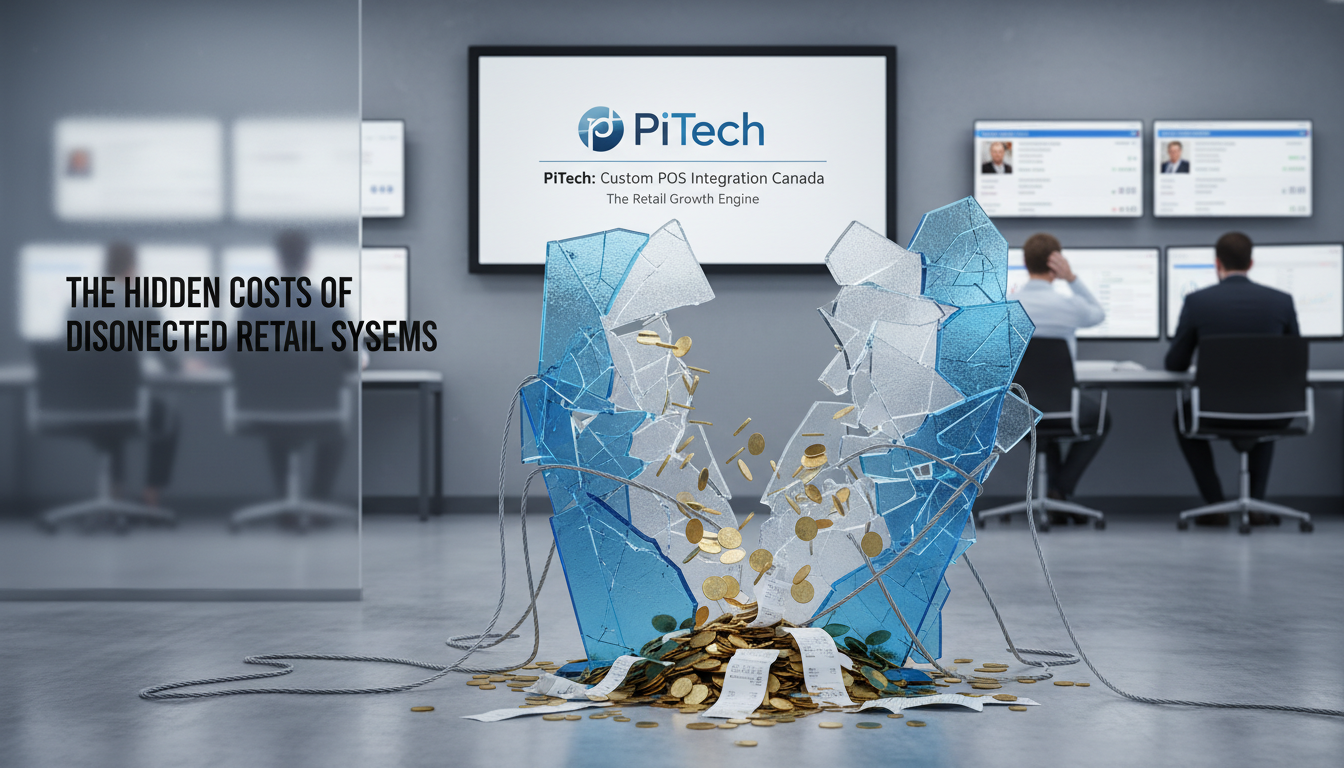
Many retailers underestimate the true cost of running disconnected systems. The expense goes far beyond the occasional lost sale. These data silos create a constant, low-grade operational drag that erodes profitability, stifles growth, and damages the customer experience in ways that are hard to quantify but easy to feel.
First, there is the staggering cost of inefficiency. When your e-commerce platform doesn’t talk to your POS, staff must spend countless hours manually reconciling sales data, updating inventory levels, and transferring customer information. This isn't just a waste of payroll; it’s a recipe for human error. A single misplaced decimal or incorrect SKU entry can cascade through your systems, leading to inaccurate financial reports, misplaced stock, and flawed marketing campaigns.
Second, inaccurate inventory management is a direct drain on cash flow. Without a unified view, retailers are flying blind. They either overstock items to avoid disappointing customers, tying up capital in slow-moving goods, or they understock and face frequent stockouts on popular products, leaving revenue on the table. The inability to implement strategies like ship-from-store or accurately allocate stock across multiple locations means inventory isn't working as hard as it could be.
Finally, the most significant hidden cost is the fragmented customer view. When a loyal in-store shopper is treated like a stranger on your website, you've failed to capitalize on your most valuable asset: your customer relationship. Without unified data, you cannot track a customer's total lifetime value, understand their cross-channel buying habits, or deliver the personalized offers and experiences that build lasting loyalty. You are essentially marketing to segments of a customer, not the whole person.
What is Custom POS Integration? Beyond Off-the-Shelf Limits

When retailers hear "integration," they often think of simple, pre-built connectors or apps from a marketplace. While these can be useful for basic tasks, custom POS integration is a fundamentally different and more powerful approach. It's not about forcing two systems to shake hands; it's about designing and building a sophisticated, intelligent data highway that connects all your critical business platforms, from POS and e-commerce to inventory, accounting, and marketing.
At its core, a custom integration project involves using Application Programming Interfaces (APIs) to create a "middleware" layer. This custom-built software acts as a central translator and traffic controller. It pulls data from one system's API, transforms it according to your specific business rules, and then pushes it to another system's API. This is far more robust than a simple plugin that might only sync product titles and prices.
For example, a standard connector might update inventory when an item is sold online. A custom integration, however, could be designed to:
* Check inventory levels across three different store locations and a central warehouse.
* Prioritize fulfilling the order from the location with the slowest foot traffic to balance stock.
* Automatically tag the customer's profile in your CRM with the product category they purchased.
* Trigger a follow-up email sequence from your marketing automation platform a week later.
This level of tailored logic is impossible with off-the-shelf solutions. It requires a deep understanding of your operational workflow and the technical expertise to build a solution that enforces it. This is the domain of retail software development in Canada, where developers create bespoke solutions that mold technology to the business, not the other way around.
Core Benefits of Custom POS Integration for Canadian Retailers
Investing in a custom integration strategy delivers compounding returns across every facet of your retail business. It moves you from a reactive, siloed operation to a proactive, data-driven organization capable of delivering a superior customer experience.
Achieving True Omnichannel with Unified Inventory Management
The holy grail of modern retail is a single, real-time view of inventory across all sales channels and physical locations. Custom integration makes this a reality. When your POS, e-commerce platform, and warehouse management system (WMS) are seamlessly connected, you eliminate the guesswork and delays that lead to stock discrepancies. This unlocks powerful omnichannel retail solutions Canada retailers need to compete.
With unified inventory, you can confidently offer services that customers now expect as standard. Buy Online, Pickup In-Store (BOPIS) becomes reliable, as online stock levels accurately reflect what's on the shelf. Ship-from-store capabilities turn your retail locations into mini-distribution centers, speeding up delivery times and moving stagnant inventory. Furthermore, you can prevent overselling during high-traffic periods like Black Friday, protecting both your revenue and your brand's reputation. This is a direct result of effective inventory management integration Canada.
Unlocking a 360-Degree Customer View for Personalization
Your customer data is one of your most valuable assets, but it's often scattered across your POS, website, loyalty app, and email list. Custom integration brings it all together. By centralizing data into a single source of truth, often a Customer Relationship Management (CRM) system or a Customer Data Platform (CDP), you achieve true customer data unification in retail.
This unified profile allows you to see every touchpoint. You know what a customer bought in-store last month and what they browsed online yesterday. You can see their loyalty point balance, their return history, and their engagement with your marketing emails. This 360-degree view is the foundation for effective personalization. You can segment customers with incredible precision, deliver relevant product recommendations, create targeted promotions, and build loyalty programs that reward total brand engagement, not just transactions on one channel.
Streamlining Operations and Reducing Manual Errors
The immediate ROI of custom POS integration is often found in operational efficiency. By automating the flow of data between systems, you eliminate thousands of hours of manual work. Consider the daily tasks that can be automated:
* Sales Reconciliation: End-of-day sales data from your POS automatically syncs with your accounting software, eliminating manual entry and reconciliation errors.
* Order Processing: Online orders are instantly pushed to your POS or WMS for fulfillment, with no need for a human to re-key the information.
* Customer Creation: A new customer who buys in-store is automatically added to your central CRM and e-commerce database, ready for future marketing.
This automation does more than just save time. It frees up your most valuable resource, your staff, to focus on higher-value activities like assisting customers, merchandising, and strategic planning. It also drastically reduces the risk of costly data entry mistakes, ensuring the information you use to run your business is clean, accurate, and reliable.
Gaining Actionable Insights with Centralized Business Intelligence
Making strategic decisions with fragmented data is like trying to navigate a ship with multiple, conflicting compasses. Custom integration provides a single, accurate compass. When all your sales, customer, and inventory data flows into a centralized repository, you can generate comprehensive reports and dashboards that give you a true picture of business performance.
You can finally answer critical questions with confidence:
* What is our true customer lifetime value across all channels?
* Which products are most profitable when you factor in return rates from online vs. in-store?
* How does a marketing campaign online impact foot traffic and sales in our physical stores?
* Which store locations are most effective at fulfilling online orders?
This level of insight is transformative. It allows you to optimize your marketing spend, make smarter inventory purchasing decisions, and identify opportunities for growth that were previously invisible. This is the power of a truly integrated retail technology Canada stack.
Essential Integrations for a Modern Canadian Retail Tech Stack
While every business is unique, a powerful retail tech stack is typically built around a few core integrations that connect the POS system to other mission-critical platforms.
E-commerce and POS Synchronization
This is the foundational integration for any omnichannel retailer. E-commerce POS synchronization ensures that product information (name, description, price, images) and inventory levels are consistent between your online store and your physical locations. Whether you use Shopify, Magento, WooCommerce, or another platform, a custom integration can manage the real-time flow of data, ensuring a customer in Calgary sees the same information online as a customer browsing in your Halifax store. This is the cornerstone of a frictionless customer journey.
Connecting POS with ERP and Accounting Systems
For larger or more complex retail operations, integrating the POS with an Enterprise Resource Planning (ERP) system like Microsoft Dynamics or SAP is crucial. The ERP is the central nervous system of the business, managing financials, supply chain, human resources, and more. A custom integration ensures that sales transaction data from the POS flows directly into the ERP's general ledger. This automates financial reporting, simplifies tax compliance, and provides management with a real-time view of the company's financial health without manual data aggregation.
Integrating CRM and Marketing Automation Platforms
To move from transactional selling to relationship building, integrating your POS with a CRM (like Salesforce or HubSpot) is key. When a sale is made in-store, the integration can instantly create or update a customer record in the CRM, capturing their purchase history. This data can then be used to trigger automated marketing campaigns. For example, a customer who buys a high-end running shoe could be automatically entered into a marketing sequence featuring related apparel, nutrition tips, and information about local running clubs, creating a personalized and engaging post-purchase experience.
The Strategic Process of Implementing Custom POS Integration
Embarking on a custom integration project can seem daunting, but with the right partner and a structured approach, it's a manageable and highly rewarding process. It's not a simple IT task; it's a strategic business initiative that requires careful planning and execution.
Discovery and Tech Stack Audit
The first step is a thorough discovery phase. This involves mapping out your current systems, data flows, and operational workflows. A skilled integration partner will work with your team to understand your specific pain points and business goals. What processes are manual and inefficient? Where are the data bottlenecks? What is the ideal "future state" you want to achieve? This audit forms the blueprint for the entire project.
API Strategy and Custom Middleware Development
Once the requirements are defined, the technical strategy is developed. This involves analyzing the APIs of your existing systems (POS, e-commerce, CRM, etc.) to determine how they can be connected. In most cases, this is where the core retail software development occurs. Developers will design and build the custom middleware layer that orchestrates the data flow, enforces your unique business logic, and handles any necessary data transformations. This is the "brain" of your integrated system.
Data Migration, Testing, and Deployment
Before going live, the integration must be rigorously tested in a staging environment. This involves simulating real-world scenarios: processing test orders, updating inventory, syncing customer profiles, and attempting to "break" the system to identify potential issues. Any necessary data migration from old systems to new ones is also planned and executed during this phase. Deployment is typically handled in a phased approach, often during off-peak hours, to minimize any disruption to business operations.
Ongoing Maintenance and System Evolution
A custom integration is not a "set it and forget it" solution. It's a living part of your technology ecosystem that requires ongoing maintenance and support. Your technology partner should provide monitoring to ensure data is flowing correctly and be available to troubleshoot any issues that arise. As your business grows and your needs evolve, the integration itself can be updated and expanded, making it a scalable foundation for future growth.
Practical Business Takeaways for Canadian Retailers
If you're feeling the pain of disconnected systems, it's time to take action. Here are the practical steps you can take to move toward a more integrated, efficient, and customer-centric operation:
- Map Your Customer Journey: Trace the path a customer takes from discovery to purchase and beyond, across all your channels. Identify every point of friction caused by system disconnects.
- Quantify the Pain: Calculate the time your team spends on manual data entry and reconciliation. Estimate the revenue lost from stockouts or abandoned online carts due to inaccurate inventory. This builds the business case for investment.
- Audit Your Tech Stack: List every piece of software you use, from your POS and e-commerce platform to your accounting and email marketing tools. Understand what data lives where and which systems don't communicate.
- Define Your Ideal Future State: Don't just think about fixing current problems. Envision what's possible with fully integrated systems. What new customer experiences could you offer? What new efficiencies could you gain?
- Engage an Expert Partner: POS system customization Canada and integration is a specialized skill. Look for a development partner with proven experience in retail, a deep understanding of APIs, and a strategic, business-first approach. Avoid partners who only talk about technology; find one who talks about solving your business problems.
The PiTech Perspective: Building Your Cohesive Commerce Engine
At PiTech, we see custom POS integration as more than just connecting software; we see it as building the central engine for your company's growth. Our approach is rooted in understanding your unique business strategy first and then architecting a technology solution to support it. We recognize that the limitations of off-the-shelf connectors are where your competitive advantage can begin.
Our expertise in [Custom Software Development](https://pitech.ca/services/custom-software-development) allows us to build the robust middleware and custom API layers that form the backbone of a truly integrated system. We don't just connect boxes; we design intelligent data flows that automate your unique workflows and enforce your business rules. This is particularly critical for syncing your POS with a sophisticated [E-commerce Development](https://pitech.ca/services/web-design-ecommerce-development) platform, ensuring every piece of data is where it needs to be, in real time.
Furthermore, we look beyond simple integration. We see it as the foundation for more advanced capabilities. Once your data is unified, our [AI Automation](https://pitech.ca/services/ai-automation) services can be layered on top to unlock deeper insights, create predictive inventory models, and deliver hyper-personalized customer experiences. By building you an integrated business platform, we empower you to not only operate more efficiently but also to innovate and outmaneuver your competition.
Conclusion: From Fragmented Tools to a Unified Growth Strategy
The disconnect between your digital and physical retail operations is no longer a minor inconvenience; it's a major strategic liability. The manual processes, inaccurate data, and disjointed customer experiences it creates are actively inhibiting your growth. For ambitious Canadian retailers, the path forward is clear: investing in custom POS integration Canada is the most effective way to eliminate these barriers, streamline operations, and build a scalable foundation for the future.
By unifying your inventory, sales channels, and customer data, you transform a collection of fragmented tools into a single, cohesive commerce engine. This enables you to deliver the seamless omnichannel experience modern customers demand, while simultaneously unlocking the operational efficiencies and data-driven insights needed to grow profitably. It's an investment not just in technology, but in customer loyalty, operational excellence, and long-term competitive advantage.
Ready to unlock the full potential of your Canadian retail operations? Contact PiTech today for a consultation on how custom POS integration can streamline your business, enhance customer experiences, and drive sustainable growth.
Ready to Transform Your Business?
Let PiTech help you implement these strategies with proven technology solutions.
Get StartedRelated articles
- Boost Pipeline: Custom CRM Integrations for Sales EfficiencyAre data silos slowing your Canadian sales team? Learn how custom CRM integrations automate workflows, sync data, and boost pipeline efficiency for rapid growth.
- Custom CRM Integration in SaaS Canada: The Definitive EdgeStruggling with fragmented sales data? Discover how a custom CRM integration for SaaS in Canada can unify your tech stack and automate workflows for a huge lead.
- Custom Mobile App for Retail Canada: The Ultimate GuideTired of generic solutions? Discover how a custom mobile app for retail in Canada can drive sales, build loyalty, and create unique in-store experiences.
- Custom Sales Process Automation: The B2B Growth EngineDiscover how custom sales process automation in Canada can fix pipeline leaks, boost efficiency, and drive revenue for your B2B enterprise. Go beyond CRM.