

AI Automation in Manufacturing: A Guide for Canadian Businesses
See how AI automation for manufacturing in Canada solves downtime and inefficiency, from quality control to predictive maintenance.
Published Updated
Why Read This?
This article is a vital guide for Canadian manufacturers seeking to overcome common operational nightmares like unexpected downtime. It illuminates how AI automation offers a strategic imperative for survival and growth, transforming reactive problem-solving into predictive, data-driven excellence.
It’s 3:17 AM on a Tuesday, and the phone rings, jolting a plant manager in southern Ontario from his sleep. The call is from the night shift supervisor. Line 3, the heart of their automotive component assembly, is down. A critical hydraulic press has failed unexpectedly, and with it, the entire production schedule for the next 48 hours is thrown into chaos. The cascading effects are immediate: delayed shipments to a major automaker, overtime costs for emergency maintenance, and a frantic scramble to diagnose a problem that nobody saw coming. This scenario is not a fictional worst-case; it's a recurring nightmare for manufacturers across the country. It represents a fundamental vulnerability in traditional production models, a vulnerability that is becoming increasingly costly in a hyper-competitive global market. The critical question is no longer if such a failure will happen, but how to prevent it from ever happening again. The answer lies in a transformative shift toward proactive, data-driven operations, a new paradigm powered by AI automation for manufacturing in Canada.
This is not about replacing human workers with robots wholesale. It’s about augmenting human intelligence with machine precision, transforming mountains of raw data into actionable insights, and turning reactive problem-solving into predictive, strategic execution. For Canadian manufacturers facing pressures from all sides, supply chain volatility, international competition, and a persistent skills gap, embracing AI is no longer a luxury for the tech-forward few. It has become a strategic imperative for survival, growth, and long-term resilience.
The New Competitive Arena for Canadian Manufacturing
Canadian manufacturing has a proud history of innovation and quality, but the ground is shifting beneath its feet. The operational models that guaranteed success a decade ago are now showing signs of strain. Global market dynamics, technological advancements, and domestic economic pressures are converging to create a challenging environment where only the most agile and efficient can thrive. Relying on legacy systems and traditional workflows is akin to navigating a modern highway with a horse and buggy; it’s no longer a sustainable strategy for long-term success.
Why Traditional Manufacturing Models are Reaching Their Limits in Canada
The core challenge for Canadian manufacturers is a perfect storm of internal and external pressures. Globally, competition from low-cost manufacturing hubs continues to intensify, while nearshoring trends demand unprecedented levels of agility and responsiveness. Domestically, rising labor costs and a well-documented shortage of skilled tradespeople make it difficult to scale operations or even maintain current production levels. Furthermore, post-pandemic supply chain disruptions have exposed the fragility of just-in-time inventory systems, forcing a re-evaluation of everything from procurement to logistics.
Compounding these issues is the inherent limitation of reactive management. Traditional manufacturing often operates on a break-fix cycle. A machine runs until it fails, a product is made and then inspected for defects, and energy is consumed without real-time optimization. This approach leads directly to unplanned downtime, material waste, costly rework, and missed delivery targets. In this environment, government bodies like Innovation, Science and Economic Development Canada (ISED) are actively encouraging industrial innovation, recognizing that digital transformation is key to the sector's future. The message is clear: incremental improvements are no longer enough. A fundamental change in operational philosophy is required, one that leverages data and intelligence to move from a reactive to a predictive state.
Deconstructing AI's Impact on the Factory Floor
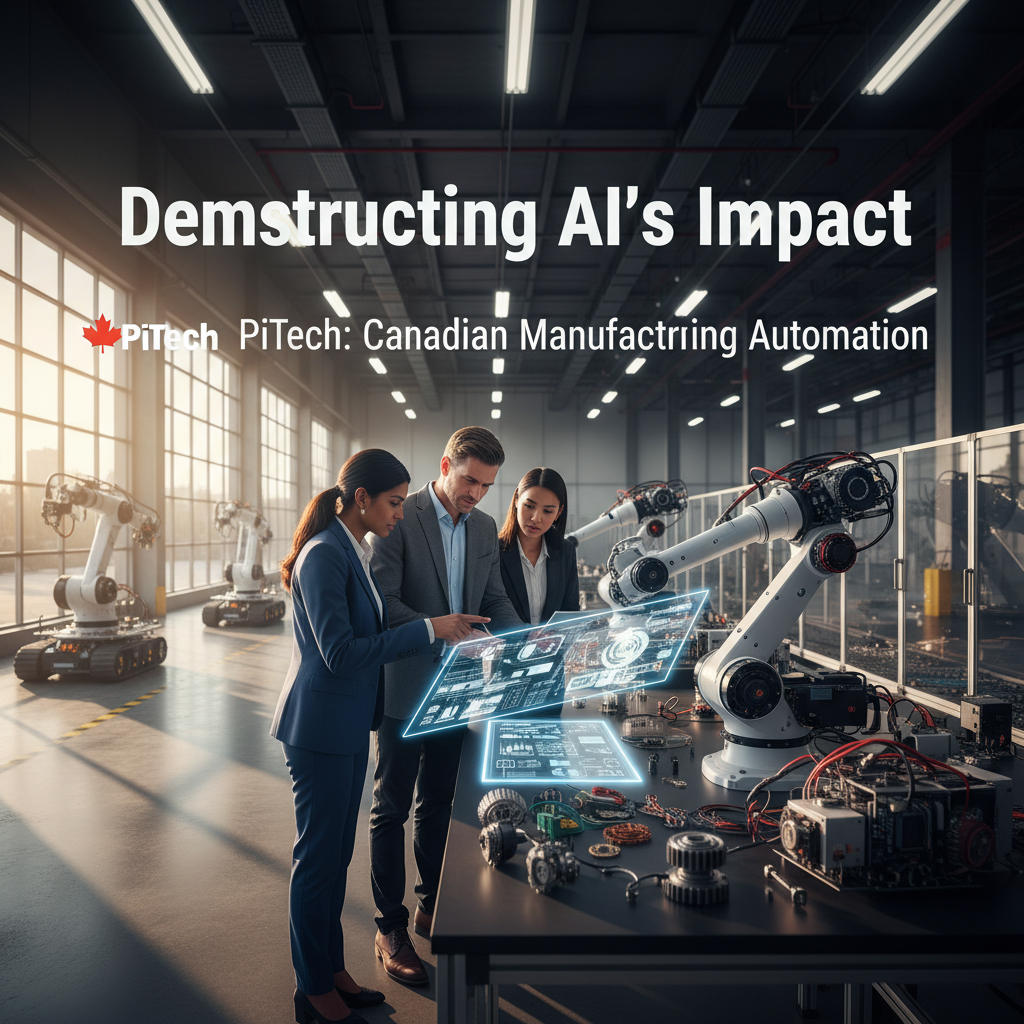
Artificial intelligence is not a single, monolithic technology. It's a suite of powerful tools and techniques that can be applied to solve specific, high-value problems within a manufacturing environment. From machine learning algorithms that detect subtle patterns in sensor data to computer vision systems that inspect products with superhuman accuracy, AI is unlocking new frontiers of operational efficiency. By understanding these core applications, Canadian manufacturers can begin to see a clear path from their current challenges to future success.
Mastering Proactive Operations with Predictive Maintenance Manufacturing
The single largest source of lost revenue for many manufacturers is unplanned downtime. When a critical piece of equipment fails, the entire production line can grind to a halt. Predictive maintenance flips this script entirely. Instead of repairing equipment after it breaks, AI enables you to service it before failure is even imminent, transforming maintenance from a costly emergency response into a scheduled, low-impact activity.
#### How AI Models Predict Equipment Failure Before It Happens
Modern manufacturing equipment is rich with sensors, generating a constant stream of data about temperature, pressure, vibration, power consumption, and more. To a human operator, this data stream is often just noise. However, to a machine learning model, it's a detailed narrative of the machine's health. The process begins by collecting this historical data from IoT sensors attached to the equipment. An AI model is then trained on this data, learning the subtle signatures of normal operation versus the early indicators of impending failure.
Once trained, the model monitors the live data stream in real time. It acts as a vigilant, always-on observer, performing advanced anomaly detection. It can identify a minute increase in vibration that signals a bearing is starting to wear out or a slight temperature drift that indicates a cooling system is becoming less efficient. When a potential issue is detected, the system automatically generates an alert for the maintenance team, detailing the specific problem and recommending a course of action, weeks or even months before a catastrophic failure would have occurred.
#### The Tangible ROI of Eliminating Unplanned Downtime
The return on investment for predictive maintenance is one of the most compelling in the industrial AI landscape. First, it drastically reduces unplanned downtime, ensuring production schedules remain stable and customer delivery commitments are met. Second, it cuts maintenance costs by shifting from expensive emergency repairs (which often require overtime and rushed part shipments) to planned, efficient servicing. Third, it extends the lifespan of expensive capital equipment by addressing issues before they cause cascading damage. Finally, it optimizes the allocation of maintenance resources. Technicians are no longer running from fire to fire; they are strategically deployed based on data-driven priorities, improving their own efficiency and job satisfaction.
Achieving Flawless Production with AI-Powered Quality Control
Maintaining consistent product quality is paramount for brand reputation and customer loyalty. Yet, manual inspection is often a bottleneck, prone to human error, fatigue, and inconsistency. AI-powered quality control, primarily using computer vision, automates and elevates this critical process, delivering a level of accuracy and speed that is simply unattainable through manual methods alone.
#### Computer Vision: Surpassing Human Limitations in Defect Detection
Imagine a high-speed production line churning out hundreds of parts per minute. A computer vision system, comprised of high-resolution cameras and a sophisticated AI model, can inspect every single item. The AI has been trained on thousands of images, learning to distinguish between a perfect product and one with any number of defects, such as microscopic cracks, surface blemishes, incorrect color, or missing components.
Unlike a human inspector, the AI system does not get tired or distracted. It can operate 24/7 with unwavering consistency, identifying defects that are invisible to the naked eye. This not only dramatically reduces the number of defective products that reach the customer but also provides a 100% inspection rate, a feat that is often logistically and financially impossible with manual inspection. The system can instantly flag or divert defective items, ensuring the integrity of the final output.
#### From Reactive Fixes to Proactive Quality Assurance
The true power of AI quality control extends beyond just finding defects. It creates a rich data feedback loop. By analyzing the types and frequencies of defects, the AI system can start to identify root causes within the production process itself. For example, if a specific type of surface scratch consistently appears, the system can correlate this with data from an upstream machine, perhaps indicating a misaligned tool or a worn component.
This transforms quality control from a reactive "catch-the-mistake" function into a proactive quality assurance process. The insights generated by the AI are used to fine-tune machine settings, adjust material inputs, and optimize workflows, preventing defects from occurring in the first place. This continuous improvement cycle leads to higher yields, less scrap and rework, and a direct positive impact on the bottom line.
How Manufacturing Process Optimization in Canada Drives Unprecedented Efficiency
Beyond individual machines and quality checks, AI offers the ability to optimize the entire manufacturing ecosystem. By creating a holistic, data-driven view of the factory floor, manufacturers can uncover hidden inefficiencies and orchestrate their operations for maximum throughput and minimal waste. This is a core component of achieving true operational efficiency in manufacturing and is central to the promise of smart manufacturing in Canada.
#### Using Digital Twins to Simulate and Refine Production Lines
A digital twin is a virtual, real-time replica of a physical asset or process. By continuously feeding the digital twin with data from IoT sensors on the factory floor, manufacturers create a dynamic simulation of their entire operation. This virtual environment becomes a risk-free sandbox for optimization.
Want to know the impact of increasing the speed of a conveyor belt, rerouting material flow, or introducing a new piece of equipment? Instead of disrupting the live production line for a risky real-world test, you can run dozens of simulations in the digital twin. The AI can model the downstream effects, predict potential bottlenecks, and calculate the impact on throughput and costs. This allows engineers and managers to identify the optimal configuration before making a single physical change, dramatically accelerating innovation cycles and de-risking process improvements.
#### AI-Driven Resource Allocation: Optimizing Energy, Materials, and Labor
Manufacturing is incredibly resource-intensive. AI can act as a master optimizer, ensuring that every kilowatt of energy, every kilogram of raw material, and every hour of labor is used to its fullest potential. For example, AI models can analyze energy consumption patterns across the entire facility, identifying machines that are consuming too much power or processes that could be shifted to off-peak hours to take advantage of lower electricity rates.
Similarly, AI can optimize material usage by analyzing production data to minimize scrap. It can also assist in production planning and scheduling, ensuring that the right people with the right skills are in the right place at the right time, avoiding both idle labor and overtime costs. This deep level of manufacturing process optimization Canada-based businesses can achieve moves them from a state of simply using resources to intelligently managing them for peak financial and environmental performance.
Integrating Robotics and Intelligent Automation for a Smarter Workforce
The discussion of factory automation invariably brings up robotics. The new generation of robots, enhanced with AI, is less about replacing humans and more about collaborating with them. These intelligent systems handle tasks that are repetitive, physically demanding, or require a level of precision that is difficult for humans to sustain, freeing up the human workforce for more complex, value-added roles.
#### The Rise of Cobots: Augmenting Human Skill, Not Replacing It
Collaborative robots, or "cobots," are designed to work safely alongside human employees. Unlike traditional industrial robots that are caged off for safety, cobots are equipped with advanced sensors that allow them to stop or alter their path if they come into contact with a person or object. They are ideal for tasks like lifting heavy components, performing repetitive screwing or fastening, or tending to other machines.
This symbiotic relationship augments the human worker. A skilled technician can focus on the complex final assembly and quality checks while the cobot handles the physically strenuous task of positioning a heavy part. This not only increases productivity and ergonomic safety but also helps address the skilled labor shortage by making existing employees more efficient and capable. The fear of job replacement is replaced by a reality of workforce transformation, where employees are upskilled to supervise, program, and maintain these new robotic partners.
#### Automating Material Handling with Autonomous Mobile Robots (AMRs)
One of the most significant non-value-added activities in any factory is moving materials from one place to another. Forklifts, pallet jacks, and manual carts create congestion, pose safety risks, and consume valuable labor hours. Autonomous Mobile Robots (AMRs) are a game-changing solution to this internal logistics challenge.
Unlike traditional Automated Guided Vehicles (AGVs) that follow fixed magnetic strips or wires, AMRs use AI, LiDAR, and cameras to navigate the factory floor dynamically. They can understand their environment, avoid obstacles (like people or misplaced pallets), and calculate the most efficient route to their destination. AMRs can be deployed to transport raw materials to the production line, move work-in-progress between stations, and carry finished goods to the shipping area, all without human intervention. This creates a seamless, efficient, and safe flow of materials throughout the facility, eliminating a major source of operational friction.
Practical Business Takeaways: Your Roadmap to Canadian Factory Automation

The potential of industrial AI is immense, but the prospect of implementation can feel daunting. The key is to approach it not as a massive, one-time technology overhaul but as a strategic, incremental journey. A successful AI adoption strategy begins with a clear understanding of your business's most pressing problems and a commitment to starting small, proving value, and scaling intelligently.
Building a Strategic AI Implementation Plan for Your Manufacturing Business
A well-defined plan is the difference between a successful AI initiative and a costly science project. This roadmap should align technology with specific business outcomes, ensuring that every dollar invested is tied to a measurable improvement in efficiency, quality, or cost reduction.
#### Starting Small: Identifying the Right Pilot Project
Instead of attempting to "boil the ocean" by implementing AI across the entire factory at once, the most successful adopters start with a focused pilot project. Identify a single, high-impact problem. Is it the unplanned downtime of one specific, critical machine? The high defect rate on a particular production line? A bottleneck in material transport between two key work cells?
By choosing a well-defined and measurable problem, you create a controlled environment to prove the technology's value. A successful pilot, for instance, a predictive maintenance solution that prevents a single costly outage, builds institutional confidence, secures executive buy-in, and provides invaluable hands-on experience for your team. This initial win becomes the cornerstone upon which you can build a broader, factory-wide AI strategy.
#### Addressing the Data Challenge: Collection, Quality, and Governance
AI models are only as good as the data they are trained on. This is the single most critical factor for success. Before embarking on an AI project, you must assess your data landscape. Do your machines have the necessary sensors to capture the required data? Is the data being collected and stored in an accessible format? Is the data clean and reliable, or is it riddled with errors and gaps?
Developing a robust data governance strategy is essential. This involves standardizing data collection processes, ensuring data integrity, and establishing clear ownership. You may need to invest in retrofitting older equipment with modern IoT sensors or implementing a centralized data historian. Partnering with experts who understand industrial data can be crucial in building the solid data foundation necessary for any successful industrial AI solution.
#### Navigating the Financials: Investment, ROI, and Government Incentives
The initial investment for AI and automation can seem significant, encompassing software, hardware, and integration services. However, it's crucial to evaluate this cost against a clear projection of the return on investment (ROI). Calculate the current costs of the problem you are solving: how much money is lost to downtime, scrap, or inefficient labor each year? A well-scoped AI project should deliver a clear and compelling ROI within a reasonable timeframe, often 12-24 months.
Furthermore, Canadian businesses should actively explore federal and provincial government programs designed to encourage technology adoption and industrial innovation. Grants, tax credits, and funding assistance programs can significantly offset the initial investment, making it easier to build a strong business case for AI automation.
PiTech's Perspective: Why Custom Manufacturing Software is the Backbone of Industrial AI Solutions
While the market is flooded with off-the-shelf AI platforms, a one-size-fits-all approach rarely works in the complex and varied world of manufacturing. Every factory has a unique mix of new and legacy equipment, distinct operational workflows, and existing software systems like Enterprise Resource Planning (ERP) and Manufacturing Execution Systems (MES). The real challenge, and the greatest opportunity, lies in integrating these disparate elements into a single, intelligent ecosystem.
This is where the power of custom manufacturing software becomes indispensable. Off-the-shelf AI tools often fail to communicate effectively with a 20-year-old PLC or a proprietary ERP system. This creates data silos and prevents the realization of a truly holistic, optimized smart factory. A technology partner specializing in custom development can bridge these gaps, creating the digital connective tissue that enables a seamless flow of information from the oldest machine on the floor to the most advanced cloud-based AI model.
PiTech specializes in architecting these bespoke solutions. We develop custom software layers and APIs that allow your new AI systems to integrate perfectly with your existing infrastructure. We build intuitive, integrated business platforms and dashboards that provide a single pane of glass for monitoring your entire operation in real-time. This tailored approach ensures that the technology adapts to your business, not the other way around, maximizing the value of your investment and ensuring that the AI solution directly addresses your most critical operational challenges.
The Future is Now: Seizing the Competitive Advantage with AI Automation
The story of the 3 AM phone call is a relic of a past era of manufacturing. The future belongs to the plant manager who sleeps soundly, confident that an AI system is watching over their operations, ready to flag a potential issue weeks in advance. For Canadian businesses, the path to renewed competitiveness, enhanced resilience, and sustainable growth is clear. It requires moving beyond traditional methods and embracing the transformative power of intelligent automation.
From eliminating downtime with predictive maintenance to achieving near-perfect quality with computer vision, the applications are tangible, proven, and deliver a powerful return on investment. The journey begins with a strategic decision to act, to identify a critical business problem, and to find the right technology partner to guide the implementation. Adopting AI automation for manufacturing in Canada is not about chasing the latest technological trend; it's a fundamental business decision about securing a prosperous and efficient future in a rapidly evolving global market.
Ready to transform your factory floor from reactive to predictive? PiTech's experts in custom software and AI automation can help you design and deploy industrial AI solutions tailored to your unique Canadian manufacturing operation. Contact us today for a complimentary strategic consultation.
Ready to Transform Your Business?
Let PiTech help you implement these strategies with proven technology solutions.
Get StartedRelated articles
- AI Automation for Manufacturing Canada: The SMB Growth EngineStruggling with high costs and low output? Discover how AI automation for manufacturing in Canada is helping SMBs boost efficiency, cut waste, and compete globally.
- Custom Call Center Software Canada: The Efficiency BlueprintOff-the-shelf software failing your team? Discover how custom call center software in Canada solves compliance, bilingualism, and efficiency challenges for good.
- Unlocking Growth with Custom IoT Solutions for Canadian LogisticsFacing rising costs and complexity in Canadian logistics? Discover how custom IoT solutions transform supply chains with real-time tracking, automation, and predictive insights.
- Custom CPQ Software Canada: The Key to SaaS Sales EfficiencyDiscover how custom CPQ software in Canada solves B2B SaaS sales bottlenecks, eliminates quoting errors, and accelerates deal velocity for sustainable growth.