

Unlocking Growth with Custom IoT Solutions for Canadian Logistics
How custom IoT solutions transform Canadian logistics with real-time tracking, automation, and predictive insights.
Published
Why Read This?
This article reveals how custom IoT solutions are essential for Canadian logistics, moving beyond generic systems to tackle unique challenges like extreme climates and vast distances. Discover how real-time data and tailored alerts can prevent costly losses and drive efficiency in a demanding supply chain environment. Learn why embracing custom IoT is no longer a luxury, but a strategic imperative for Canadian businesses aiming to thrive.
A single shipping container of high-value pharmaceuticals sits on a frigid Edmonton tarmac, its internal temperature creeping dangerously close to the lower viability threshold. Miles away, the logistics manager is completely blind to this impending six-figure loss. This is not a hypothetical worst-case scenario; it is a daily risk baked into the Canadian supply chain, a system stretched across vast distances and extreme climates. What if a single, custom-configured sensor and a specific alert threshold, tailored to that exact product, could have flagged the deviation instantly, saving the shipment and the company's reputation? This is the fundamental, value-driven promise of moving beyond generic systems to embrace custom IoT solutions for Canadian logistics.
The era of operating on historical data and educated guesses is over. For logistics and supply chain companies in Canada, the pressure has never been greater. A confluence of global disruptions, razor-thin margins, persistent labor shortages, and rising customer expectations for Amazon-level transparency has created a new operational reality. Thriving in this environment requires more than just working harder; it demands working smarter. It requires real-time, granular data that can inform decisions, automate processes, and predict failures before they happen. This is where the Internet of Things (IoT) transitions from a technological buzzword into a core strategic asset.
The Strategic Imperative for IoT in Canadian Supply Chains
The Canadian logistics landscape is a unique beast, characterized by immense geographical scale, challenging weather patterns, and critical cross-border trade flows. These factors render one-size-fits-all technology solutions inadequate and often inefficient. While off-the-shelf IoT products offer a starting point, they rarely account for the specific operational nuances, legacy systems, and competitive pressures that define a particular Canadian logistics business. The real competitive advantage lies not in simply adopting IoT, but in deploying custom IoT solutions Canada logistics operators can mold to their precise needs.
This strategic shift is driven by a convergence of factors. The rollout of 5G and LPWAN (Low-Power Wide-Area Network) technologies offers reliable connectivity even in previously challenging remote corridors. The cost of sensors, from simple temperature and humidity monitors to complex LiDAR and vibration sensors, has plummeted. Most importantly, the power of cloud computing and artificial intelligence (AI) has matured to a point where the massive volumes of data generated by IoT devices can be translated into actionable, predictive, and profitable insights. For a logistics director in Calgary or a fleet manager in Montreal, this means the tools to build a truly resilient, efficient, and future-proof supply chain are finally within reach. It represents a move from reactive problem-solving to proactive, data-driven optimization.
Beyond Off-the-Shelf: Why Canadian Logistics Demands Customization

Many businesses are tempted by the apparent simplicity of plug-and-play IoT devices. However, the true value for a complex operation is unlocked through custom development that addresses specific, high-impact challenges. A generic solution might tell you where a truck is, but a custom solution can tell you if the driver is exhibiting signs of fatigue based on driving patterns, if the specific cargo inside is nearing its temperature limit, and automatically re-route the truck around an unexpected blizzard in Northern Ontario, all while communicating updates to the client's ERP system.
Addressing Canada's Unique Geographical and Climate Challenges
A fleet management solution designed for California will fail spectacularly during a Saskatchewan winter. Canada’s extreme temperature swings, from the heat of a summer in the Okanagan to the deep freeze of a winter on the prairies, demand robust hardware and intelligent software. Custom IoT solutions can be designed with industrial-grade sensors and enclosures rated for these conditions. The software can incorporate custom logic, for instance, adjusting predictive maintenance alerts for engine components based on prolonged operation in sub-zero temperatures or dynamically changing routing algorithms to account for seasonal road closures and weight restrictions on northern ice roads. This level of environmental-specific intelligence is simply not available in generic platforms.
Overcoming the Limitations of Generic Fleet Management Solutions
Standard telematics provides a dot on a map. Custom fleet management solutions, built on an IoT framework, provide operational intelligence. Instead of just GPS location, a custom solution can integrate data from CAN bus systems to monitor real-time fuel consumption, engine diagnostics, and driver behavior like harsh braking or acceleration. This data can be used to create individualized driver scorecards for training purposes, optimize fuel purchasing strategies, and automate compliance with Hours of Service (HoS) regulations. For specialized fleets, such as those in mining or construction, custom sensors can be added to monitor tipper usage, crane operation, or power take-off (PTO) engagement, providing a complete picture of asset utilization that goes far beyond simple location tracking.
Integrating with Legacy ERP and TMS Systems Seamlessly
One of the biggest hurdles to technology adoption in established logistics companies is the presence of entrenched, often decades-old, legacy systems like Enterprise Resource Planning (ERP), Warehouse Management Systems (WMS), and Transportation Management Systems (TMS). Off-the-shelf IoT platforms often create yet another data silo, forcing staff to toggle between multiple screens and manually transfer information. A core component of logistics software development in Canada is building custom APIs and middleware that allow new IoT platforms to communicate bidirectionally with these existing systems. This means an IoT sensor detecting a late shipment can automatically update the TMS and trigger an alert in the customer's portal via the ERP, creating a seamless, automated workflow that eliminates manual error and improves customer service.
Transforming Warehouse Operations with Custom IoT-Powered Automation in Canada
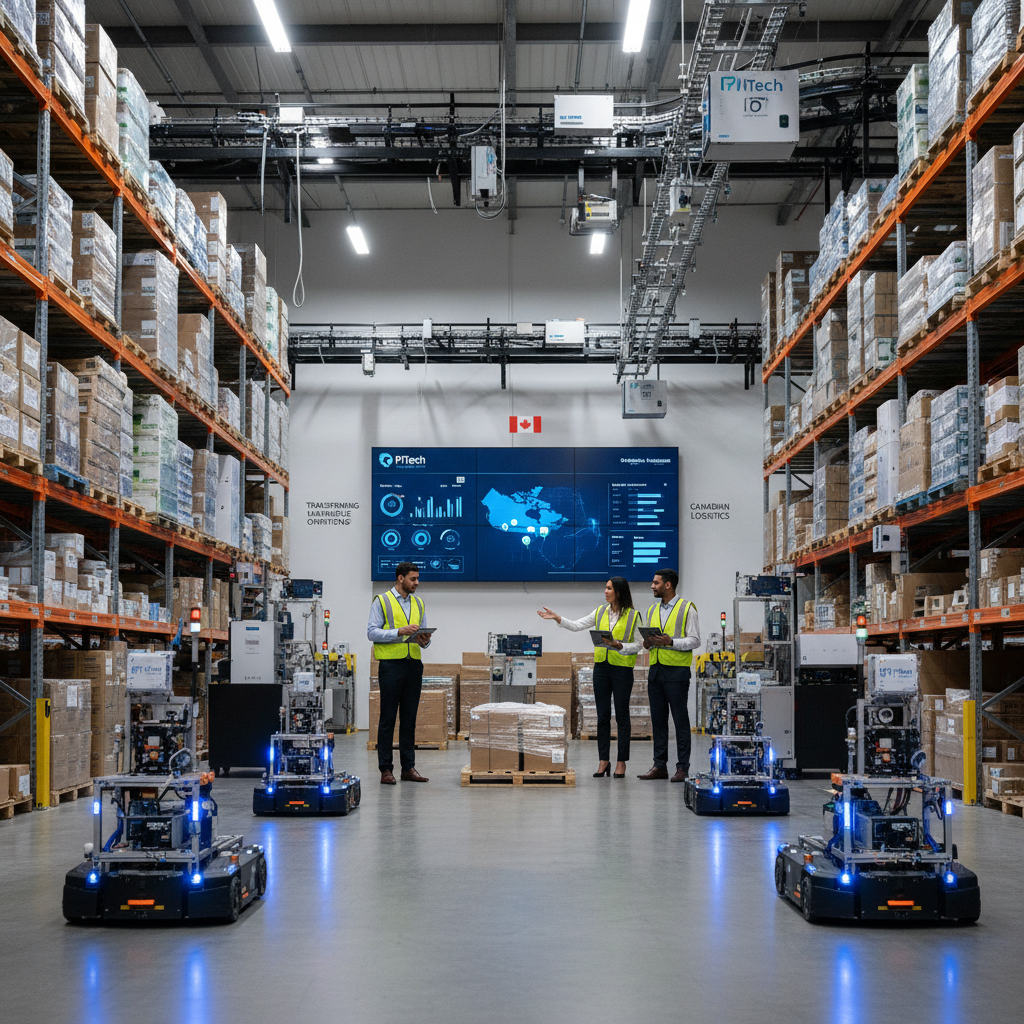
The warehouse is the heart of the supply chain, and it is an environment ripe for IoT-led transformation. In a tight labor market, using technology to augment human capabilities, improve safety, and drastically increase throughput is not an option; it is a necessity for survival and growth. Warehouse automation Canada initiatives are moving beyond rudimentary conveyor belts to embrace intelligent, connected ecosystems.
Smart Inventory Management: From Barcodes to Autonomous Tracking
Manual cycle counting and barcode scanning are time-consuming and error-prone. Custom IoT solutions offer a far more dynamic approach. Imagine a warehouse where pallets are equipped with low-cost RFID or Bluetooth Low Energy (BLE) tags. Stationary readers create a geofence, allowing the WMS to have a real-time, 100% accurate view of every single item's location. This eliminates misplaced inventory, dramatically speeds up picking and packing processes, and provides perfect data for demand forecasting. For high-value goods, individual items can be tracked, providing unparalleled security and traceability from the moment they enter the warehouse to the moment they leave.
Enhancing Worker Safety and Productivity with Wearable IoT
Your workforce is your most valuable asset. Wearable IoT devices can play a crucial role in protecting them and making their jobs easier. Smart vests or wristbands can monitor for signs of fatigue or heat stress in demanding environments. Proximity sensors can alert forklift operators and floor staff when they are too close to one another, preventing collisions in busy aisles. These same devices can be integrated with the WMS to provide navigational guidance to pickers, highlighting the most efficient path to their next item and confirming picks with a simple tap, freeing their hands and improving their speed and accuracy.
Predictive Maintenance for Conveyors, Forklifts, and Sorting Systems
A single conveyor belt failure during peak season can bring an entire distribution center to a standstill, costing tens or even hundreds of thousands of dollars per hour. Traditional preventative maintenance schedules are often inefficient, either servicing equipment too frequently or, worse, not catching an impending failure. A predictive maintenance logistics Canada strategy uses IoT sensors to monitor the actual condition of equipment. Vibration sensors on motors, thermal imagers on electrical panels, and acoustic sensors on moving parts can detect subtle deviations from normal operation. This data is fed into an AI model that predicts when a specific component is likely to fail, allowing maintenance to be scheduled at the most opportune, least disruptive time.
Achieving End-to-End Visibility with IoT Supply Chain Management in Canada
For decades, the holy grail of logistics has been true end-to-end visibility. Shippers, carriers, and clients have operated in relative darkness, with significant information gaps between each leg of a product's journey. IoT supply chain management Canada is finally breaking down these walls, creating a transparent, connected, and responsive ecosystem.
Real-Time Shipment Tracking: Monitoring Location, Condition, and Security
Real-time tracking Canada is evolving far beyond a simple GPS ping. Today's custom IoT solutions involve placing small, often disposable or reusable, multi-sensor devices directly onto pallets or into containers. These devices can report not only on location but also on critical environmental conditions. Shippers can receive alerts if a package is dropped (via an accelerometer), if its box is opened (via a light sensor), or if it deviates from its planned route. This provides an unprecedented level of security against theft and damage, while also giving customers the real-time visibility they have come to expect.
Revolutionizing Cold Chain Logistics for Perishables and Pharmaceuticals
For Canada's food and pharmaceutical industries, the cold chain is non-negotiable. A temperature excursion can turn a valuable shipment of vaccines or fresh seafood into a total loss. Custom IoT cold chain monitoring provides a continuous, auditable record of temperature and humidity from farm to fork or from lab to pharmacy. Alerts can be configured with extreme precision; for example, an initial alert at a warning threshold, followed by a critical alert if the temperature continues to deviate. This allows logistics teams to intervene proactively, perhaps instructing a driver to check on a reefer unit, rather than discovering a spoiled shipment upon arrival. This automated compliance trail is also invaluable for regulatory audits.
Streamlining Cross-Border Freight Management with Automated Compliance
Trade between Canada and the United States is the lifeblood of the economy, but it comes with significant administrative and regulatory burdens. Custom IoT solutions can help automate many aspects of Canadian freight management technology. Geofencing can be used to automatically trigger the filing of customs documentation as a truck approaches the border. Secure e-seals can report if a container has been tampered with after its initial inspection, providing a "green lane" advantage at border crossings. By integrating with Canada Border Services Agency (CBSA) and U.S. Customs and Border Protection (CBP) systems, these custom solutions reduce clearance delays, minimize paperwork errors, and ensure a smoother, faster flow of goods.
The Data-Driven Advantage: From Raw Telemetry to Predictive Logistics Insights
Collecting data is easy; turning it into a competitive advantage is the hard part. The true power of a custom IoT solution is not the sensors themselves, but the data analytics and AI engine that sits behind them. This is where raw telemetry from thousands of assets is transformed into strategic business intelligence.
How AI and Machine Learning Unlock the Power of IoT Data
Artificial Intelligence (AI) and Machine Learning (ML) are the brains of a smart IoT operation. These algorithms sift through historical and real-time data streams to identify patterns that are invisible to the human eye. For a logistics company, this means moving from answering "What happened?" to "Why did it happen?", "What will happen next?", and "What is the best thing we can do about it?". An AI model can analyze delivery records, traffic data, weather patterns, and time of day to produce demand forecasts and delivery time estimates with startling accuracy.
Developing Predictive Maintenance Models for Canadian Freight Fleets
For any company operating a fleet of trucks, downtime is a profit killer. A custom predictive maintenance model, powered by IoT data from each vehicle's engine and components, can be a game-changer. By analyzing factors like oil pressure, engine temperature, vibration patterns, and fault codes, an ML algorithm can predict the remaining useful life of a specific part, like a brake pad or a water pump. Instead of replacing parts on a fixed schedule, maintenance is performed exactly when needed, maximizing component life, minimizing unexpected roadside breakdowns, and reducing overall maintenance costs.
Leveraging Analytics for Dynamic Route Optimization and Fuel Savings
Fuel is one of the largest variable costs for any Canadian carrier. Dynamic route optimization uses real-time IoT data to go beyond what standard GPS software can do. The system can analyze traffic congestion, weather reports, and even real-time fuel price data from across a network of stations. It can then recommend the most fuel-efficient route, not just the shortest or fastest. Over a large fleet and millions of kilometers driven annually, the savings from this type of intelligent optimization can be substantial, directly impacting the bottom line and reducing the company's carbon footprint.
Practical Business Takeaways: A Roadmap for IoT Implementation
Embarking on a custom IoT journey can seem daunting, but a structured approach can ensure success and maximize return on investment.
- Start with a Strategic Audit of Your Biggest Pain Points: Before talking about technology, talk about problems. Is your biggest issue fuel costs? Warehouse inefficiency? Shipment spoilage? Identify the one or two most costly, persistent problems in your operation. A successful IoT implementation is a solution to a real business problem, not a technology in search of one.
- Define Clear KPIs and Justify the ROI: How will you measure success? Define specific, measurable Key Performance Indicators (KPIs). For example, "reduce unplanned fleet downtime by 20% within 12 months" or "decrease average pick-and-pack time by 15%." Using these KPIs, build a clear business case that outlines the expected costs and financial returns, ensuring buy-in from all stakeholders.
- Plan for Phased Implementation: The Pilot Project Approach: Do not try to boil the ocean. A successful strategy is to start with a focused pilot project. Select a small subset of your fleet, a specific section of your warehouse, or a single high-value shipping lane. Proving the concept and the ROI on a smaller scale makes it much easier to get approval and build momentum for a full-scale rollout.
- Prioritize Data Security and Integration from Day One: In a connected world, security cannot be an afterthought. Ensure your technology partner has a robust plan for data encryption, access control, and network security. Similarly, plan for integration with your existing systems from the very beginning. A successful custom solution must enhance, not complicate, your existing software stack.
- Choose the Right Technology Partner, Not Just a Vendor: You are not buying a product; you are building a strategic capability. Look for a partner with proven expertise in both logistics software development Canada and IoT implementation. They should ask deep questions about your business processes before they ever suggest a piece of hardware. A true partner will work with you to co-create a solution that provides a sustainable competitive advantage.
Building Your Competitive Edge: PiTech's Approach to Custom Logistics Technology
At PiTech, we understand that a revolution in the Canadian logistics sector requires more than just hardware. It requires a deep, process-level understanding of the challenges you face every day. Our approach is not to sell you a pre-packaged "IoT box" but to partner with you to architect and build integrated digital systems that solve your most expensive problems and create new opportunities for growth. We see technology as a tool to amplify your operational expertise.
Our methodology begins with a collaborative discovery process, where we immerse ourselves in your world, from the dispatch office to the warehouse floor to the driver's cab. We then apply our deep expertise in custom software development, AI automation, and cloud solutions to design a system tailored to your unique reality. This could mean developing a mobile application for drivers that integrates HoS, DVIRs, and real-time routing. It might involve building a predictive analytics dashboard that gives your maintenance team unprecedented foresight. Or it could be architecting a complete, end-to-end platform that unifies data from your fleet, your warehouse, and your partners into a single source of truth. By focusing on seamless integration with your existing ERP, WMS, and TMS platforms, we ensure that new technology empowers your team rather than burdening them.
The Future is Custom: From Surviving to Thriving
The Canadian logistics and supply chain industry is at a critical inflection point. The challenges of distance, climate, cost, and competition are immense, but so too are the opportunities. In this new landscape, relying on generic, off-the-shelf technology is no longer a viable strategy for ambitious organizations. It's a recipe for falling behind. The companies that will lead the next decade of logistics will be those who harness the power of data through technology built for their specific purpose.
Investing in custom IoT solutions for Canadian logistics is not merely an IT upgrade; it is a fundamental business strategy. It is the most effective path to building a truly resilient, efficient, and intelligent supply chain. By converting operational blind spots into data-driven insights, you can reduce costs, enhance service levels, mitigate risks, and unlock new avenues for growth. The technology is here. The time to build your competitive advantage is now.
Are you ready to move beyond the limitations of generic software and unlock the full potential of your logistics operation? Transform your Canadian supply chain with PiTech's custom IoT development expertise. Contact us for a strategic consultation to address your unique challenges.
Ready to Transform Your Business?
Let PiTech help you implement these strategies with proven technology solutions.
Get StartedRelated articles
- Scaling E-commerce: Custom Logistics Software in Canada GuideYour off-the-shelf logistics software is hitting its limits. Discover how building custom logistics software in Canada can optimize your operations and fuel growth.
- Canadian E-commerce Inventory: Unlocking Growth Beyond ExcelStruggling with stockouts and syncing inventory across channels in Canada? Learn to optimize your e-commerce inventory management beyond basic spreadsheets.
- Custom Fleet Management Software Canada: Your Growth EngineGeneric tools can't handle Canadian logistics. Discover how custom fleet management software in Canada unlocks major ROI, optimizes routes, and ensures compliance.
- Custom Inventory Software for Canadian Retailers: Your GuideSee why generic solutions fail Canadian retailers. Learn how custom inventory management software drives profit, efficiency, and customer loyalty in Canada's unique market.