

Headless Ecommerce Development Canada: The Shopify Shift
Discover why scaling Canadian retailers are shifting to headless Shopify architecture to conquer speed ceilings, Bill 96 compliance, and complex multi-region logistics.
Published
Why Read This?
$10
A scaling Canadian apparel brand generating fifteen million dollars in annual gross merchandise value launched its holiday campaign, only to watch its mobile conversion rate crater by twenty-two percent. The backend did not crash, and Shopify processed payments without a hitch. The failure happened entirely in the browser: thirty-six third-party Shopify apps had injected nearly five megabytes of unminified JavaScript into the theme, driving mobile Time-to-Interactive past six seconds and triggering Google Core Web Vitals penalties.
For high-growth domestic brands, this scenario is becoming uncomfortably common. Monolithic architectures that rely on standard Shopify Liquid themes serve early-stage merchants exceptionally well, but they impose severe operational and technical ceilings once a catalog scales, operations expand across provincial lines, and omnichannel requirements mature.
To solve this, leading technical directors and digital executives are embracing headless ecommerce development in Canada. By decoupling presentation from backend commerce engines, retailers maintain the transaction security and merchant operations of Shopify Plus while unlocking sub-second performance, bespoke user experiences, and native compliance workflows. This architectural transition is not an aesthetic upgrade; it is an infrastructure evolution driven by unit economics, regulatory realities, and customer acquisition pressure.
The Monolithic Ceiling: Why Standard Shopify Themes Struggle Beyond Ten Million GMV
Standard Shopify architecture couples the presentation layer directly to the commerce platform. Liquid, Shopify's open-source templating engine, renders HTML on Shopify servers based on database records, static assets, and theme settings. For direct-to-consumer startups, this integrated approach provides an accessible path to market. A lean team can install a theme, configure third-party plugins from the app marketplace, and begin selling within days.
As transaction volume climbs into eight figures, this tightly bound model develops systemic friction points:
* Accumulated Script Bloat: Every business function, from customer reviews and sizing calculators to loyalty points and urgency countdowns, typically requires an individual app. Most marketplace applications inject their own script tags, external CSS sheets, and tracking pixels directly into the document object model. Because standard themes lack centralized bundle optimization across independent plugins, these assets execute sequentially, blocking main-thread rendering and degrading Largest Contentful Paint.
* Rigid Data Models: Standard themes force every product, variant, and category into predefined Shopify database structures. Retailers selling complex, bundled, or configurable products must rely on fragile metafield hacks or cumbersome custom scripts that are difficult to maintain and prone to breaking during platform updates.
* Frontend Engineering Bottlenecks: Because frontend layout logic is intertwined with Shopify backend dependencies, software engineers cannot deploy interface enhancements independently. Merchandising adjustments risk destabilizing checkout hooks, while simple layout experimentation requires full theme deployments that complicate version control.
* Database Query Latency: As product catalogs expand into tens of thousands of SKUs with multiple variant dimensions, rendering heavy Liquid templates requires repetitive server-side queries. This raises Time-to-First-Byte across international endpoints and creates inconsistent response times during traffic spikes.
Scaling retailers eventually encounter a threshold where adding another commercial app or optimizing theme Liquid code yields diminishing returns. The underlying framework itself becomes the barrier to scalable revenue growth.
Architectural Breakdown: Shopify Liquid Monolith Versus Modern Composable Commerce
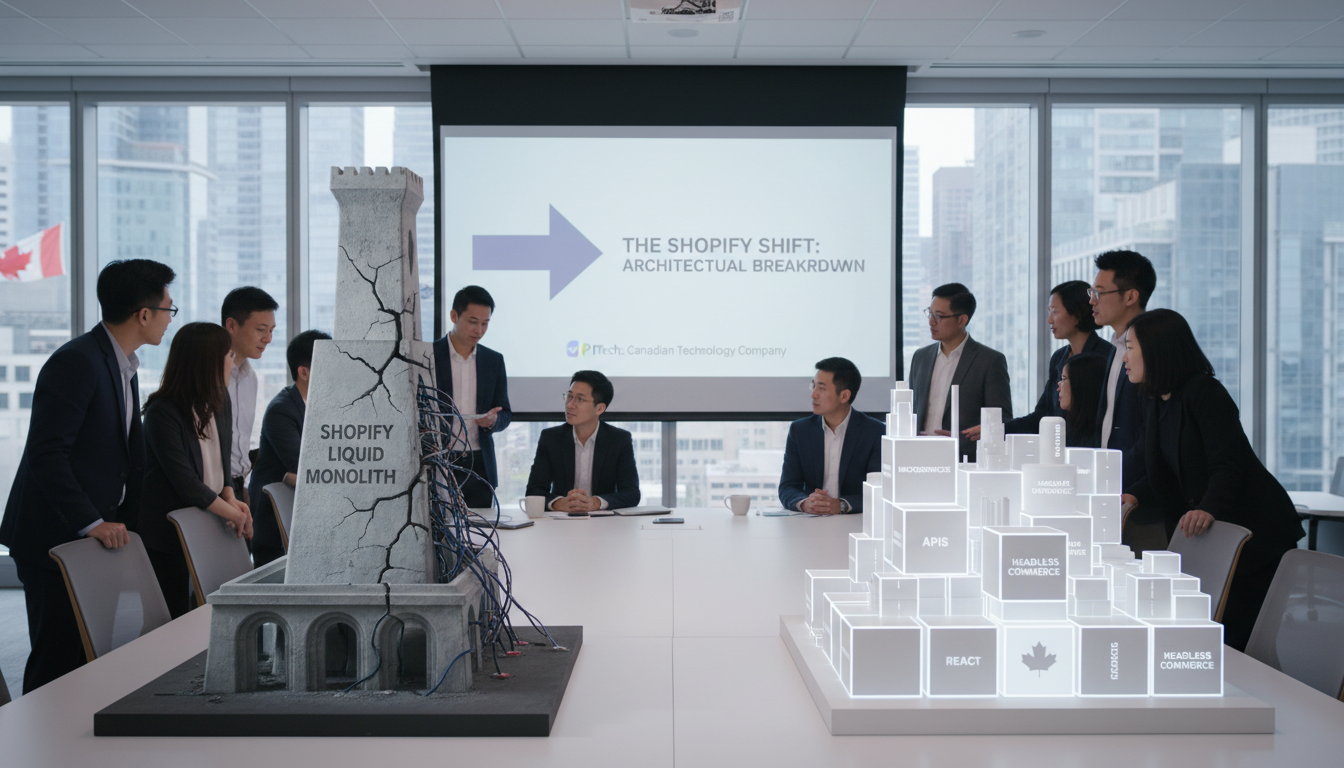
Moving away from a monolithic theme does not mean abandoning Shopify. In a decoupled architecture, Shopify is repurposed into an enterprise commerce engine. The platform provides its hardened checkout system, PCI-compliant payment gateways, tax calculation tables, and administrative dashboard, while an external, dedicated frontend framework handles user interactions.
```
Monolithic Architecture (Standard Shopify):
++
| Browser / User Device |
++
|
v
++
| Shopify Infrastructure |
| - Theme Engine (Liquid) |
| - Third-Party Apps (Injected Scripts) |
| - Commerce Backend & Checkout |
++
Decoupled Architecture (Headless Composable):
++
| Browser / Mobile App / Point of Sale |
++
|
v
++
| Edge Presentation Layer (Next.js / Hydrogen / Vercel Edge) |
| - Pre-rendered Pages (ISR / SSR) |
| - Tailored UI Components |
| - Sub-second Global Edge Caching |
++
| |
v v
++ ++
| Headless CMS | | Shopify Storefront API |
| (Sanity/Contentful) | | (GraphQL Engine) |
++ ++
| |
+++
|
v
++
| Central Business Systems (Custom Middleware, ERP, WMS) |
++
```
In this composable commerce model, the user interface is completely detached. Teams build the consumer-facing interface using modern web frameworks such as Next.js, Remix, or Shopify Hydrogen. This application is deployed to global edge networks like Vercel, Cloudflare, or Shopify Oxygen.
The presentation layer communicates with the commerce backend through the Shopify Storefront API using GraphQL. Instead of downloading rigid HTML pages generated by Shopify servers, the user's browser loads an optimized, static application shell that fetches only the precise data payloads required for the current view.
| Technical Dimension | Monolithic Shopify (Liquid) | Decoupled Shopify Architecture |
| : | : | : |
| Frontend Framework | Server-side Liquid templates | React, Next.js, Remix, or Hydrogen |
| Hosting & Delivery | Centralized Shopify theme servers | Edge computing networks with geo-distributed caching |
| Data Fetching | Embedded server queries executed per page load | Granular GraphQL queries pulling targeted JSON payloads |
| Third-Party Integrations | Unregulated script injection directly into the DOM | Unified API orchestration via serverless middleware |
| Content Management | Basic rich text and nested Shopify metafields | Dedicated headless CMS (e.g., Sanity, Contentful) |
| Channel Reach | Standard responsive web browsers | Omnichannel endpoints: Web, iOS, Android, and POS kiosks |
This separation isolates presentation changes from core transactional logic. Frontend teams can redesign navigation paths, implement personalized shopping flows, or run multivariate testing without modifying Shopify backend data structures or risking transactional stability.
The Canadian Localization Challenge: Bilingual Parity, Tax Logic, and Dual-Hub Inventory

Operating an enterprise ecommerce footprint within Canada introduces unique regional complexities that international monolithic templates rarely address cleanly. Retailers must manage domestic regulatory requirements and geographic logistical realities that demand customized technical execution.
Native Bilingual Compliance Under Quebec Bill 96
Quebec's legislative updates regarding the French language require commercial enterprises operating in the province to provide complete linguistic parity across digital customer journeys. On standard Shopify setups, brands typically address translation through automated translation plugins.
These plugins function by loading English content, reading the DOM, and replacing text strings client-side via JavaScript. This approach harms Core Web Vitals, causes visible layout shifts as words swap on-screen, and frequently leaves dynamic components like error notifications, loyalty widgets, and search bars untranslated.
With decoupled ecommerce solutions, multilingual architecture is treated as a foundational data routing concern rather than a cosmetic overlay. Retailers manage structured localization using an enterprise headless CMS:
```
// Example: Next.js Edge Middleware localized routing strategy
import { NextRequest, NextResponse } from 'next/server';
const PUBLIC_FILE = /\.(.*)$/;
export function middleware(request: NextRequest) {
const { pathname } = request.nextUrl;
if (
pathname.startsWith('/_next') ||
pathname.includes('/api/') ||
PUBLIC_FILE.test(pathname)
) {
return;
}
const locale = request.cookies.get('NEXT_LOCALE')?.value ||
(request.geo?.region === 'QC' ? 'fr-ca' : 'en-ca');
if (pathname === '/') {
return NextResponse.redirect(new URL(`/${locale}`, request.url));
}
}
```
Through edge middleware, user locale preferences are evaluated before the page renders. French content is statically generated or server-rendered at the edge with matching URL slugs (`/fr-ca/collections/`), ensuring clean search engine indexing, instant load times, and rigorous legal compliance without layout flickering.
Cross-Provincial Tax Structures and Real-Time Dual-Hub Logistics
Domestic shipping across Canada spans five and a half time zones, requiring fulfillment routing from distinct warehouses in hubs like Calgary, Toronto, or Montreal. Furthermore, transactions must dynamically apply specific provincial tax regimes: single-tier GST, combined HST rates, or dual GST and QST calculations.
Standard themes often force merchants to calculate inventory allocations and shipping timelines late in the checkout flow. A headless architecture running custom ecommerce web development allows engineers to connect custom enterprise resource planning platforms and warehouse management systems directly into the frontend state.
Using geolocation data and direct API queries, the storefront can display real-time inventory availability based on the shopper's closest fulfillment hub, calculate estimated ground-transit shipping times down to the postal code, and present transparent provincial tax estimates before the customer enters the checkout funnel.
Core Web Vitals and Conversion Economics: How Millisecond Speed Offsets Rising Acquisition Costs
Digital marketing economics have shifted significantly across the Canadian retail landscape. As customer acquisition costs on paid social and search channels rise, enterprise brands can no longer afford storefront performance that leaks qualified traffic before an initial interaction occurs.
Google uses Core Web Vitals as a direct organic ranking signal and a primary metric for ad landing page experience:
* Largest Contentful Paint (LCP): Measures perceived loading speed. It marks the point on the timeline when the page's main content has likely loaded.
* Interaction to Next Paint (INP): Measures interface responsiveness. It tracks the latency of every tap, click, and keyboard interaction throughout the user session.
* Cumulative Layout Shift (CLS): Measures visual stability. It quantifies unexpected shifts of page elements during the rendering phase.
```
Monolithic Theme Asset Waterfall (Average Load Cycle):
[Server TTFB: 780ms] > [HTML Parsing: 420ms] > [App Script Downloads (38 files): 2100ms] > [DOM Re-flow / LCP: 3800ms]
Total Blocking Time: High | INP Risk: High
Headless Edge-Rendered Waterfall (Hydrated Next.js/Hydrogen):
[Edge TTFB: 85ms] > [Optimized Asset Shell: 210ms] > [LCP Rendered: 650ms] > [Background Hydration: 300ms]
Total Blocking Time: Negligible | INP Risk: Minimal
```
When an enterprise moves to Shopify Plus headless development, the performance returns are direct and measurable. Assets are bundled with modern build tools that split code automatically. Third-party trackers, customer data platforms, and analytics scripts execute through server-side tag management frameworks running in cloud containers, completely isolated from the user's main browser thread.
The correlation between latency and revenue velocity is well documented. Analysis across consumer retail sectors confirms that every 100-millisecond reduction in mobile checkout load time yields incremental gains in conversion efficiency. By cutting mobile page load from four seconds down to under eight hundred milliseconds, high-volume merchants recover abandoned carts, achieve higher Google Ads Quality Scores, lower cost-per-click rates, and extract greater gross margin from existing media budgets.
The Total Cost of Ownership Reality: When Does Decoupled Commerce Make Financial Sense?
Despite its architectural advantages, headless commerce is not a universal solution for every merchant. Decoupling a store replaces an all-in-one software-as-a-service application with an integrated multi-tier software system. This approach introduces operational overhead that must be balanced against commercial gains.
A candid examination of Total Cost of Ownership reveals that moving to a composable stack entails ongoing financial commitments:
* Independent Infrastructure Hosting: In addition to standard Shopify Plus licensing fees, merchants must budget for cloud hosting platforms such as Vercel, AWS, or Cloudflare to handle edge routing, serverless executions, and CDN delivery.
* Content Management Licensing: Decoupling removes reliance on the native Shopify Theme Editor. To give marketing teams drag-and-drop autonomy, retailers must integrate a headless CMS, which carries usage-based software subscriptions.
* Engineering Talent Requirements: Maintaining a modern React or Next.js codebase requires experienced frontend engineers. Minor design updates that were once executed by non-technical staff within a theme settings panel may now require structured code pull requests and staging deployments.
* Custom Integration Maintenance: Because off-the-shelf Shopify apps cannot inject themselves into a detached frontend, integrations for reviews, search, and user loyalty must be built and maintained via custom APIs and webhooks.
```
Annual GMV Viability Matrix:
< $2M GMV: Monolithic Liquid Architecture (Optimal ROI, Low Maintenance)
$2M - $5M GMV: Evaluation Phase (Headless viable only for complex multi-region or catalog needs)
$5M - $20M+ GMV: Headless Inflection Point (Performance gains directly offset engineering overhead)
$20M+ GMV: Composable Imperative (Mission-critical for omnichannel scale and enterprise stability)
```
For a boutique retailer turning over two million dollars annually with standard catalog structures, the operational overhead of a headless architecture rarely pencils out. A disciplined optimization of a standard Liquid theme remains the fiscally prudent approach.
However, once a retailer passes five to ten million dollars in digital GMV, the economic calculus shifts. At this scale, a one-half percent lift in checkout conversion rate generates hundreds of thousands of dollars in high-margin top-line revenue. This gain readily covers the cost of software licenses, infrastructure tiers, and professional engineering retainers.
Engineering the Composable Stack: Next.js, Headless CMS, and the Shopify Storefront API
Building an enterprise composable commerce stack requires choosing complementary components that communicate cleanly via structured APIs. Rather than relying on a single vendor for every capability, engineering teams integrate best-of-breed services into a cohesive digital platform.
```
++
| Presentation Layer: Next.js / React Framework |
++
|
v
++
| Edge Infrastructure: Vercel / Cloudflare Edge / Oxygen |
++
| | |
v v v
++ ++ ++
| Content Engine | | Commerce Core | | Search & Merch |
| Sanity CMS | | Shopify Plus | | Algolia Engine |
| - Editorial Copy | | - Cart & Pricing | | - Instant Index |
| - Landing Pages | | - Storefront API | | - Visual Filters|
| - Asset Library | | - Native Checkout| | - AI Ranking |
++ ++ ++
| | |
+++
|
v
++
| Enterprise Integration Middleware (Node.js / Go microservices)
| Connecting: SAP, NetSuite, Klaviyo, Segment, Custom ERPs |
++
```
The Presentation Layer: Next.js and Shopify Hydrogen
The modern choice for decoupled storefronts centers on React-based frameworks. Next.js offers native Incremental Static Regeneration, allowing merchants with massive SKU counts to build static product pages on demand and refresh them in the background as prices update, without rebuilding the entire application.
Shopify Hydrogen, built on Remix, provides another robust option. It comes pre-packaged with performance-tuned components built specifically around Shopify's data structures, such as Cart providers, Variant Selectors, and Money formatters, reducing time-to-launch while retaining full architectural control.
The Content Layer: Sanity and Contentful
A common frustration for marketing departments migrating to headless environments is the loss of visual page-building tools. Modern architectures address this by implementing visual headless CMS platforms like Sanity or Contentful.
Through structured schemas, developers provide non-technical team members with reusable visual components. Marketers can construct interactive campaign landing pages, embed transactional product cards, and schedule promotional banners across international storefronts with real-time editorial previews, all while the underlying code guarantees brand compliance and design consistency.
Unified Search and Merchandising: Algolia and Constructor.io
Standard monolithic search functions become sluggish when querying complex variant combinations, localized inventories, and multilingual catalogs simultaneously. Decoupled platforms address this by integrating dedicated search platforms like Algolia or Constructor.io directly into the client application.
Search queries execute over lightning-fast search indexes that return instant, typo-tolerant results within thirty milliseconds, complete with personalized product ranking and dynamic facet filtering that bypasses the primary commerce database entirely.
How PiTech Engineers High-Performance Headless E-Commerce Architectures
Designing, building, and deploying a composable commerce engine requires senior systems engineering that balances operational stability with business growth goals. PiTech serves as a dedicated technical partner for Canadian mid-market and enterprise retailers, transforming brittle web stores into modern, scalable digital platforms.
PiTech approaches headless commerce through an integrated technical methodology:
* Architectural Audits and Feasibility Assessments: We evaluate your current technical infrastructure, app ecosystem dependencies, and conversion data to determine whether a headless transition delivers clear return on investment, or if advanced monolithic optimization offers a better near-term path.
* Custom Frontend Development: Our engineering teams design and build bespoke Next.js and Shopify Hydrogen storefronts optimized for sub-second edge delivery, high conversion rates, and strict adherence to Google Core Web Vitals targets.
* Canadian Compliance and Localization: We engineer native multilingual architectures that provide seamless English and French parity, helping your business comply fully with Quebec Bill 96 while preserving performance across every regional market.
* Bespoke Middleware and Enterprise Integrations: Through custom software development, PiTech connects your headless Shopify engine to mission-critical business platforms, including custom ERPs, warehouse management software, dual-hub inventory networks, and third-party logistics endpoints.
* Omnichannel Expansion: By unifying your business logic around API endpoints, our mobile app development teams can build native iOS and Android apps that draw directly from the same Shopify inventory and product data powering your web experience.
* Technical SEO and Organic Traffic Preservation: Architectural migrations risk disrupting established organic rankings. Our technical teams maintain precise URL routing, implement complete schema markup, and design robust server-side rendering pipelines to protect and enhance your search presence from day one.
From initial systems architecture to deployment and ongoing technical iteration, PiTech designs infrastructure that helps scaling retailers outpace competitors and run efficient, modern commerce operations.
Navigating Your Architectural Transition: Practical Steps for Canadian Retail Leaders
Decoupling an enterprise ecommerce platform is a strategic decision that touches every department in your organization, from customer service and fulfillment to creative teams and financial leadership. Retail leaders considering this architectural path can follow a structured implementation sequence to minimize risk and manage operational impact.
Step 1: Conduct an App and Integration Audit
Review every installed plugin within your current Shopify environment. Categorize each app into three groups: mission-critical operational tools, redundant plugins that can be replaced by native code, and deprecated scripts that are no longer used. This audit defines the exact API integrations your composable frontend must support.
Step 2: Establish Your Data and Editorial Workflow
Determine how internal teams will manage content after launch. Select a headless CMS that reflects your publishing rhythms, and map out structured component models with your engineering team. This preparation ensures non-technical team members maintain day-to-day autonomy over digital marketing and merchandising initiatives.
Step 3: Prototype Core User Journeys
Before committing to a full replatforming project, commission a focused proof-of-concept. Build and test your highest-traffic pages, such as the home view, category listing, and product detail page, against the Shopify Storefront API. Benchmark real-world Core Web Vitals and test your localized language routing within a staging environment.
Step 4: Plan for Incremental Migration
A successful shift to composable commerce does not require an abrupt cutover. Forward-thinking retailers often use reverse proxies to run high-value landing pages or high-intent localized flows on a modern headless frontend, while leaving standard account management pages on the existing infrastructure until full rollout is complete.
Step 5: Prioritize Post-Launch Telemetry
Prepare real-time monitoring infrastructure to track frontend performance, API endpoint latency, and user purchase flows continuously. Modern composable platforms offer deep operational observability, allowing engineers to identify and resolve performance regressions long before they affect your bottom line.
Canadian online retail tech is moving beyond the constraints of monolithic architecture. By building on modern decoupled ecommerce solutions, scaling brands turn their digital storefronts into high-velocity engines designed to support sustainable, long-term commercial growth.
Transform Your Digital Storefront into an Enterprise Growth Engine
Are script-heavy templates and regional complexities slowing down your digital expansion? Connect with PiTech's technical team for a comprehensive performance audit and headless feasibility review. We analyze your store architecture, isolate systemic bottlenecks, and chart a clear, performance-driven path to scale.
[Schedule an Architectural Consultation with PiTech Today]
Ready to Transform Your Business?
Let PiTech help you implement these strategies with proven technology solutions.
Get StartedRelated articles
- Custom PIM Software in Canada: The Key to E-commerce ScaleStruggling with product data chaos? Discover how custom PIM software in Canada helps retailers streamline operations, enhance CX, and unlock scalable growth.
- Custom eCommerce Platform Canada: Beyond Shopify's LimitsIs your growing Canadian business hitting Shopify's ceiling? Discover when a custom ecommerce platform is the right move for scalability, B2B, and long-term ROI.
- Scaling in Canada: Shopify vs. Custom Online Ordering SystemChoosing between Shopify and a custom online ordering system in Canada? Our deep dive helps you decide based on scalability, cost, and unique business growth needs.
- Boost Online Retail: Custom Chatbot Development Canada GuideDiscover how custom chatbot development in Canada is revolutionizing e-commerce CX. This guide covers AI automation, integration, and strategies to boost sales.