

Flutter vs React Native: Cut App Development Costs in Canada
Compare Flutter and React Native costs in Canada. Discover how labor rates, time-to-market, and maintenance impact cross-platform mobile app development ROI.
Published
Why Read This?
duplic
A Toronto-based fintech startup allocating 350,000 CAD to build separate native iOS and Android apps will spend nearly 180,000 CAD solely on duplicating business logic, data models, and interface layouts. In a Canadian market constrained by elevated capital costs, stricter venture scrutiny, and tight operational budgets across Vancouver, Montreal, and the Toronto-Waterloo tech corridor, dual-native engineering is becoming an unsustainable luxury for most mid-market commercial applications. Engineering executives and non-technical founders face an urgent question: does Flutter or React Native provide the fastest path to reducing cross platform app development canada costs without compromising long-term platform stability?
The debate between Google’s Flutter and Meta’s React Native has moved past basic feature comparisons. Both ecosystems have attained enterprise-grade maturity, with Flutter deploying its high-performance Impeller rendering engine and React Native rolling out its C++ based New Architecture to eliminate runtime serialization bottlenecks. Choosing between them is no longer an abstract architectural exercise. It is a corporate finance decision governed by local engineering hourly rates, onboarding ramp-up timelines, third-party dependency vulnerabilities, and the total cost of ownership across a multi-year lifecycle.
Why Cross Platform App Development Canada Is Replacing Dual Native Engineering
The historical justification for maintaining distinct Swift and Kotlin codebases centered on raw execution speed, deterministic access to new mobile operating system features, and flawless user interface responsiveness. For graphics-intensive gaming engines, low-latency audio DSP pipelines, or complex computer vision workflows, native engineering remains necessary. However, for more than ninety percent of enterprise applications, software-as-a-service dashboards, telehealth portals, and consumer commerce products, hybrid mobile app development delivers an identical user experience at a fraction of the cost.
Maintaining dual-native teams requires dual specialized engineering managers, separate quality assurance workflows, independent continuous integration pipelines, and synchronized product release schedules. When a security patch or algorithmic adjustment is implemented on iOS, a duplicate engineering cycle must occur on Android, doubling billable hours. This redundant operational model creates persistent friction for Canadian organizations striving to preserve cash runway while shipping features quickly.
By utilizing cross platform app developers, businesses immediately eliminate between thirty and forty-five percent of overall software delivery expenditures. Engineering teams consolidate business logic, API authentication layers, state management systems, and automated test suites into a single unified repository. The core operational challenge shifts from deciding whether to build cross-platform to determining which cross-platform framework optimizes capital expenditure across the Canadian tech labor market.
```
++
| DUAL-NATIVE vs. CROSS-PLATFORM (CAD) |
++
| Dual-Native (Swift + Kotlin): |
| [==================================================] $300k - $450k |
| |
| Cross-Platform (React Native / Flutter): |
| [============================== ] $175k - $260k |
++
| Estimated Savings: 30% to 45% Capital Expenditure Reduction |
++
```
Canadian Tech Labor Economics: Dart Versus JavaScript Talent Availability
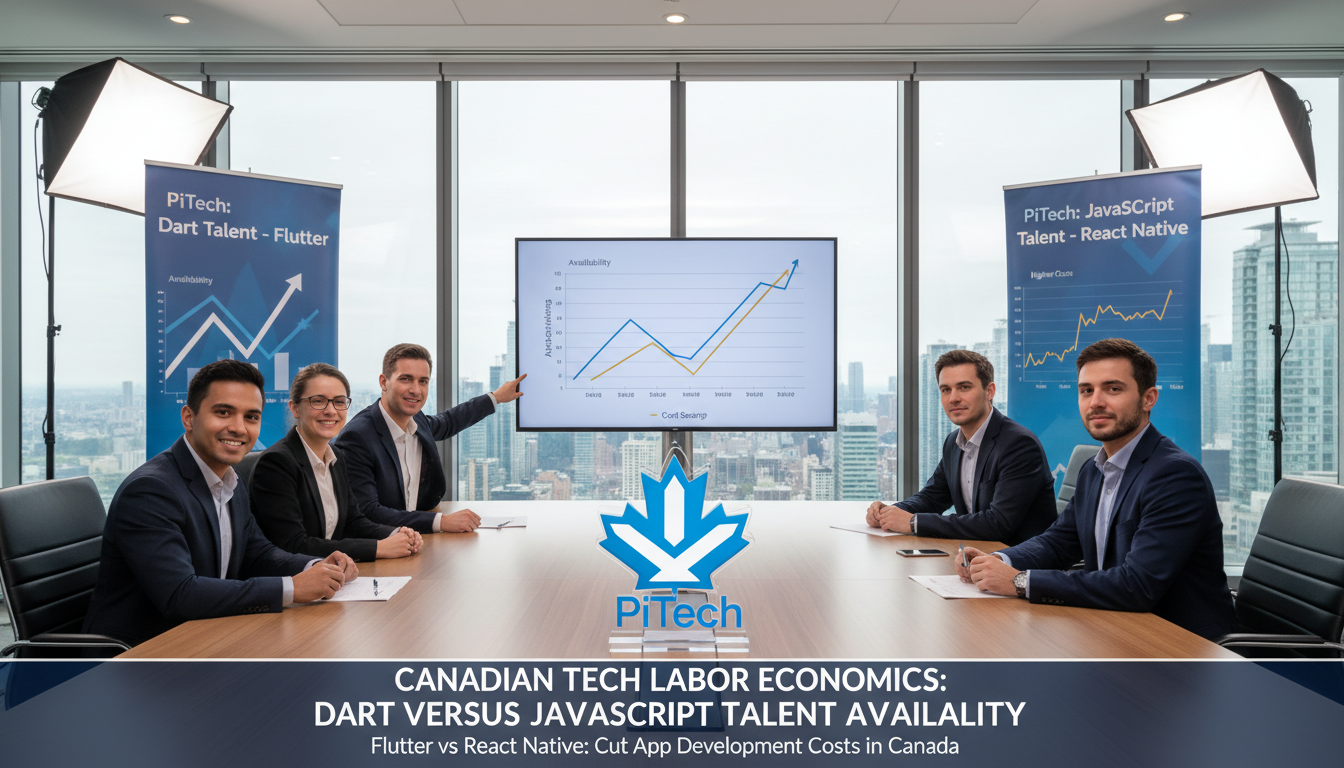
Framework performance is irrelevant if an organization cannot hire qualified developers to build, maintain, and scale the application within domestic borders. The hourly developer billable rate across Ontario, British Columbia, Alberta, and Quebec fluctuates widely between junior freelancers and specialized software consultancies. Understanding talent market liquidity is essential for predicting overall mobile app development cost canada.
```
++++
| Region | Avg. RN Dev Rate | Avg. Flutter Dev Rate |
| | (CAD / Hour) | (CAD / Hour) |
++++
| Toronto / GTA | $95 - $165 | $105 - $175 |
| Montreal | $85 - $145 | $90 - $155 |
| Vancouver | $95 - $160 | $100 - $170 |
| Calgary / Remote | $80 - $135 | $85 - $145 |
++++
```
How the Canadian JavaScript Pool Gives React Native a Hiring Advantage
JavaScript and TypeScript remain the dominant languages across the Canadian software engineering landscape. Web developers across Canada build enterprise frontends with React, meaning the domestic talent pool for React Native is structurally larger and more liquid than any competing mobile ecosystem. When a business engages a react native agency canada or attempts to build an internal product team, the recruiting timeline is consistently shorter.
This talent fungibility generates direct cost efficiencies:
* Existing in-house web engineers who understand React state primitives, hooks, and virtual DOM concepts can transition into mobile application development with minimal onboarding overhead.
* The abundant supply of intermediate and senior TypeScript developers exerts downward pressure on average compensation packages compared to niche mobile language specialists.
* Canadian organizations can deploy unified full-stack engineering pods where developers manage Next.js web applications, Node.js backend microservices, and React Native client applications simultaneously.
* Offboarding and turnover risks are substantially mitigated because replacement candidates can be sourced rapidly from major tech clusters like Toronto, Montreal, and Vancouver.
For enterprises seeking long-term operational resilience, React Native's alignment with TypeScript delivers lower recruitment friction, reduced developer onboarding costs, and predictable labor budgeting.
The True Cost of Recruiting Flutter and Dart Specialists in Canadian Tech Hubs
Flutter relies on Dart, an object-oriented, class-based programming language developed by Google. While Dart's syntax is intuitive for developers with backgrounds in Java, C#, or modern Swift, the number of dedicated, enterprise-ready Dart engineers located physically within Canada remains noticeably smaller than the JavaScript workforce. Consequently, companies pursuing flutter app development canada must account for higher talent acquisition premiums or plan for internal upskilling programs.
Recruiting specialized senior Flutter engineers in the Toronto-Waterloo corridor or Vancouver often commands an hourly premium of ten to twenty percent over comparable React Native developers. When sourcing domestic contract talent, specialized Flutter developers frequently charge between 105 CAD and 175 CAD per hour, driven by limited local market supply. If an organization chooses to hire web developers and cross-train them in Flutter, it must budget for three to five weeks of reduced velocity while the team masters Dart idioms, the widget lifecycle, and Flutter-specific state management libraries like Bloc, Riverpod, or Provider.
However, this talent limitation is counterbalanced by developer productivity. Once an engineering team achieves fluency in Flutter, feature throughput often surpasses that of React Native teams, particularly when constructing visually intricate user interfaces from scratch.
Time to Market Benchmarks: The First 100 Days from Wireframe to App Store Deployment
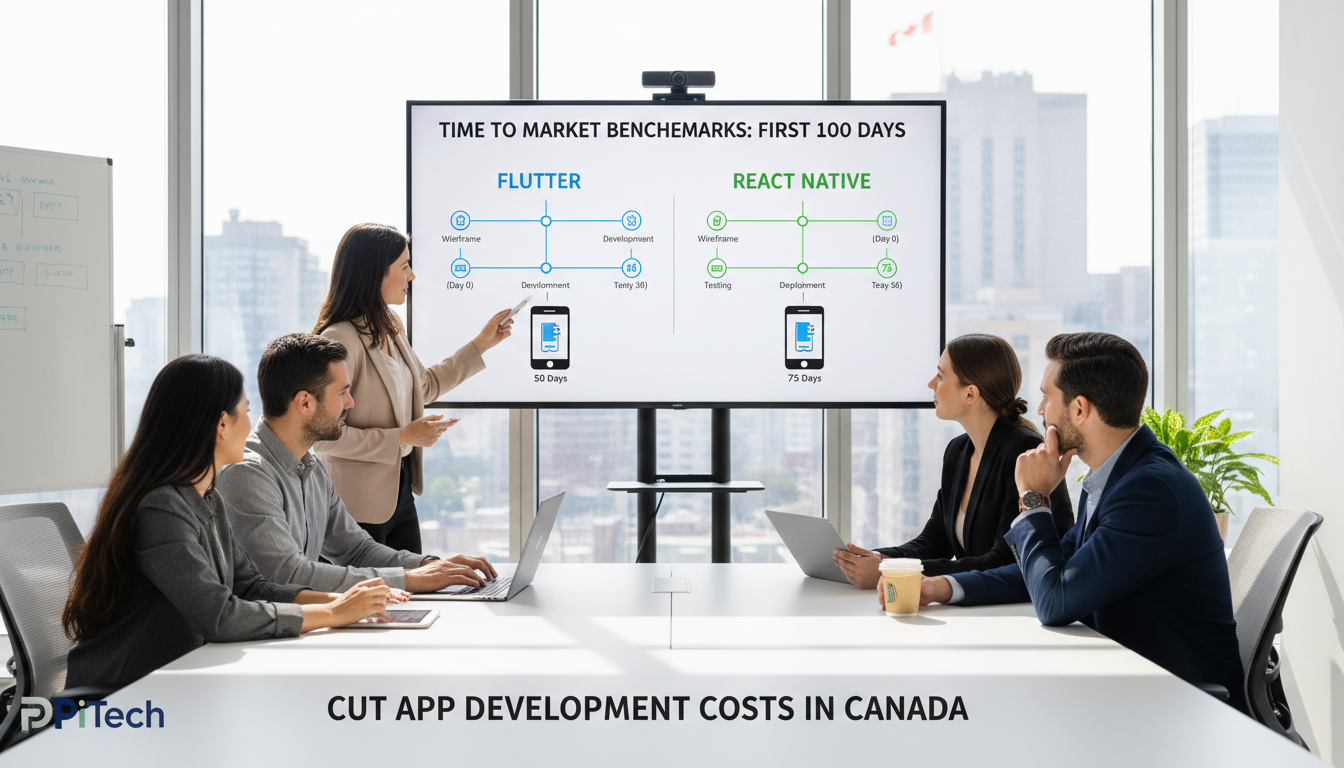
Launching an application rapidly protects operational runway and accelerates market feedback loops. The first one hundred days of an engineering initiative determine whether a company validates its commercial hypotheses or drains its development budget on low-level infrastructure setup.
```
++
| FIRST 100 DAYS VELOCITY BENCHMARK |
++
| Day 1 - 30: UI Foundations & Scaffolding |
| - Flutter: Comprehensive native widget set (High Velocity) |
| - React Native: Third-party UI assembly (Moderate Velocity) |
| |
| Day 31 - 70: Business Logic & Hardware Integration |
| - Flutter: Consistent cross-platform rendering (Predictable) |
| - React Native: Rapid sharing of web code (Fast if React web) |
| |
| Day 71 - 100: Device QA, OS Parity & App Store Review |
| - Flutter: Deterministic layout testing (Low QA cycle count) |
| - React Native: Platform-specific UI tweaking (Higher QA churn) |
++
```
How Flutters Pre-Compiled Widgets Accelerate Rapid MVP Prototyping
Flutter provides an exceptional zero-to-MVP development speed for greenfield applications that have no pre-existing codebase. Because Flutter controls every pixel rendered on the screen via its own rendering pipeline, it avoids the styling inconsistencies between Android and iOS that frequently complicate mobile development. Google ships Flutter with an extensive, thoroughly documented library of Material Design and Cupertino widgets out of the box.
Engineers do not need to stitch together disparate, unmaintained third-party open-source libraries to construct basic user interface components like date pickers, navigation drawers, bottom sheets, or interactive charts. Everything is available in the core framework, thoroughly tested and optimized. Furthermore, Flutter’s stateful Hot Reload feature allows developers to modify source code and view changes instantly on emulators or physical devices without losing application state. This reduces user interface iteration cycles from minutes to seconds, directly trimming the billable hours required to build out complex user journeys.
For Canadian startups racing against funding deadlines to launch an initial product, Flutter reliably delivers a polished, multi-platform minimum viable product with twenty to thirty percent less initial frontend engineering effort.
Accelerating React Native Velocity by Reusing Existing React Web Logic
While Flutter excels at greenfield UI creation, React Native accelerates development timelines through direct business logic reuse when an organization already maintains an existing React web platform. If your company operates a web portal built on modern React, your engineering team has already authored, tested, and optimized data validation routines, authentication flows, Redux or Zustand state stores, and REST or GraphQL API interaction layers.
```
Existing React Web Application:
[API Layer] > [Zustand Store] > [Form Validation] > [React DOM]
|
Reused in React Native (Shared Core Logic): |
[API Layer] > [Zustand Store] > [Form Validation] > [Native Views]
```
By leveraging React Native, cross platform app developers can share between forty and seventy percent of this pre-existing TypeScript code directly with the mobile application. Developers import production-tested business rules straight into the mobile repository, avoiding the need to re-write API consumers or reimplement complex data transformation algorithms. For companies with substantial React web codebases, this code reusability can cut weeks off early development, neutralizing Flutter’s UI prototyping advantages.
Total Cost of Ownership: Hidden Maintenance Invoices Over a 24 Month Lifecycle
The upfront development contract covers only the beginning of software expenditures. Over a two-year production lifecycle, applications face annual iOS and Android operating system upgrades, third-party dependency updates, performance tuning, and compliance revisions. Calculating the real return on investment requires evaluating the hidden maintenance costs inherent to both frameworks.
```
++
| 24-MONTH MAINTENANCE OVERHEAD PROFILE |
++
| React Native: |
| Bridge/JSI Migrations [===========] |
| Dependency Drift [=================] |
| OEM UI Adaptations [======] |
| |
| Flutter: |
| Engine Updates [======] |
| Bundle Optimization [=========] |
| Non-Native UI Fixes [============] |
++
```
React Native Architecture Evolution and Third Party Dependency Risks
Historically, React Native's primary maintenance liability was its asynchronous JavaScript bridge. The bridge serialized data into JSON strings to pass messages between the JavaScript thread and the native platform thread. Heavy animations, scroll events, or high-frequency data streams often caused dropped frames, unpredictable lag, and expensive native bridge debugging cycles.
Meta's New Architecture resolves these issues by deprecating the legacy bridge in favor of the JavaScript Interface (JSI). JSI allows JavaScript to invoke methods directly on native C++ objects without serialization overhead, unlocking native-level runtime speeds.
However, this transition introduces architectural churn:
* Legacy open-source packages that have not updated to support TurboModules and Fabric components can trigger runtime crashes or build failures during major framework upgrades.
* Upgrading a React Native application through major version jumps historically requires careful dependency auditing, manual native build configuration adjustments in Xcode and Gradle, and regression testing across devices.
* Teams often depend on disparate third-party libraries for native device capabilities like Bluetooth, camera access, or biometric sensors, which increases the risk of unmaintained packages breaking after annual iOS and Android releases.
These architectural migrations translate directly into engineering maintenance bills. Organizations retaining a react native agency canada must budget for quarterly dependency maintenance sprints to ensure ongoing compliance with Apple App Store and Google Play requirements.
Flutters Canvas Rendering Engine Versus Native OS Upgrades
Flutter approaches mobile rendering differently than React Native. Instead of mapping to underlying native platform UI components (such as `UIView` on iOS or `android.view.View` on Android), Flutter ships with its own rendering engine (Impeller on modern iOS and Android runtimes, with legacy Skia fallbacks). It draws its own interface on a custom canvas provided by the operating system.
This rendering architecture provides distinct commercial maintenance advantages:
* When Apple or Google pushes a major operating system update that tweaks native component padding, typography styles, or layout behaviors, Flutter applications remain visually stable. The interface executes deterministically, eliminating the layout regressions that frequently disrupt React Native views after system updates.
* Quality assurance cycles following major OS updates are substantially shorter because visual rendering logic is decoupled from platform UI primitives.
* Cross-device consistency is absolute. A button or input field rendered on an older Android device displays identically on the latest iPhone, dramatically reducing time spent on device-specific layout adjustments.
However, this autonomy introduces its own maintenance costs. When Apple or Google introduces brand-new native user interface behaviors, gestures, or dynamic system widgets (such as Apple's Dynamic Island or Android's predictive back gestures), Flutter does not inherit them automatically. The Flutter engineering team or the application's developers must build or backport those interaction patterns manually.
Furthermore, Flutter engines require a baseline binary overhead, meaning compiled application packages are generally larger than comparable React Native builds. This necessitates extra optimization effort if minimizing initial download size over cellular connections is a core performance metric.
The Canadian Executive Decision Matrix: Selecting Your Mobile Stack
Selecting the optimal framework requires matching your corporate strengths, operational priorities, and technical prerequisites against framework characteristics. Review this evaluation matrix to assess which ecosystem provides the lowest total cost of ownership for your specific deployment:
```
++++
| Strategic Evaluation | Flutter Advantage | React Native |
| Metric | | Advantage |
++++
| Greenfield Time to MVP | High (Pre-built UI) | Moderate |
| Logic Sharing with Web | Low (Dart on web is | High (Shared React / |
| | niche) | TypeScript code) |
| Canadian Talent Supply | Moderate (Growing) | High (Massive JS pool)|
| Native Device IO Needs | Moderate (Plugins) | High (C++ JSI/Native) |
| UI/UX Determinism | Superior (Canvas-led) | Good (OEM Dependent) |
| Long-Term Portability | Dart Vendor Lock-in | Portable Business |
| | | Logic |
++++
```
Scenario A: When Flutter Cuts Costs Faster
Flutter is the mathematically superior financial choice when:
- The application requires a highly customized, branded design language. If your design team produces an unconventional user experience with bespoke micro-interactions, smooth brand animations, and proprietary interface layouts, Flutter builds it in less time. Because Flutter renders directly to its own canvas, building unique interfaces requires significantly less effort than forcing native platform components to mimic non-standard layouts.
- You are launching a greenfield initiative without an existing React codebase. When starting from an empty repository, Flutter’s complete suite of pre-packaged components enables an agile product team to construct functional, production-ready interfaces rapidly without assembling dozens of fragmented third-party libraries.
- Cross-device predictability is your primary quality metric. If your testing budget cannot support exhaustive multi-device hardware labs to identify subtle platform rendering differences, Flutter’s deterministic UI engine eliminates thousands of dollars in exploratory QA and visual bug patching.
- Target verticals include automotive, industrial IoT, or digital kiosks. Flutter compiles down to machine code across desktop, mobile, and embedded hardware platforms, making it ideal for unified systems spanning touchscreens, tablets, and companion mobile applications.
Scenario B: When React Native Cuts Costs Faster
React Native is the more cost-effective option when:
- Your enterprise runs a modern web ecosystem built with React. The ability to share TypeScript interfaces, state management architectures, network layers, and developer mindshare across web and mobile platforms delivers compounding organizational cost savings that Flutter cannot match.
- You want to protect against talent scarcity and maintain agile staffing. If you operate in Canadian tech markets and plan to scale an internal engineering department without paying specialist premiums, React Native gives you access to the largest software developer pool in North America.
- The application depends heavily on native platform integrations and hardware accessories. If your roadmap requires continuous integration with native platform APIs, Bluetooth low-energy peripherals, custom audio processors, or advanced biometric authentication, React Native’s JSI architecture makes communicating with native Swift and Kotlin modules straightforward.
- Enterprise technology longevity is a vital governance requirement. In the event of a framework pivot, business logic written in modular TypeScript can be adapted to other runtime environments with minimal refactoring. Conversely, migrating away from Flutter requires rewriting the application from Dart into another language.
Sector-Specific Realities Across Key Canadian Industries
Different economic sectors inside Canada face distinct regulatory frameworks, device ecosystems, and operational parameters that tilt the cost equation toward one platform over the other.
```
++
| CANADIAN INDUSTRY ALIGNMENT OVERVIEW |
++
| FinTech & Wealth Management (Payments, PCI, Biometrics): |
| -> Lean: React Native (Broad auditability, deep native tooling) |
| |
| HealthTech & Telehealth (PIPEDA compliance, Custom UI flows): |
| -> Lean: Flutter (Consistent cross-device UX, rapid clinic MVPs) |
| |
| Omnichannel Retail & E-Commerce (Shopify integrations, Web par): |
| -> Lean: React Native (Direct alignment with modern web stacks) |
| |
| Natural Resources, Logistics & Field Ops (Ruggedized hardware): |
| -> Lean: Flutter (Deterministic offline-first canvas rendering) |
++
```
Canadian FinTech and Wealth Management
Fintech firms operating in Toronto, Calgary, and Montreal must balance intuitive consumer interfaces with rigorous security controls, including biometric authentication, secure hardware keychains, and automated fraud-detection telemetry. React Native holds an advantage in this sector due to its deep penetration among leading global financial platforms and major domestic market champions.
Because financial applications lean heavily on native platform security APIs, React Native's modular native integration simplifies internal security reviews and vulnerability scans. When enterprise teams require custom mobile application canada solutions that interface with legacy banking cores, the ability to hire senior engineers experienced with TypeScript and native code bridging reduces security compliance timelines.
Telehealth and HealthTech Under PIPEDA Regulations
Healthtech platforms managing secure medical records, patient data collection, and remote appointments across provinces must comply with the Personal Information Protection and Electronic Documents Act (PIPEDA) as well as provincial regulations like Ontario's PHIPA. These applications often prioritize accessible, consistent user interfaces that function identically across older, low-cost smartphones used by patients as well as high-end provider hardware.
Flutter’s canvas-driven rendering architecture makes it a powerful option for medical interfaces that require absolute visual consistency across different devices. A clinical monitoring tool, prescription portal, or diagnostic survey rendered via Flutter behaves predictably across fragmented Android models, reducing post-launch compliance validation and layout QA expenditures.
Omnichannel Retail and E-Commerce
Retail and consumer brand operations headquartered across Canada often anchor their commerce infrastructure in ecosystem leaders like Shopify. Shopify has invested heavily in React Native, migrating its primary merchant mobile surfaces to the framework and open-sourcing libraries like FlashList to optimize list virtualization performance.
For Canadian retailers building customer loyalty applications, the alignment between React-driven web storefronts (Headless Shopify, Hydrogen, Next.js) and React Native creates massive operational efficiencies. Development teams can share design tokens, cart validation logic, checkout flows, and analytics tracking libraries between the web storefront and the iOS and Android applications. This shared foundation slashes multi-channel maintenance overhead significantly.
Step-by-Step Framework Selection Checklist for Product Leaders
Before approving an engineering capital budget, technical and financial leadership should complete this pragmatic evaluation exercise:
```
[Step 1: Codebase Audit]
Do you maintain a production React web asset?
├── YES ──> +2 Points React Native
└── NO ──> +1 Point Flutter
[Step 2: UI/UX Assessment]
Does the product feature bespoke, non-native design elements?
├── YES ──> +2 Points Flutter
└── NO ──> +1 Point React Native
[Step 3: Staffing Strategy]
Are you building an internal team in Canada vs. using a managed partner?
├── In-House Team ──> +2 Points React Native (Labor Liquidity)
└── Managed Partner ──> Neutral (Stack selected by partner competency)
[Step 4: Native Hardware Footprint]
Does the app rely on specialized Bluetooth, background sync, or low-level OS APIs?
├── Deep Native Hardware ──> +2 Points React Native (JSI Architecture)
└── Standard REST/GraphQL ──> +1 Point Flutter
```
Total your points to identify your baseline framework alignment. If your requirements fall in the middle, your decision should prioritize your primary commercial constraint: speed to initial market validation (favoring Flutter) versus long-term developer availability and code reuse across web properties (favoring React Native).
Avoiding Common Cross-Platform Development Pitfalls
Selecting the right framework is only half the battle; managing implementation risks prevents unbudgeted capital burn. Many engineering initiatives suffer cost overruns not because of fundamental framework flaws, but due to avoidable architectural missteps.
The most common trap is the native bridge fallacy. When engineering teams build a cross-platform application, junior developers may rely on unvetted third-party plugins for minor native features like fetching device battery levels or playing simple audio notifications. Over time, the project accumulates dozens of abandoned dependencies. When iOS or Android rolls out a major platform update, these unmaintained wrappers fail to compile, forcing costly emergency refactoring sprints. Engineering teams must establish a strict dependency policy: build light native integrations directly in-house using platform channels or JSI, and only adopt third-party libraries that have active community backing and proven test coverage.
A second common risk is neglecting platform-specific UX guidelines. While Flutter simplifies cross-platform visual consistency, forcing an identical interface onto both platforms can confuse end users. iOS users expect specific swipe-to-back navigation dynamics and navigation bar button placements; Android users expect predictable back button handling and standard Material drawer behavior. Cross-platform developers must deliberately architect navigation stacks and input handling to respect platform norms. Failing to do so increases user friction, degrades app store ratings, and demands costly UX redesigns after release.
```
++
| TECHNICAL DEBT PREVENTION WORKFLOW |
++
| 1. Dependency Vetting: Audit update cadence, issues, and authors |
| 2. Modular Native Access: Encapsulate OS-level APIs cleanly |
| 3. Automated CI Regression: Test both platforms on physical rigs |
| 4. UX Platform Guardrails: Adhere to Human Interface & Material |
++
```
How PiTech Accelerates Cross-Platform Application Delivery
Navigating the financial, architectural, and operational trade-offs between Flutter and React Native requires practical production experience across complex deployments. PiTech operates as a specialized Canadian engineering partner, helping scaling businesses, mid-market organizations, and digital innovators design and deploy cost-efficient mobile solutions that de-risk capital investment.
Our engineering and consulting teams support organizations at every stage of the mobile product lifecycle:
* Architectural Audits and Feasibility Assessments: We evaluate your target product specifications, existing codebases, performance requirements, and domestic hiring goals to deliver an objective framework recommendation tailored to your budget constraints.
* Full-Lifecycle Cross-Platform Engineering: We provide end-to-end delivery of high-performance mobile products utilizing both Flutter and React Native. Our teams design intuitive, brand-aligned user experiences and engineer secure, maintainable code architectures that reduce long-term operational costs.
* Enterprise Backend and Cloud Integration: We connect cross-platform mobile clients with resilient enterprise backends, building out custom cross-platform software that links mobile interfaces to scalable cloud environments, secure databases, and modern APIs.
* Modernization and Codebase Remediation: If an existing hybrid application is suffering from technical debt, sluggish performance, or broken legacy bridges, we conduct deep code audits to stabilize dependencies and optimize runtime speed.
* AI-Enabled Business Architecture: For organizations modernizing operations, our engineers integrate AI-driven operational workflows directly into mobile client applications, unlocking automated data processing, on-device intelligence, and responsive customer interactions.
```
++
| THE PITECH ACCELERATION MODEL |
++
| [Discovery & Stack Feasibility] |
| └── Labor Cost Modelling & Platform Architecture Selection |
| |
| [Iterative Sprint Delivery] |
| └── Pre-built Component Blueprints & Test-Driven Development |
| |
| [Unified Digital Ecosystem Integration] |
| └── Scalable Cloud, Web Parity, and AI-Driven Workflows |
++
```
Whether you need enterprise mobile application development to launch a new product line or want to optimize an existing multi-platform application, PiTech provides the technical leadership and execution speed needed to build reliable software while protecting your financial runway. Explore our work in scalable digital product architecture to see how our engineering teams help businesses ship faster and operate more efficiently.
Strategic Verdict: Which Framework Cuts Costs Faster?
When evaluating which framework cuts Canadian development costs faster, the answer depends on your time horizon:
* Flutter cuts costs faster during the initial launch phase (Months 1-6). If your priority is building a greenfield application from the ground up, proving user traction, and delivering a visually engaging, custom-designed mobile product on a lean budget, Flutter's comprehensive built-in widget ecosystem and unified rendering engine deliver the fastest time-to-market. It slashes early frontend development and visual QA hours more effectively than any other solution.
* React Native cuts costs faster over a multi-year corporate lifecycle (Months 6-36). If your business already owns a React web ecosystem, employs TypeScript engineers, or values hiring flexibility within the Canadian developer talent market, React Native delivers a lower total cost of ownership over time. Its code sharing with web systems, large talent pool, and evolving JSI architecture make it a stable, cost-effective foundation for ongoing enterprise growth.
By assessing your existing technical foundation, user interface requirements, and domestic hiring strategy, your leadership team can choose the right cross-platform framework with confidence. Making an informed decision ensures you build an application that not only reaches the market quickly, but also scales smoothly without exhausting your technology budget.
Planning your cross-platform build? Book a technical scoping session with PiTech's mobile engineering team to benchmark Flutter vs. React Native against your delivery timeline and Canadian budget constraints.
Ready to Transform Your Business?
Let PiTech help you implement these strategies with proven technology solutions.
Get StartedRelated articles
- Web Design Vancouver Cost: 2025 Agency Pricing BreakdownDiscover the real web design Vancouver cost in 2025. Explore agency pricing tiers, hidden build expenses, and an evaluation rubric for Canadian businesses.
- AI Call Center Software Canada: The Ultimate Optimization GuideDiscover how AI call center software for Canada transforms operations. Our guide covers automation, cost savings, and delivering a superior customer experience.
- Personalized Push Notifications: The Key to App Retention CanadaStruggling with low mobile app engagement? Personalized push notifications are key for app user retention in Canada's competitive market. Learn how to stop churn.
- Boost SaaS Retention: A Custom Customer Success Platform GuideDiscover how a custom customer success platform in Canada can slash churn rates and dramatically boost LTV. This guide covers features, ROI, and development.