

B2B Website UX for Canadian Manufacturing: A Growth Blueprint
A practical UX growth blueprint for Canadian manufacturers, so your B2B website attracts and converts more qualified leads.
Published
Why Read This?
This article reveals how a poor B2B website UX can cost Canadian manufacturers significant contracts, transforming your online presence from a brochure into your most critical sales and lead generation tool. Learn why optimizing your digital front door is no longer an IT task but an essential business growth strategy to attract today's digital-native buyers and secure future success.
Table of Contents
22 sections
Table of Contents
22 sections
A project engineer for a major Canadian aerospace firm sits in a remote northern facility, tablet in hand, tasked with sourcing a new line of custom-machined components. She lands on your company’s website. The page takes ten seconds to load. The menu is a confusing jumble of acronyms. Finding technical specifications requires downloading a massive, poorly scanned PDF. Frustrated, she hits the back button and within three clicks finds a competitor’s site with a fast, intuitive interface, interactive 3D models, and a simple “Configure & Quote” button. You just lost a six-figure contract, and you don’t even know it.
This scenario is not a hypothetical future; it is the daily reality of B2B commerce in Canada’s industrial sector. For decades, the strength of a manufacturing business was measured by its machinery, its supply chain, and the handshakes of its sales team. Today, a new, critical asset has taken center stage: the digital user experience (UX) of your website. Your online presence is no longer a digital brochure; it is your perpetually open sales office, your primary lead generation engine, and the first impression you make on a new generation of digital-native B2B buyers. Optimizing your B2B website UX for Canadian manufacturing is not an IT project, it is a fundamental business growth strategy.
Why Your Digital Front Door Matters More Than Ever in Canadian Manufacturing
The traditional B2B sales model in manufacturing, reliant on trade shows, cold calls, and established relationships, is undergoing a seismic shift. This digital transformation in Canadian manufacturing is not a choice, but a response to powerful market forces. Today's B2B buyer, whether a procurement manager, engineer, or operations director, now conducts the majority of their preliminary research online before ever speaking to a salesperson. They expect the same seamless, informative, and efficient digital experience they get in their consumer lives.
A website that fails to meet these expectations actively harms your business. It creates friction, erodes trust, and sends highly-qualified prospects directly to your competitors. Conversely, a strategically designed website becomes a competitive advantage. It functions as a tireless sales development representative, answering questions, qualifying leads, and nurturing prospects 24/7. In a landscape where Canadian manufacturers are grappling with global competition and the need for greater efficiency, leveraging your digital assets is the most direct path to sustainable growth and market leadership. Your website is no longer just marketing overhead; it's a core component of your sales infrastructure.
Redefining the User Journey for the Modern Industrial Buyer
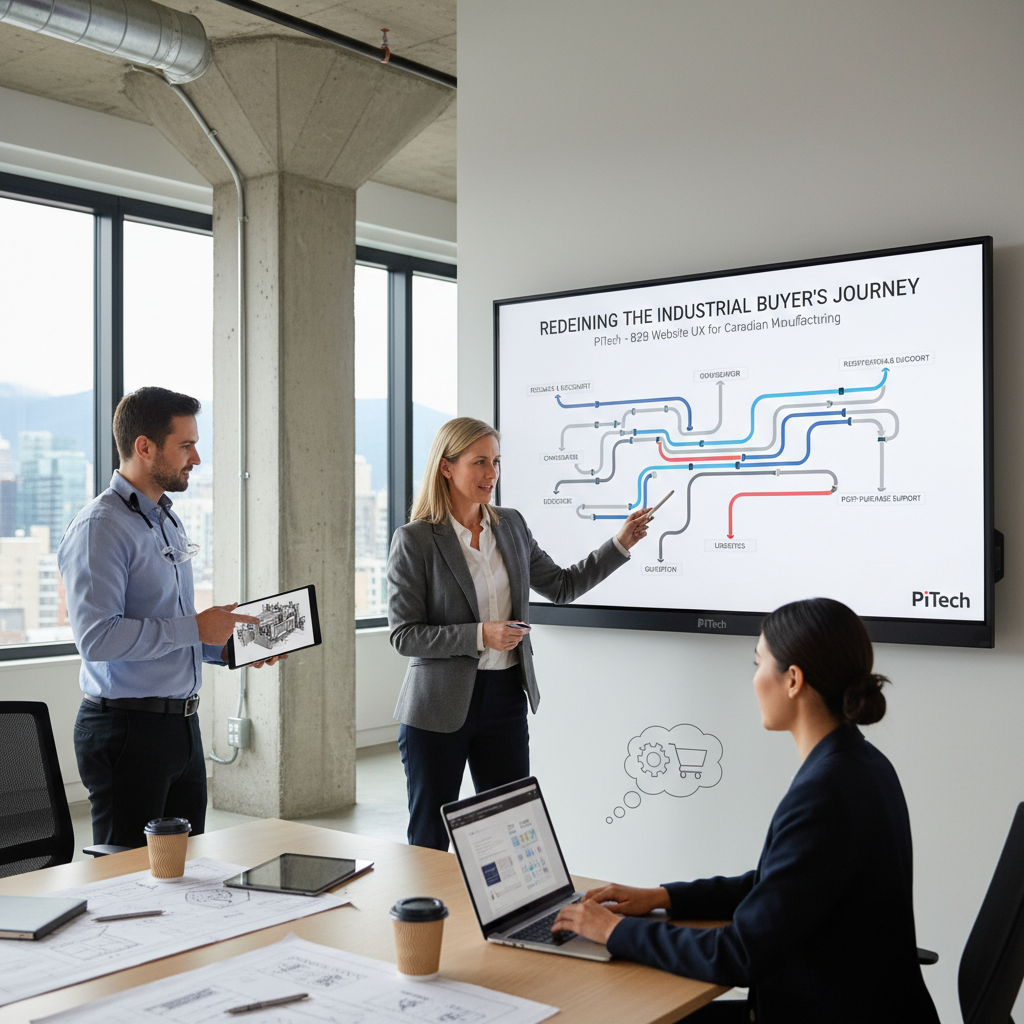
To design a website that converts, you must first abandon the outdated "build it and they will come" mindset. Instead, you need to deeply understand and map the journey your specific buyers take. This involves thinking less like a manufacturer and more like a problem-solving partner for your clients.
Mapping the B2B Manufacturing Buyer's Path from Awareness to Purchase
The industrial buyer journey is complex and non-linear. It involves multiple stakeholders with different needs, from the engineer focused on specs to the procurement officer focused on cost and logistics. A successful industrial web design in Canada must cater to these diverse personas at every stage.
* Awareness: At this stage, the buyer is identifying a problem or a need. They are using broad search terms like "custom metal fabrication services Ontario" or "aerospace component suppliers Canada." Your content must be optimized to appear in these searches, offering educational blog posts, industry reports, or high-level guides that establish your expertise.
* Consideration: The buyer is now researching specific solutions. They are comparing vendors and digging into capabilities. This is where your website's UX is truly tested. They need to easily find detailed service pages, case studies demonstrating your past work, and transparent information about your processes and certifications (e.g., ISO, AS9100).
* Decision: The buyer is ready to engage. They are looking for clear pricing signals, an easy way to request a quote (RFQ), and direct contact information. Friction at this stage is fatal. A confusing RFQ form or a hidden phone number can immediately disqualify you from the shortlist.
Your website's architecture must guide users through this journey. Intuitive navigation and clear information hierarchy are not just design niceties; they are essential tools for moving a prospect from initial curiosity to a qualified sales lead.
How to Build Trust Digitally Before the First Sales Call
In the B2B world, trust is the ultimate currency. Before a company commits to a significant purchase order, they need to believe in your capability, reliability, and quality. Your website is the first and most critical touchpoint for building this trust.
First, professionalism in design is non-negotiable. An outdated, slow, or broken website signals a lack of investment and attention to detail, leading buyers to question your operational standards. A modern, clean, and responsive design conveys competence and credibility.
Second, transparency is key. Don't hide your process. Use your website to showcase your facility with high-quality photos and videos. Feature your team and their expertise. Clearly list your certifications, quality control processes, and industry partnerships. This openness demystifies your operations and builds confidence. Case studies and testimonials are powerful trust signals, providing social proof that you deliver on your promises for clients in relevant industries.
Foundational Elements of High-Converting B2B Manufacturing UX
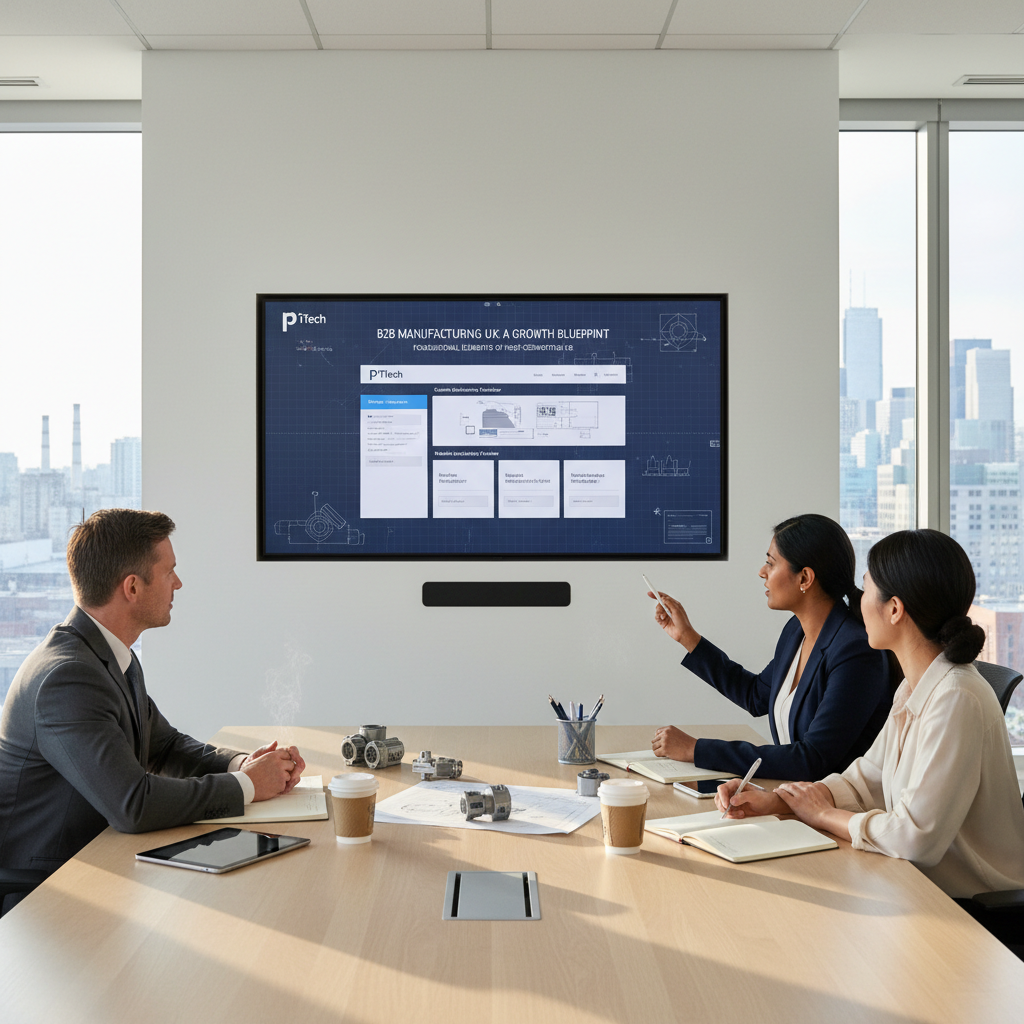
A high-performance manufacturing website is built on a foundation of user-centric principles. Overlooking these core elements is like building a state-of-the-art factory on unstable ground. Ensuring these fundamentals are in place is the first step in any successful website optimization for Canadian manufacturing.
Mastering Navigation: From Complex Product Catalogs to Simple RFQs
For many manufacturers, the sheer breadth and complexity of their product or service offerings present a major UX challenge. The goal is to make the complex simple without losing critical detail. Your navigation should be built around user intent, not your internal organizational chart.
Avoid generic menu labels like "Services." Instead, use descriptive, user-focused language like "CNC Machining," "Sheet Metal Fabrication," or "Custom Solutions." A key strategy is to offer multiple paths to the same information. For example, a user should be able to find a specific component by navigating through "Products," by its application in "Industries Served," or by searching its part number. A well-implemented mega-menu can be highly effective, allowing you to present a large number of options in an organized, visual hierarchy without overwhelming the user. Finally, your "Request a Quote" or "Contact Us" call-to-action should be persistently visible in the main navigation, ensuring a prospect can take action from any page on your site.
The Critical Role of Mobile-First Design for Field Sales and On-Site Engineers
The idea that B2B decisions are only made from a desk is dangerously outdated. Today’s industrial professionals are constantly on the move. An engineer on the factory floor might need to pull up a spec sheet on their phone. A field sales representative might need to show a client a case study on a tablet. A CEO might review potential suppliers on their phone while traveling.
If your website is not designed with a mobile-first approach, you are alienating a significant and influential portion of your audience. Mobile-first design means more than just having a site that shrinks to fit a smaller screen. It means re-thinking the user experience for the mobile context. This includes large, easy-to-tap buttons, simplified forms, vertically-oriented content, and click-to-call phone numbers. Every piece of content and every function must be just as accessible and usable on a 6-inch screen as it is on a 24-inch monitor. In the modern Canadian manufacturing web strategy, mobile is not an afterthought; it is the starting point.
Why Website Speed and Performance Are Non-Negotiable for Lead Generation
In the digital world, speed equals trust and quality. Study after study shows a direct correlation between page load time and conversion rates. A slow website is one of the fastest ways to lose a potential lead. B2B buyers are busy professionals; they will not wait for slow-loading images, complex scripts, or unoptimized resources.
Website performance is particularly critical for manufacturers, who often need to display high-resolution images, detailed CAD files, and extensive technical data. The challenge is to deliver this rich content without bogging down the site. This requires a concerted technical effort, including optimizing images, leveraging modern web development frameworks, utilizing content delivery networks (CDNs) to serve assets from servers closer to the user in Canada, and ensuring clean, efficient code. A fast website feels professional, keeps users engaged, and directly impacts your ability to generate leads.
Showcasing Complexity with Clarity: UX Strategies for Technical Products
The core challenge for many manufacturing websites is communicating the value of highly complex, technical, or customizable products to a varied audience. Effective UX design bridges this gap, translating intricate engineering details into clear business benefits.
Leveraging Interactive 3D Models and Product Configurators
Static images and long-winded text descriptions are no longer sufficient for showcasing sophisticated machinery or custom components. The most forward-thinking manufacturers are using interactive tools to bring their products to life directly in the browser.
An interactive 3D model allows a user to rotate, zoom, and inspect a product from every angle, providing a level of understanding that a flat image or even a video cannot match. This is immensely powerful for demonstrating complex assemblies or internal components. Even better is a product configurator. This tool allows a user to select different options, materials, finishes, and specifications, seeing the product update in real-time. This not only creates a highly engaging experience but also serves as a powerful qualification tool. The user-configured product can be submitted directly with an RFQ, providing your sales and engineering teams with precise requirements from the very first interaction. This one feature can dramatically shorten sales cycles and improve quote accuracy.
Creating Technical Resource Hubs that Educate and Convert
Engineers, designers, and technical buyers are hungry for information. Position your company as an indispensable resource by building a comprehensive technical library on your website. This is a cornerstone of effective industrial digital marketing in Canada. This hub should be a central, easy-to-navigate section containing all your technical documentation.
This includes downloadable CAD files in various formats (e.g., STEP, IGES, SolidWorks), detailed spec sheets, material data sheets, performance charts, and application notes. Organizing this information logically with faceted search (allowing users to filter by product type, material, industry standard, etc.) is crucial. By providing this valuable information freely, you not only attract technical buyers but you also integrate your products into their design process early on, making you the path of least resistance when it comes to procurement.
How to Use Video and Case Studies to Demonstrate Value and Application
While technical specifications are vital, it is equally important to show your products and services in action. Video and detailed case studies are the most effective mediums for demonstrating real-world application and proving your value proposition.
Create high-quality videos that show your machinery in operation, explain a complex manufacturing process, or offer a virtual tour of your facility. These videos can be embedded on relevant product pages and in your resource hub. A well-produced case study is more than just a testimonial. It should tell a story: outline the client's problem, detail your solution, and quantify the results (e.g., "Reduced production cycle time by 15%," "Improved component strength by 25%"). By framing your capabilities within the context of a customer's success, you move from selling a product to selling a proven solution.
From Passive Brochure to Active Lead Generation Engine
The ultimate goal of your B2B website is to drive business growth. This requires a proactive approach to design that guides users toward conversion goals and seamlessly integrates with your sales processes. A successful website is an active participant in B2B lead generation for your manufacturing website.
Designing High-Impact Call-to-Action (CTA) Pathways for B2B Leads
Every page on your website should have a purpose and a clear next step for the user. A Call-to-Action (CTA) is the button or link that prompts this next step. Vague CTAs like "Learn More" or "Submit" are ineffective. Your CTAs should be specific, action-oriented, and relevant to the user's context.
For example, on a product page, the primary CTA should be "Request a Quote" or "Configure This Product." A secondary CTA might be "Download Spec Sheet" or "Watch a Demo." On a blog post about a technical challenge, the CTA could be "Download Our In-Depth Guide" or "Speak with an Engineer." Your design should use color, contrast, and placement to make these CTAs stand out. The goal is to create clear, intuitive pathways that lead every type of visitor towards a valuable conversion event.
Streamlining the Request for Quote (RFQ) Process with Smart Forms
The RFQ form is arguably the most critical conversion point on a manufacturing website. A poorly designed form is a major source of friction and lead abandonment. Your form should be as simple and intuitive as possible while still collecting the necessary information for your sales team to provide an accurate quote.
Use conditional logic to create "smart forms" that adapt based on user input. For example, if a user selects "Custom Fabrication," the form can dynamically show fields for material type and quantity. If they select a standard product, it can hide those fields. Allow users to upload files (like drawings or CAD models) directly with the form. Provide clear instructions and inline validation to prevent errors. Finally, always provide an alternative contact method, such as a prominent phone number, for those who prefer to speak with someone directly.
Integrating Your Website with CRM for Seamless Lead Nurturing
What happens after a lead fills out your RFQ form? In many organizations, it triggers a manual email chain, risking slow response times and lost information. A modern digital transformation in manufacturing connects your website directly to your Customer Relationship Management (CRM) system (like HubSpot or Salesforce).
When a lead is submitted through your website, this integration can automatically create a new contact and deal in your CRM, assign it to the correct sales representative, and log all the submitted information. It can even trigger an automated email confirmation to the prospect and an internal notification to the sales team. This automation eliminates human error, ensures rapid follow-up (a critical factor in conversion), and provides your sales team with a complete, centralized view of every lead. This seamless flow of data from your digital front door to your sales team is the hallmark of a truly optimized B2B growth engine.
An Action Plan for Canadian Manufacturing Leaders
Transforming your website from a digital brochure into a lead generation asset requires a strategic commitment. Here is a practical action plan to get started:
- Conduct a Comprehensive UX Audit: View your website through the eyes of your customers. Test it on a phone, a tablet, and a desktop. How fast does it load? Can you find technical specs in three clicks or less? Is the RFQ process simple? Identify the key points of friction.
- Prioritize Mobile and Performance: Treat your mobile site as the primary experience, not an afterthought. Invest in technical optimization to ensure your pages load in under three seconds. This is the foundation upon which everything else is built.
- Invest in Interactive Content: Move beyond static pages. Plan for the implementation of 3D models for your key products or a product configurator for customizable solutions. This is a direct investment in a better sales process.
- Redesign Your RFQ Funnel: Map out the ideal path for a user to request a quote. Simplify your forms, clarify your CTAs, and ensure the process is frictionless from start to finish.
- Integrate Your Tech Stack: Connect your website to your CRM. This single action will revolutionize your lead management process, improve sales efficiency, and provide invaluable data on your marketing ROI.
PiTech's Perspective: Your Partner in Digital Industrial Growth
The principles outlined here form a blueprint for digital success, but execution requires specialized expertise at the intersection of technology, marketing, and industrial business logic. This is where PiTech provides critical value. We don't just build websites; we engineer digital growth platforms for Canadian manufacturers. Our approach to industrial web design in Canada is holistic and results-driven.
Our team combines top-tier web development and UX design with a deep understanding of the B2B manufacturing landscape. We build websites that are not only visually professional and technically robust but are also strategically architected to drive lead generation. For clients who need to showcase complex products, our custom software development capabilities allow us to create bespoke product configurators and interactive 3D viewers that set them apart from the competition.
Furthermore, we understand that a website is a living asset. We integrate analytics and connect your site to CRM and ERP systems, creating an integrated business platform. By implementing AI-powered chatbots for instant support and leveraging data-driven SEO strategies, we ensure your digital presence consistently attracts the right audience and converts them into tangible business opportunities. At PiTech, we act as a strategic partner, helping you navigate your digital transformation and build a durable competitive advantage.
Conclusion: Building Your Future-Proof Digital Asset
The Canadian manufacturing sector stands at a crossroads. The path to future growth and resilience is undeniably digital. Your website is the most powerful tool in your arsenal to engage with the modern B2B buyer, streamline your sales process, and outmaneuver your competition. By committing to an optimized B2B website UX, you are not just updating your marketing; you are making a strategic investment in the fundamental infrastructure of your business.
From simplifying navigation and ensuring mobile-first performance to implementing interactive product showcases and integrating with your CRM, every improvement you make removes friction and builds trust. The result is a powerful lead generation engine that works for you around the clock, empowering your sales team and future-proofing your position in the market. The time to transform your digital front door from a static liability into your most valuable asset is now.
Ready to transform your B2B manufacturing website into a powerful growth engine? Request a Free UX Audit & Strategy Session from PiTech today and get a clear roadmap for digital success.
Ready to Transform Your Business?
Let PiTech help you implement these strategies with proven technology solutions.
Get StartedRelated articles
- Custom CRM for B2B Canada: Boost Your Sales Pipeline NowGeneric CRMs fail Canadian B2B firms. Learn how a custom CRM for B2B Canada addresses unique market needs, automates sales, and drives pipeline growth.
- Digital Transformation Roadmap for Canadian SMBs: A GuideOur step-by-step digital transformation roadmap helps Canadian SMBs create a winning strategy, from initial assessment to full technology integration.
- Google Shopping Ads Canada: The Ultimate E-commerce GuideUnlock e-commerce growth with our guide to optimizing Google Shopping Ads in Canada. Master product feeds, bidding, and strategy for maximum ROI and sales.
- Custom CPQ Software Canada: The Key to SaaS Sales EfficiencyDiscover how custom CPQ software in Canada solves B2B SaaS sales bottlenecks, eliminates quoting errors, and accelerates deal velocity for sustainable growth.