

AI Personalization E-commerce Canada: A Guide to Boosting Sales
Unlock sustainable growth with AI personalization for e-commerce in Canada. Our guide shows you how to transform customer experiences and boost conversions.
Published
Why Read This?
Discover how AI personalization can transform your Canadian e-commerce store from a generic shop into a tailored experience, increasing engagement and sales. Learn why a one-size-fits-all approach is costing you millions and how to leverage AI to cultivate individual customer relationships at scale for significant growth.
Table of Contents
18 sections
Table of Contents
18 sections
A shopper from Montreal and a shopper from Calgary both land on your online store. The Montrealer, a French speaker searching for a durable winter parka, has previously browsed high-end technical outerwear. The Calgarian, an English speaker looking for lightweight hiking shoes, is a first-time visitor who arrived via a blog post about trail running. A generic e-commerce site shows them both the exact same homepage: a generic "New Arrivals" banner and a mix of best-selling products. Both users click around for a minute, feel uninspired, and leave. This scenario plays out thousands of times a day, representing millions in lost revenue for Canadian businesses. Now, imagine an alternative: the Montrealer instantly sees a homepage banner in French highlighting new parkas, while the Calgarian is greeted with a "Welcome" offer on trail running gear. This is not science fiction; it is the immediate, revenue-generating power of AI-powered personalization.
For Canadian e-commerce brands, the days of a one-size-fits-all digital storefront are definitively over. The market has matured beyond the initial pandemic-driven boom, and consumers now expect, and even demand, experiences tailored to their specific needs, preferences, and browsing history. Simply having a functional website is no longer enough to compete. The businesses that are thriving are the ones that make each customer feel seen, understood, and uniquely valued. This is the core promise of AI personalization for e-commerce in Canada: leveraging intelligent technology to build individual customer relationships at scale, fostering loyalty and driving significant commercial growth in a uniquely diverse and competitive market.
The Strategic Imperative: Why E-commerce Personalization is Non-Negotiable in Canada
The Canadian digital retail landscape is at a critical inflection point. Competition is fierce, with global giants and local startups all vying for the Canadian consumer's dollar. At the same time, customer acquisition costs are rising, making customer retention more important than ever. In this environment, generic marketing blasts and uniform website experiences are increasingly ineffective, leading to high bounce rates, low engagement, and the dreaded abandoned cart.
AI-powered personalization directly addresses these challenges by shifting the focus from mass marketing to individual engagement. It enables businesses to move from simply transacting with customers to building genuine relationships. This is particularly crucial in Canada, a market characterized by its regional diversity, bilingualism (English and French), and distinct urban versus rural consumer behaviours. An AI engine can dynamically adjust language, currency, product recommendations, and even promotional offers based on a user's location, language preference, and past behaviour, creating a level of relevance that manual segmentation could never achieve. This hyper-targeting not only improves the immediate customer experience but also provides a powerful competitive moat, making it harder for rivals to lure away your loyal customers.
How AI-Powered Personalization Transforms the Canadian Customer Journey
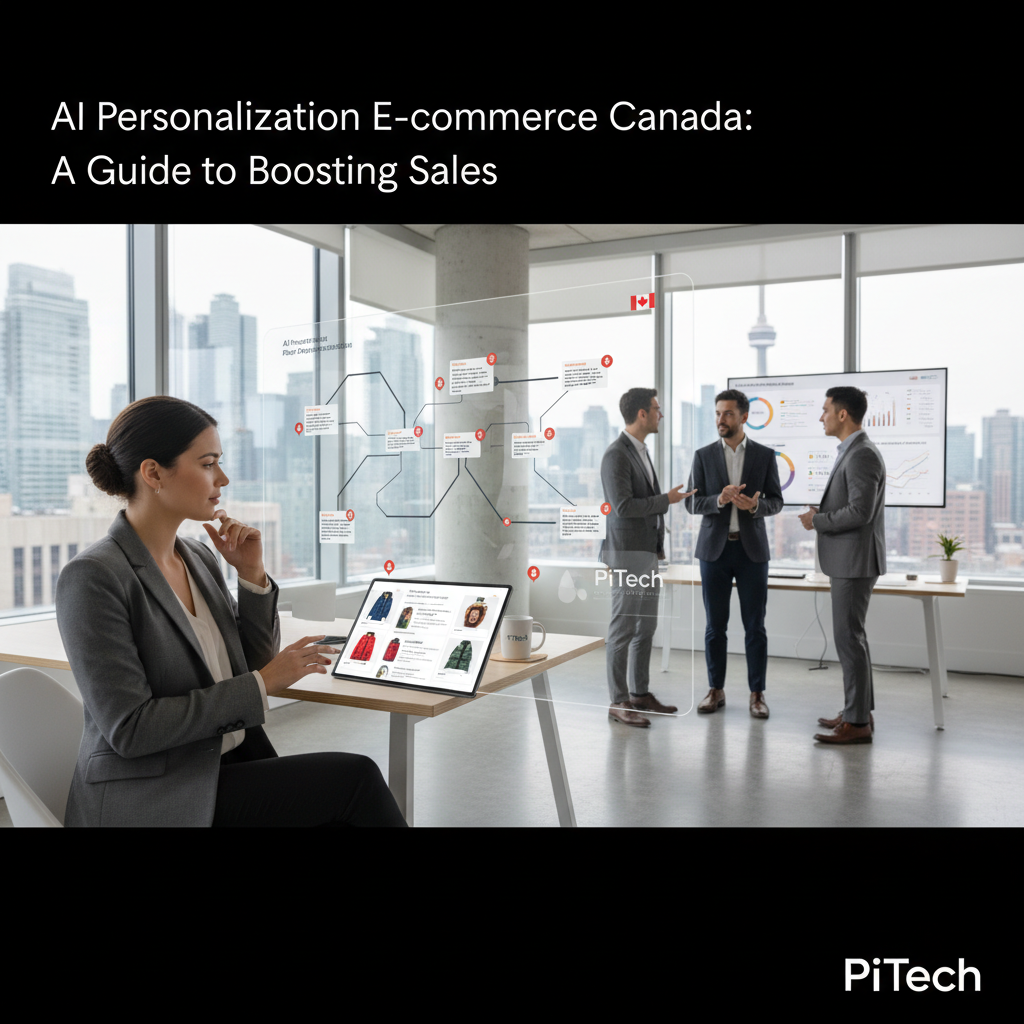
Implementing an AI personalization e-commerce Canada strategy is not just about adding a "recommended for you" carousel. It's a fundamental rethinking of the entire customer journey, embedding intelligence at every touchpoint to create a seamless, intuitive, and compelling path to purchase. From the moment a user lands on your site to the post-purchase follow-up emails, AI works behind the scenes to optimize every interaction.
Dynamic Product Recommendations That Actually Convert
Early e-commerce recommendation systems were basic, often relying on simple "customers who bought this also bought" logic. Modern AI takes this to a completely new level. By analyzing vast datasets including individual browsing history, purchase patterns, items added to cart, and even real-time behaviour like mouse movements and time spent on a page, AI algorithms can predict with startling accuracy what a customer is most likely to be interested in next. This moves beyond simple associations to uncover latent intent. For example, if a user in Edmonton purchases a high-performance ski jacket in November, the AI can infer they are a serious winter sports enthusiast and recommend compatible thermal layers, goggles, or even travel insurance for a ski trip, not just other jackets. This predictive capability massively increases the chances of upsells and cross-sells, directly boosting Average Order Value (AOV).
Personalized Content and Offers Across Your Entire Digital Funnel
Personalization extends far beyond the product grid. A powerful AI engine can dynamically alter almost any element on your e-commerce site to cater to the individual. This includes homepage banners, promotional pop-ups, and even entire content blocks. A new visitor might see a "10% off your first order" incentive, while a loyal VIP customer is shown an exclusive "early access" banner for an upcoming product launch. Furthermore, this personalization can be synchronized across channels. If a customer abandons a cart containing a specific pair of boots, your AI marketing platform can trigger an email or a social media ad a few hours later featuring those exact boots, perhaps with a small incentive to complete the purchase. This cohesive, omnichannel experience reinforces brand messaging and significantly improves marketing ROI by delivering the right message to the right person at the right time.
Intelligent Site Search That Understands User Intent
For many online shoppers, the search bar is the most important tool on a website. A poor search experience is a fast track to a lost sale. AI-powered search solutions revolutionize this interaction by moving beyond simple keyword matching to understand semantic context and user intent. These intelligent search engines can handle typos, understand synonyms (e.g., "running shoes" vs. "sneakers"), and process natural language queries. This is especially vital in the bilingual Canadian market. A user should be able to type "manteau d'hiver pour femme" and receive the same accurate results as someone searching "women's winter coat". Advanced systems can even personalize search results, prioritizing items and categories based on the user's past browsing and purchase history, ensuring the most relevant products appear first.
AI-Powered Chatbots for 24/7 Personalized Customer Service
Providing timely and helpful customer support is a cornerstone of a positive customer experience AI Canada strategy. AI-powered chatbots and virtual assistants offer a scalable solution to provide instant, 24/7 support. These are not the frustrating, simplistic bots of the past. Modern AI chatbots can integrate with your e-commerce platform and CRM to provide truly personalized assistance. They can answer common questions in multiple languages, check an order's status, process a return, and even act as personal shopping assistants. For instance, a customer could ask, "Do you have any waterproof jackets under $200 in a size medium?" The AI chatbot can parse the query, search the real-time inventory, and present the user with a curated list of matching products directly within the chat window, creating a frictionless and highly convenient shopping experience.
Navigating the Canadian Landscape: Key Considerations for Implementation

Successfully deploying AI personalization requires more than just choosing a software vendor. For Canadian businesses, it involves a strategic approach that accounts for unique regulatory, technical, and cultural factors. Ignoring these nuances can lead to ineffective implementation, compliance risks, and a failure to achieve the desired ROI.
PIPEDA and Data Privacy: Building Trust with Ethical AI
In Canada, customer data is protected by the Personal Information Protection and Electronic Documents Act (PIPEDA) and various provincial equivalents. This is not a barrier to personalization; it is a framework for doing it ethically. Trust is the currency of e-commerce, and Canadian consumers are increasingly savvy about their data privacy. Effective AI personalization depends on transparent data collection practices and obtaining clear, unambiguous consent from users. Your privacy policy should be easy to understand and clearly state what data you are collecting and how it will be used to improve their experience. The goal is to create a "value exchange": in return for sharing their data, customers receive a more relevant, convenient, and enjoyable shopping journey. Avoid "creepy" personalization tactics that use sensitive information without consent, as this can irrevocably damage brand trust and lead to significant regulatory penalties.
Choosing the Right E-commerce AI Solutions for Your Canadian Business
The market for e-commerce AI solutions in Canada is growing rapidly, offering a range of options from integrated apps on platforms like Shopify to sophisticated, standalone enterprise solutions. The right choice depends on your business size, technical expertise, and specific goals. For many small to medium-sized businesses, starting with AI-powered apps available on the Shopify App Store for recommendations or email marketing can be a low-risk way to get started. Larger enterprises may consider more robust platforms like Dynamic Yield, Braze, or Insider, which offer a full suite of personalization tools. Key factors to consider when evaluating vendors include: ease of integration with your existing tech stack (e.g., e-commerce platform, CRM, ERP), the depth and breadth of personalization capabilities, the quality of analytics and reporting, and the ability to support bilingual requirements.
Measuring the True ROI of Your AI Personalization Strategy
One of the biggest hurdles for businesses is proving the value of their investment in personalization. Attributing a sales lift directly to a personalized banner versus a general marketing campaign can be challenging. A successful measurement framework requires looking beyond top-line revenue and focusing on a specific set of KPIs that reflect the impact of a better customer experience.
Key Performance Indicators (KPIs) Beyond Conversion Rate
While boosting e-commerce conversions in Canada is a primary goal, a holistic view of success includes several other critical metrics.
* Average Order Value (AOV): Effective product recommendations and up-sells should directly increase the average amount spent per transaction.
* Customer Lifetime Value (CLV): By creating more relevant experiences, you foster loyalty and encourage repeat purchases, which significantly increases the total value a customer brings to your business over time.
* Cart Abandonment Rate: Personalizing the checkout process, offering relevant shipping options, or using timely abandoned cart reminders can dramatically reduce the number of shoppers who leave without buying.
* Customer Engagement: Track metrics like time on site, pages per session, and interaction with personalized elements. Higher engagement is a strong leading indicator of future conversions and loyalty.
* Customer Satisfaction (CSAT) / Net Promoter Score (NPS): Directly ask customers about their experience. A well-executed personalization strategy should lead to higher satisfaction scores.
A/B Testing and Attribution Models for Personalization
To isolate the impact of your AI efforts, rigorous testing is essential. Use A/B testing (or multivariate testing) to compare personalized experiences against a generic control version for a segment of your audience. For example, test a personalized homepage against the standard homepage and measure the difference in conversion rates and AOV between the two groups. This provides concrete data on what's working. Furthermore, sophisticated attribution models can help you understand which touchpoints in the personalized journey are most influential. This data-driven approach allows you to continuously refine your strategy, doubling down on tactics that deliver measurable results and optimizing those that don't.
Practical Business Takeaways for Canadian E-commerce Leaders
Embarking on an AI personalization journey can seem daunting. Here are five actionable steps to guide your strategy and ensure a successful implementation:
- Unify Your Customer Data: AI is only as good as the data it's fed. Before you invest in any tool, work on breaking down data silos. Your goal is a single, unified view of each customer that combines data from your e-commerce platform, CRM, email service, and any other touchpoints.
- Start with High-Impact Areas: You don't need to personalize everything at once. Begin with the low-hanging fruit that offers the highest potential return. Implementing an advanced product recommendation engine or an AI-powered abandoned cart email sequence are often excellent starting points.
- Prioritize Ethical and Compliant Data Use: Make PIPEDA compliance a cornerstone of your strategy, not an afterthought. Be transparent with your customers about how you're using their data to create a better experience. Build trust first.
- Choose Integrated, Scalable Tools: Select AI solutions that integrate seamlessly with your core e-commerce platform (like Shopify, Magento, or WooCommerce). This minimizes technical headaches and ensures data can flow freely between systems. Think about your future needs and choose a platform that can scale with your business.
- Adopt a Mindset of Continuous Optimization: AI personalization is not a "set it and forget it" project. It's an ongoing process of testing hypotheses, analyzing results, and refining your algorithms and tactics to constantly improve the customer experience and drive better business outcomes.
From Strategy to Execution: How PiTech Enables AI-Powered Growth
Understanding the potential of AI is the first step; implementing it effectively is the next. Many Canadian businesses face the challenge of limited in-house technical expertise or find that off-the-shelf solutions don't perfectly align with their unique workflows and customer base. This is where a strategic technology partner becomes invaluable. At PiTech, we bridge the gap between AI strategy and real-world execution for Canadian e-commerce businesses.
Our approach is built on a deep understanding of both advanced technology and the specific nuances of the Canadian market. We don't just sell software; we build integrated growth engines. This can involve developing custom AI personalization modules that integrate directly with your existing systems, creating a solution perfectly tailored to your business logic. We specialize in building integrated business platforms, connecting your e-commerce storefront with CRM, analytics, and marketing automation tools to create the unified data foundation essential for powerful personalization.
Furthermore, our expertise in web design and development ensures that your online store is architected from the ground up to support dynamic, personalized content without sacrificing speed or performance. We ensure that every personalized element is delivered seamlessly, enhancing the user experience rather than disrupting it. Through our AI automation services, we help you implement and optimize everything from intelligent chatbots to predictive analytics models, turning data into automated actions that boost efficiency and revenue. By partnering with PiTech, you gain not just a developer but a digital growth team dedicated to translating the power of AI into measurable, sustainable success for your Canadian e-commerce brand.
Conclusion: The Future of E-commerce is Personal
In the increasingly crowded Canadian online marketplace, the ability to create a personalized shopping experience is no longer a perk, it's a prerequisite for survival and growth. Generic storefronts that treat every visitor the same are bleeding revenue and customer loyalty to competitors who have embraced intelligence. By leveraging the power of AI personalization for e-commerce in Canada, businesses can forge deeper customer relationships, significantly boost conversions and retention, and build a powerful, lasting competitive advantage. It's about transforming your digital storefront from a static catalog into a dynamic, one-to-one conversation with every customer. The technology is here, the consumer expectation is clear, and the opportunity for growth is immense.
Ready to transform your Canadian e-commerce store with intelligence? Contact PiTech today for a personalized AI strategy consultation and discover how advanced personalization can drive your conversions and customer loyalty.
Ready to Transform Your Business?
Let PiTech help you implement these strategies with proven technology solutions.
Get StartedRelated articles
- Google Shopping Ads Canada: The Ultimate E-commerce GuideUnlock e-commerce growth with our guide to optimizing Google Shopping Ads in Canada. Master product feeds, bidding, and strategy for maximum ROI and sales.
- Custom CPQ Software Canada: The Key to SaaS Sales EfficiencyDiscover how custom CPQ software in Canada solves B2B SaaS sales bottlenecks, eliminates quoting errors, and accelerates deal velocity for sustainable growth.
- Digital Marketing for Canadian SMBs: An Acquisition BlueprintStruggling with customer acquisition? Discover our definitive guide on digital marketing for Canadian SMBs. Learn to master SEO, paid ads, and more to boost sales.
- Custom Mobile App Development for Canadian Retail EngagementStruggling with customer loyalty? Learn how a custom mobile app for your Canadian retail business drives engagement, personalization, and sales, moving beyond generic solutions.