
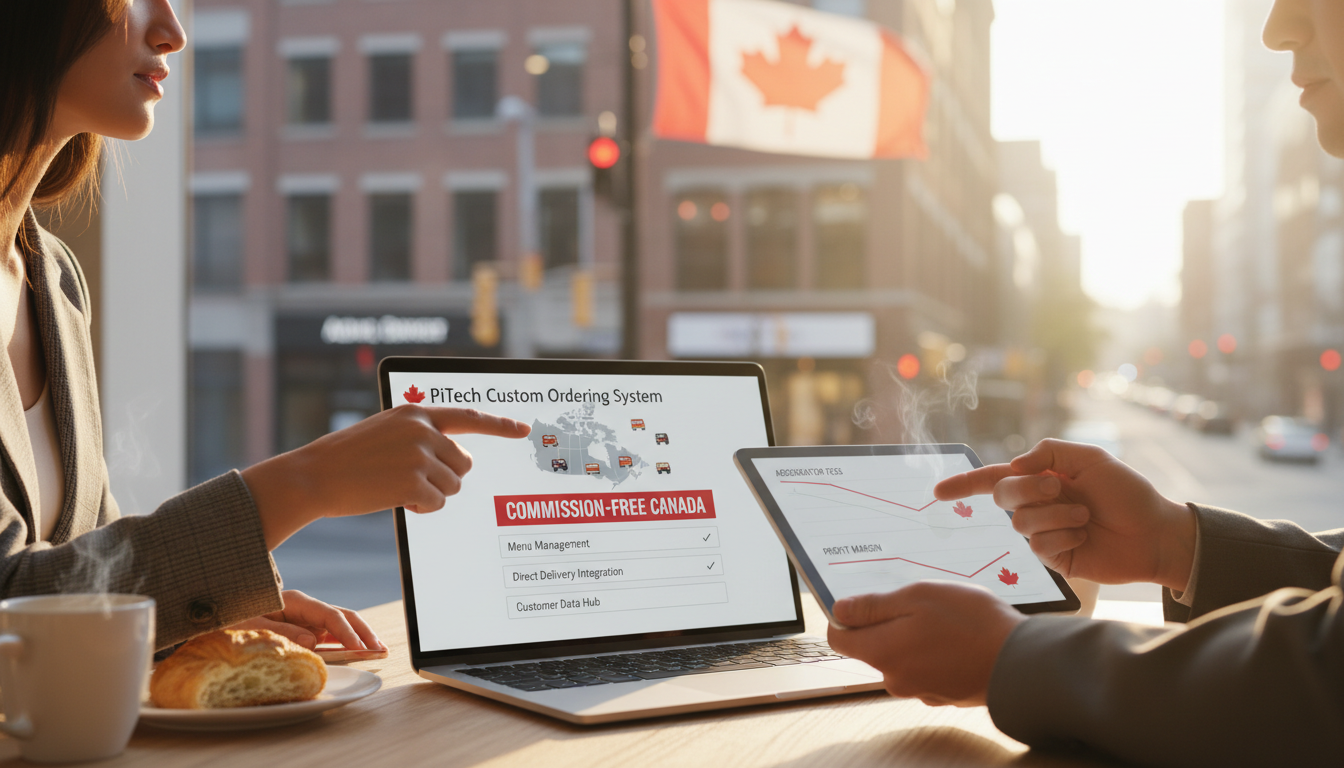
Custom Online Ordering System Canada: Stop Delivery App Fees
Discover how Canadian restaurants ditch 30% aggregator commissions by building a custom online ordering system in Canada with direct delivery integrations.
Published
Why Read This?
Uber Eats
Every month, a thriving three-location fast-casual brand in downtown Toronto or Vancouver transfers between $12,000 and $28,000 directly to DoorDash, SkipTheDishes, and Uber Eats. That capital does not buy kitchen equipment, fund staff retention, or improve product margins; it simply leases access to diners who were already searching for the restaurant by name. In an industry where Canadian operators survive on razor-thin net margins of 3% to 7%, surrendering up to 30% of gross order value on marketplace transactions is no longer a sustainable marketing expense. It is a slow-motion liquidation of restaurant equity.
The historical justification for third-party food delivery marketplaces was straightforward: they brought incremental foot traffic, provided logistics infrastructure that individual kitchens could not manage, and handled mobile payment processing. Today, that arrangement has inverted into an asymmetric dependency. Aggregators capture customer identities, mask contact data, and algorithmically redirect loyal diners to competing restaurants on the exact same block. To protect profitability and retain operational control, forward-thinking operators are transitioning toward a custom online ordering system in Canada that restores direct consumer relationships while slashing recurring commission overhead.
Achieving digital independence does not require an immediate, risky departure from major marketplace channels. Instead, it requires modern food ordering system development that pairs proprietary ordering interfaces with white-label delivery networks and automated retention loops. By examining the cost structures, technical integrations, and strategic migration playbooks involved, Canadian restaurant groups can methodically transform marketplace aggregators from margin-devouring middlemen into simple customer acquisition funnels.
The Financial Reality of Food Delivery App Commissions for Canadian Operators
Operating a hospitality business in Canada has become significantly more complex over the past three years. Food inflation rates tracked by Statistics Canada have placed sustained upward pressure on cost of goods sold, while provincial minimum wage increases in Ontario, British Columbia, and Alberta have reshaped labor models. Commercial rent across urban centres shows no signs of softening. When these baseline pressures collide with the post-pandemic expiration of municipal and provincial commission caps, third-party delivery orders quickly become unprofitable on a fully loaded cost basis.
Breaking Down the Hidden Unit Economics of Aggregator Marketplaces
Consider the actual math behind a $40 off-premise takeout or delivery order routed through a marketplace partner charging a baseline 25% commission. The platform immediately extracts $10 before the food even leaves the pass. Food cost typically absorbs 30% ($12), prime labor consumes roughly 35% ($14), and specialized delivery packaging adds another $2. Before accounting for utilities, commercial rent, insurance, and POS software subscriptions, the operator is already underwater on the ticket by $2.
```
Illustrative Unit Economics on a $40 Off-Premise Delivery Order:
Gross Order Value: $40.00 (100%)
Third-Party Marketplace Commission: -$10.00 ( 25%)
Food Ingredients Cost (COGS): -$12.00 ( 30%)
Direct Kitchen Labor: -$14.00 ( 35%)
Insulated Packaging & Disposables: -$2.00 ( 5%)
Net Contribution Margin: -$2.00 ( -5% before fixed overhead)
```
Operators frequently attempt to offset this deficit by inflating menu prices on delivery applications by 15% to 20%. While this tactic mitigates immediate bleeding, it creates secondary liabilities. Price-sensitive Canadian consumers notice the markup, leading to cart abandonment or negative brand perception regarding value. Worse, aggregators suppress menu visibility within their internal recommendation algorithms when an operator prices items significantly higher than their in-store baseline. The restaurant remains caught in a structural trap where volume increases while bank balances stagnate.
Amortization Modeling: Software Capital Investment Versus Endless Platform Rent
The financial justification for commissioning proprietary restaurant ordering software in Canada becomes clear when evaluating multi-year spending patterns. A multi-unit food brand generating $50,000 per month across third-party marketplaces pays approximately $150,000 annually in cumulative platform commissions. Over a three-year horizon, that amounts to $450,000 in operational expenditure for zero equity, zero proprietary data ownership, and zero lasting digital enterprise value.
By contrast, investing in custom software development requires upfront capital expenditure coupled with predictable, flat maintenance fees and standard interchange payment processing rates. An enterprise-grade custom ordering platform typically amortizes fully within four to eight months for high-volume concepts. Once past the break-even threshold, the variance between a 25% marketplace toll and a 2.7% credit card processing fee flows directly back into earnings before interest, taxes, depreciation, and amortization (EBITDA). Over three years, the net cash savings can comfortably fund additional physical locations, comprehensive brand overhauls, or expanded kitchen automation.
Evaluating Architecture Options for Commission Free Ordering in Canada

When leadership teams resolve to establish direct digital channels, they typically evaluate three distinct paths: turnkey marketplace add-ons, template software-as-a-service platforms, and custom headless digital systems. Each option presents structural trade-offs between execution speed, technical control, customer experience quality, and long-term scalability.
```
Comparison of Digital Ordering Approaches:
+++++
| Feature Matrix | Marketplace Apps | Template SaaS | Custom Headless |
+++++
| Commission Per Order | 15% to 30%+ | $0 (Flat Monthly) | $0 (Interchange) |
| Customer Data Access | Masked / Zero | Partial / Limited | Complete (100%) |
| POS Integration Depth | Requires Tablets | Basic Webhook | Native API Bi-dir |
| Brand Customization | Strict Template | Rigid Component | Bespoke Design |
| Checkout Friction Rate | Low (Stored Card) | Medium (Web Form) | Low (Apple/Google)|
| Long-Term ROI | Declines at Scale | Flat Cost Plateau | Maximum Expansion |
+++++
```
Why Off-the-Shelf SaaS Solutions Fall Short of True Digital Independence
Turnkey restaurant ordering software in Canada, such as out-of-the-box add-ons provided by legacy POS vendors or flat-fee web templates, represents an initial step toward lowering commission fees. These platforms provide functional menu displays and integrated checkout flows for a flat monthly subscription. For single-location independent diners with basic pickup demands, this approach can resolve immediate pain points.
However, mid-market restaurant groups, fast-casual chains, and ambitious multi-unit franchises encounter significant limitations with template platforms. Templated tools rarely allow deep custom branding, forcing premium hospitality concepts into generic digital layouts that look identical to local pizza shops. More critically, their data portability remains constrained. Exporting actionable customer telemetry into specialized CRM architectures is notoriously difficult, and modifying user checkout steps to reduce cart abandonment requires platform-level code changes that vendors rarely accommodate. Operators trade marketplace commission vulnerability for the strategic inflexibility of rigid software subscriptions.
Headless Web Platforms and Bespoke Mobile App Development for Food Brands
To capture and sustain meaningful direct ordering volume, modern hospitality operators turn to headless architectures. In a headless environment, the customer-facing interface is completely decoupled from back-end database logistics and payment gateways. This allows engineering teams to construct [high-converting web platforms](https://pitech.ca/web-design/) engineered exclusively for speed, seamless mobile interaction, and branded storytelling.
For high-frequency concepts where customers reorder weekly, investing in [bespoke mobile app development](https://pitech.ca/mobile-app-development/) builds an impenetrable retention moat. Native iOS and Android applications unlock zero-cost push notifications, native Apple Pay and Google Pay one-tap checkouts, geofenced curb-pickup alerts, and friction-free loyalty reward redemptions. When a customer places a proprietary icon on their personal smartphone home screen, the likelihood of that diner opening an aggregator app to browse nearby competitors drops dramatically. The restaurant transforms from an anonymous entry on a delivery directory into a persistent everyday consumer habit.
Technical Integrations Powering Modern Canadian Restaurant Tech Ecosystems
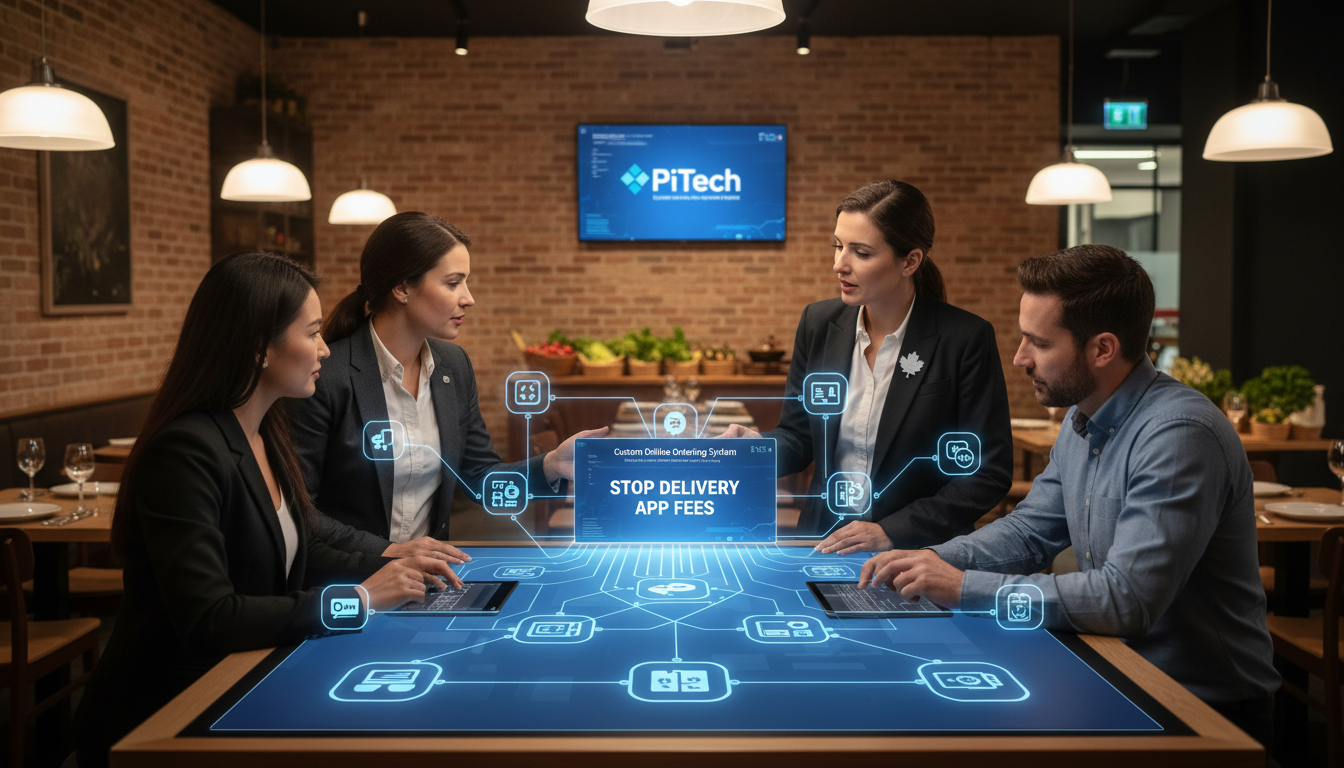
A custom online ordering platform fails if it disrupts physical kitchen operations. The primary reason kitchen managers tolerate third-party aggregator hardware is the immediate operational path to order fulfillment. If direct digital orders arrive via disorganized email notifications or require staff to manually re-type items into terminal touchscreens, order errors spike and ticket times suffer. A successful transition relies on harmonious integration across the entire Canadian restaurant tech stack.
Bridging Direct Orders to Domestic POS Systems Like Lightspeed and TouchBistro
Canada is home to leading restaurant point-of-sale innovations, notably Montreal-headquartered Lightspeed Commerce and Toronto-based TouchBistro, alongside international deployments like Square and Toast. Engineering a high-performing custom system requires connecting front-end interfaces directly to these POS ecosystems via robust RESTful APIs and real-time webhook infrastructure.
When a customer checks out on a proprietary web application, the transaction should instantaneously translate into a structured JSON payload delivered straight to the central POS server. The system automatically verifies store opening hours, checks real-time inventory levels to prevent orders for 86'd ingredients, and prints the prep ticket directly to the designated hot-line kitchen printer or Kitchen Display System (KDS). Staff handle the direct digital order exactly as they would an in-house dine-in ticket. Eliminating multiple disparate tablets reduces labor stress, cleans up counter space, and prevents manual transcription errors that hurt online customer reviews.
Solving Logistics Through White Label Delivery APIs and On-Demand Fleets
One of the greatest historical barriers to commission free ordering in Canada was delivery logistics. Most modern restaurants cannot bear the vehicle liabilities, insurance coverage, and hourly payroll required to maintain a dedicated fleet of in-house delivery drivers. Fortunately, the logistics sector has matured through the emergence of white label food ordering fulfillment networks.
Services like DoorDash Drive, Uber Direct, and regional Canadian courier cooperatives now provide delivery-as-a-service through unified logistics dispatch APIs. When an online customer selects delivery on your proprietary website, your system securely packages the order information, requests a courier quote, adds a flat delivery fee to the digital invoice, and dispatches an on-demand driver automatically. The driver arrives at your kitchen precisely as the food is boxed, while the customer tracks the courier via an interactive map embedded on your branded URL. The operator pays a flat, predictable fee per delivery run instead of forfeiting 30% of the entire basket value, leaving core product margins untouched.
Complying with Canadian Payment Rails and National Privacy Regulations
Deploying a custom digital ordering solution within Canada requires navigating domestic financial infrastructure and legal standards. Canadian consumers expect checkout experiences that support familiar, trusted payment methods. Aside from major credit card networks, transactions should accommodate Interac Debit digital implementations, Apple Pay, Google Pay, and localized gift card balances via payment gateways like Stripe Canada or Moneris.
Concurrently, collecting customer names, street addresses, dietary habits, and transaction histories places the business firmly under the governance of the Personal Information Protection and Electronic Documents Act (PIPEDA), alongside stricter provincial updates such as Quebec's Law 25. Custom platforms must be engineered with explicit opt-in mechanics, encrypted data storage, clear cookie consent parameters, and clear data deletion tools. Treating consumer data with rigorous compliance safeguards protects the brand from regulatory exposure and fosters meaningful consumer trust.
The Strategic Roadmap for Migrating Diners from Third-Party Apps to First-Party Channels
Building high-performance software represents half the battle; the remaining challenge is shifting consumer habits. Marketplaces spend hundreds of millions annually optimizing their acquisition loops, conditioning consumers to open their apps by default. A restaurant cannot simply deploy a custom website and expect thousands of monthly orders to materialize organically. Operators must execute a deliberate migration strategy that leverages third-party platforms to fuel first-party growth.
```
The Three-Stage Channel Migration Funnel:
- Top-of-Funnel Discovery:
- List on DoorDash, Skip, Uber Eats with adjusted (higher) menu pricing.
- Capture net-new diners who rely strictly on marketplace browsing.
- Onboarding & Physical Conversion:
- Insert physical conversion vouchers into delivery packaging.
- Offer clear financial incentives ($10 off first direct web order).
- Owned-Channel Retention:
- First-party profile created at checkout with stored payment info.
- Automated SMS/Email re-engagement triggers powered by purchase history.
- Proprietary loyalty tiering inaccessible through third-party apps.
```
Transforming Marketplace Diners into Direct Customers via Strategic Packaging
Treat third-party aggregators as an expensive customer acquisition tool rather than an ongoing sales channel. When a customer orders through an aggregator, they are that platform's customer; once they receive your food, they are in your physical sphere of influence. This handoff represents your greatest conversion opportunity.
Every marketplace delivery bag leaving your kitchen should contain high-value, professionally designed conversion assets. These collateral inserts must present a compelling, frictionless reason for the customer to order directly on their next visit. An effective call-to-action goes beyond a generic request to visit a website; it offers an immediate financial incentive, such as a specialized promotion code offering $10 off an initial direct order, free delivery for life on your proprietary app, or an exclusive menu item available nowhere else. By routing that second order through your custom system, the lifetime economics of that diner permanently change in your favor.
Driving Customer Lifetime Value with First-Party Data and Automated Retention
The long-term value of a custom online ordering system in Canada lies in unrestricted data ownership. Aggregators intentionally hide customer email addresses, real phone numbers, and dining trends behind proxy routing services. When you own the ordering layer, every digital interaction builds an addressable asset of immense commercial value.
Operators can integrate their direct checkout database into sophisticated marketing engines utilizing [data-driven AI automation](https://pitech.ca/ai-automation/). These automated systems can instantly run behavioral triggers without manual staff intervention:
* Re-engage lunch customers who have not ordered in fourteen days with personalized menu recommendations sent directly via SMS at 11:15 AM.
* Distribute automated birthday promotions that drive high-margin celebratory group orders.
* Detect cart abandonment on web ordering pages and send real-time recovery emails that reclaim lost revenue.
* Deploy predictive ordering models that identify high-frequency corporate accounts and automatically reward company administrators with tiered VIP perks.
Targeted customer retention campaigns generate significantly higher return on investment than general top-of-funnel customer acquisition. Direct data ownership allows independent brands to build automated marketing machines previously reserved for international enterprise franchises.
Scaling Direct Demand Through Modern Acquisition Architecture
A proprietary ordering portal requires consistent, highly targeted digital traffic to offset historical marketplace sales volumes. In the past, marketplaces captured search intent because local independent restaurants lacked sophisticated digital acquisition infrastructure. Today, Canadian operators can run focused, cost-effective digital acquisition campaigns that route local diners straight to their checkout portals.
Optimizing for localized intent requires investing in [targeted local SEO and paid acquisition](https://pitech.ca/digital-marketing/). When an individual in Calgary searches for "best smash burgers near me" or searches specifically for your brand name on Google Maps, your direct ordering link must dominate the search results. Integrating Google Food Ordering directly into your Google Business Profile allows mobile users to navigate from local map searches straight to your proprietary digital checkout in seconds.
```
Digital Traffic Redirection Architecture:
[Local Consumer Intent: Google Search / Maps / Meta Feeds]
|
v
++
| Google Business Profile / Local Search Ads |
| (One-Tap Direct Order Action Button) |
++
|
+++
| |
v v
++ ++
| Proprietary Web App | | Branded Native App |
| (Mobile Checkout) | | (Push / Stored Pay) |
++ ++
| |
+++
|
v
++
| Automated Kitchen Routing (Lightspeed/TouchB) |
| + API Dispatch to White-Label Fleet |
++
```
Concurrently, geo-targeted Meta and Instagram advertising campaigns running within a tight radius around your physical storefront can highlight signature dishes, limited seasonal menus, and direct ordering perks. Because the target audience is concentrated within your immediate delivery zone, monthly ad spend remains remarkably efficient. The savings generated by avoiding third-party commissions can easily fund these local acquisition channels while still leaving substantial net profit margins intact.
Engineering High-Performance Food Ordering System Development with PiTech
Navigating digital transformation requires an engineering partner that understands software design, conversion metrics, payment processing, and Canadian hospitality realities. Building direct ordering architecture involves far more than launching a basic WordPress menu page; it demands enterprise reliability, sub-second load times, and airtight API connectivity capable of handling severe Friday-night peak volume spikes.
PiTech delivers comprehensive digital engineering solutions tailored for Canadian enterprise brands and expanding multi-location restaurant operators. Our approach addresses every layer of your direct digital ecosystem:
* Custom Software Engineering: Our team builds dedicated [custom software development services](https://pitech.ca/software-development/) that serve as the technological backbone of your food brand, cleanly bridging proprietary web applications, real-time kitchen displays, and cloud management consoles.
* High-Velocity Web Design: We design responsive web ordering experiences optimized for lightning-fast mobile transactions, frictionless cart modification, and instant payment validation.
* Bespoke Native Mobile Applications: We engineer polished iOS and Android applications equipped with integrated loyalty programs, push notification engines, and stored payment profiles that maximize customer lifetime value.
* POS Ecosystem Integrations: We write clean, resilient API integrations connecting direct orders into Canadian-centric environments like Lightspeed, TouchBistro, Square, and Toast, ensuring seamless kitchen execution.
* Holistic Growth and Local Discovery: We pair technical platforms with data-driven local SEO campaigns, Google Business Profile management, and hyper-local paid acquisition strategies that drive sustained, profitable transaction volume directly to your platform.
By taking an architectural approach to digital ordering, PiTech helps food operators replace rent-seeking marketplace reliance with owned, enterprise-grade digital assets that build long-term business equity.
Reclaiming Operational Margins and Enterprise Value in Canadian Foodservice
The argument that restaurants must permanently sacrifice 20% to 30% of their top-line delivery revenues to survive is fundamentally flawed. Aggregator marketplaces provide useful supplemental discovery for new concepts, but treating them as your primary digital channel places an artificial cap on your brand's financial health. With food costs, commercial rents, and kitchen wages continuing to test hospitality limits across Canada, operational profit now hinges on platform ownership.
Investing in a custom online ordering system in Canada allows forward-thinking restaurant groups to capture healthy unit margins, secure actionable first-party diner data, and regain full control over their brand experience. By combining modern headless digital ordering with flat-rate, on-demand courier APIs, operators can run seamless delivery operations without sacrificing their margins. The technology is proven, consumer demand for direct brand engagement is high, and the financial advantages of commission-free ordering are indisputable.
Stop treating your customer base as rented property. Take purposeful steps toward direct digital ownership, integrate your infrastructure thoughtfully, and build an owned ordering channel that protects your bottom line for years to come.
Conduct a Digital Channel and Commission Audit with PiTech
Find out how much revenue your restaurant group loses to marketplace commission fees each month, and discover how quickly a custom direct ordering platform can pay for itself. Contact PiTech's digital growth strategists today to review your current tech stack, assess POS integration viability, and receive a tailored architectural roadmap designed to return delivery profits directly to your business.
Ready to Transform Your Business?
Let PiTech help you implement these strategies with proven technology solutions.
Get StartedRelated articles
- Best Online Ordering Systems for Canadian Restaurants (2026)Tired of aggregator fees? Our guide compares the best online ordering systems for Canadian restaurants, helping you boost profits and own your customer relationships.
- Restaurant Website Design Canada: Beyond Simple OrderingUnlock your restaurant's potential. Our guide to restaurant website design in Canada shows how to build a site that drives loyalty, cuts costs, and tells your brand story.
- Best Online Reservation Systems for Canadian Restaurants (2024)An empty table costs you money. Discover the best online reservation systems for restaurants in Canada to increase bookings, cut no-shows, and grow revenue.
- Custom Booking System Canada: Scale Your Rental OperationsStruggling with manual bookings and generic software? Discover how a custom booking system in Canada can automate your rental process and improve efficiency.