

Custom ERP Software Canada: The Key to Manufacturing Growth
Why generic ERPs fail Canadian manufacturers, and how custom ERP software improves operations and supply chain visibility.
Published
Why Read This?
This article exposes the hidden costs of generic ERP systems plaguing Canadian manufacturers, revealing how custom-built solutions can transform operational inefficiencies into strategic growth. Discover why tailored ERP is not just software, but a vital "central nervous system" essential for navigating global pressures and achieving manufacturing dominance.
Table of Contents
27 sections
Table of Contents
27 sections
The production line should have been humming. Instead, a tense silence hung over the factory floor. A single, inexpensive component, unexpectedly out of stock, had brought the entire multi-million dollar operation to a halt. The plant manager knew the problem wasn't a simple oversight; it was a data failure. Their off-the-shelf ERP system, patched together with spreadsheets and manual workarounds, couldn't integrate real-time inventory data from a new local supplier. This scenario isn't hypothetical; it's a recurring nightmare for Canadian manufacturers trapped by software that wasn't built for their specific reality. As global pressures mount, relying on generic solutions is no longer a compromise, it's a direct threat to survival and growth.
This is precisely where the conversation about custom ERP software for Canada's manufacturing sector begins. It’s not a conversation about adding another piece of software; it's a strategic dialogue about building a central nervous system for your entire business. A system that understands your unique processes, anticipates your specific challenges, and scales with your ambitions. While the allure of a pre-packaged solution is understandable, the hidden costs of inefficiency, lost opportunities, and operational friction often far outweigh the initial sticker price. For manufacturers aiming to not just compete but dominate, the path forward lies in a digital core designed from the ground up to be a perfect fit.
Strategic Context: The Digital Crossroads for Canadian Manufacturing
Canadian manufacturers are navigating a perfect storm of challenges and opportunities. On one hand, persistent supply chain volatility, rising input costs, and a tight labour market have shrunk margins and exposed operational weaknesses. On the other hand, the push towards Industry 4.0, advanced automation, and data-driven decision-making presents a clear path to enhanced productivity and global competitiveness. At the center of this crossroads lies the Enterprise Resource Planning (ERP) system, the software that should, in theory, unify every facet of the business.
The core issue is that many legacy and off-the-shelf Canadian manufacturing ERP solutions were designed for a different era. They were built on rigid assumptions about linear supply chains, predictable production schedules, and siloed business functions. Today’s reality demands agility, interconnectedness, and granular visibility. Manufacturers need to pivot production quickly based on demand shifts, track components from source to final product with absolute certainty, and comply with an ever-growing list of industry and government regulations.
This gap between what generic software offers and what modern manufacturing requires creates a significant strategic vulnerability. Companies running on ill-fitting ERPs find themselves making critical business decisions based on outdated or incomplete data. This leads to inefficient inventory management, suboptimal production planning, and a reactive, rather than proactive, approach to market changes. The digital transformation in Canadian manufacturing isn't just about adopting new gadgets on the factory floor; it's about fundamentally re-architecting the flow of information to create a resilient, intelligent, and highly efficient operation.
Why Generic ERP Systems Fail to Meet Canadian Manufacturing Demands
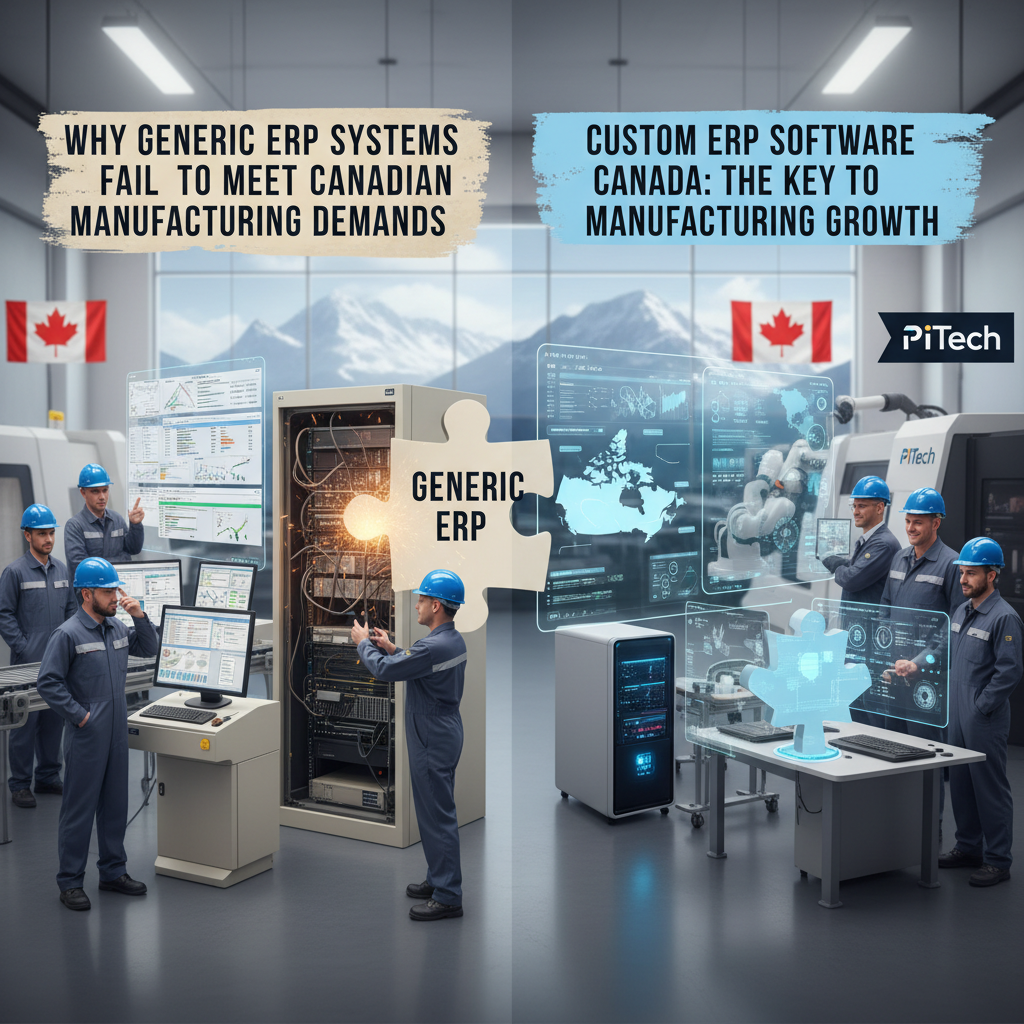
The promise of an off-the-shelf ERP is compelling: a comprehensive, pre-built solution ready for deployment. However, for many Canadian manufacturers, this promise quickly erodes when confronted with the unique complexities of their operations. The "one-size-fits-all" approach often becomes a "one-size-fits-none" reality, forcing businesses to contort their processes to fit the software, rather than the other way around.
The Inflexibility of Off-the-Shelf Workflow Logic
Every manufacturer has a secret sauce, a unique set of processes that gives them a competitive edge. It could be a proprietary multi-stage quality control check, a complex bill of materials (BOM) for customized products, or a specific method for handling returned materials. Generic ERP systems are built with standardized workflows in mind. Attempting to force your unique operational DNA into these rigid structures leads to clumsy workarounds, reliance on external spreadsheets, and manual data entry, defeating the very purpose of an integrated system and hindering efforts to streamline manufacturing operations. This rigidity stifles innovation and makes it difficult to adapt to new production techniques or customer requirements.
Gaps in Handling Canadian-Specific Regulatory Compliance
Manufacturing in Canada, particularly in sectors like food and beverage, pharmaceuticals, aerospace, and defense, is governed by stringent regulatory frameworks. Whether it's complying with CFIA traceability requirements, Health Canada’s Good Manufacturing Practices (GMP), or Controlled Goods Program (CGP) protocols, the stakes are incredibly high. Off-the-shelf ERPs, often designed with a broad international market in mind, typically lack the granular tracking, documentation, and reporting features needed for specific Canadian regulations. This forces companies to manage compliance through separate, disconnected systems, creating data silos and dramatically increasing the risk of costly errors and audit failures. A custom solution, by contrast, can build these compliance checks directly into the workflow, making adherence automatic and auditable.
The Data Silo Problem: When "Integrated" Isn't Truly Integrated
Vendors market their ERPs as fully integrated platforms, but the reality is often a collection of loosely connected modules. The finance module may not talk seamlessly to the shop floor control system, or the inventory module may not have real-time data from the CRM. This lack of deep integration recreates the very data silos that an ERP is supposed to eliminate. When teams are working from different versions of the truth, the consequences are severe: sales teams promise orders the production floor can't fulfill, procurement orders materials based on inaccurate inventory counts, and leadership lacks a unified view of business performance. True integration means a single source of truth, where an action in one part of the business is instantly and accurately reflected everywhere else.
Scalability Issues as Your Product Lines and Operations Evolve
A successful manufacturing business is a growing business. This growth might involve adding new product lines, expanding into new markets, acquiring another company, or adopting new business models like direct-to-consumer sales. Generic ERPs, with their fixed data structures and licensing models, often struggle to scale gracefully. Adding a new production facility, accommodating a different type of manufacturing process (e.g., moving from discrete to process manufacturing), or integrating a newly acquired company's systems can become a costly and complex nightmare. An ERP system for manufacturers in Canada must be an enabler of growth, not a bottleneck. A custom-built system is designed with your long-term roadmap in mind, ensuring the architecture can evolve and expand alongside your business.
How Custom ERP Software in Canada Directly Streamlines Manufacturing Operations
Moving from a generic, ill-fitting system to a tailored ERP platform is like trading a blunt instrument for a surgical tool. A custom ERP is purpose-built to address the specific pain points and capitalize on the unique opportunities within your manufacturing environment. It replaces approximation with precision, silos with integration, and reaction with proactivity.
Achieving True End-to-End Visibility Across Your Supply Chain
In an era of global disruption, robust supply chain management software in Canada is non-negotiable. A custom ERP moves beyond basic purchase order tracking to provide a holistic, real-time view of your entire supply chain. Imagine a dashboard that not only shows incoming material shipments but also tracks supplier performance metrics, flags potential delays based on carrier data, and automatically suggests alternative suppliers based on pre-set criteria. This level of visibility allows you to move from fighting fires to proactively managing risk, ensuring production continuity and improving negotiations with your supply chain partners.
Optimizing Production Scheduling and Resource Allocation in Real-Time
Effective production scheduling is a complex balancing act involving machine availability, labor skills, material lead times, and fluctuating customer demand. Generic ERP scheduling modules are often too simplistic for the dynamic nature of a modern factory. A custom solution can incorporate your specific business logic. It can automatically prioritize jobs based on margin, customer tier, or delivery deadlines. It can model the impact of unexpected machine downtime and instantly recalculate the optimal production path. This level of intelligent scheduling maximizes throughput, minimizes idle time, and significantly improves on-time delivery rates, which are critical metrics for any ERP for Canadian SMBs in the manufacturing space.
Automating Quality Control and Traceability for Superior Compliance
For many Canadian manufacturers, quality and traceability are not just best practices; they are license-to-operate requirements. A custom ERP can digitize and automate your entire quality management process. Quality checkpoints can be built directly into the production workflow, forcing operators to record measurements before proceeding to the next step. It can automatically generate certificates of analysis, manage lot and serial number tracking from raw material to finished good, and make audit preparation a matter of running a report instead of a frantic scramble for paper records. This built-in-compliance approach de-risks your operation and strengthens your brand reputation.
Unifying Financials, Inventory, and Production for Accurate Costing
Do you know the true cost of every product that leaves your facility? For many companies using generic ERPs, the answer is a rough estimate at best. Disconnected systems make it nearly impossible to accurately allocate labour, machine time, overhead, and material costs to specific jobs or production runs. A bespoke ERP, built on a unified data model, solves this problem. It links financial data directly to production and inventory events in real time. You can see the precise profitability of every order, identify sources of waste and inefficiency, and make far more informed decisions about pricing, product mix, and process improvement. This financial clarity is a cornerstone of sustainable growth.
Unlocking Advanced Capabilities with Custom-Integrated ERP Solutions
A custom ERP is not just about doing what you currently do more efficiently; it's about enabling capabilities that are impossible with off-the-shelf software. By serving as a central data hub, a bespoke ERP becomes the foundation for integrating next-generation technologies that define the smart factory and propel the digital transformation of manufacturing in Canada.
Integrating IoT for Predictive Maintenance and Real-time Floor Monitoring
Imagine your machinery telling you it needs maintenance before it breaks down. By integrating Internet of Things (IoT) sensors on your critical equipment, a custom ERP can collect and analyze data on vibration, temperature, and performance. When the data indicates a potential failure, the system can automatically generate a maintenance work order, schedule the repair during planned downtime, and even order the necessary parts. This shift from reactive to predictive maintenance drastically reduces costly unplanned shutdowns, extends equipment life, and optimizes maintenance team resources.
Leveraging AI and Machine Learning for Demand Forecasting
Guesswork in demand forecasting leads directly to stockouts or expensive overstocking. A custom ERP can integrate with artificial intelligence (AI) and machine learning (ML) algorithms to produce startlingly accurate forecasts. These models can analyze not just your historical sales data but also external factors like market trends, seasonality, economic indicators, and even competitor activities. This powerful predictive capability allows you to align your procurement and production schedules with real-world demand, optimizing inventory levels and improving cash flow. PiTech's expertise in AI automation allows these advanced forecasting tools to be seamlessly woven into the fabric of your custom ERP.
Building a Central Nervous System for Your Smart Factory (Industry 4.0)
Industry 4.0 is about creating an interconnected ecosystem where physical production processes and digital systems communicate and cooperate. A custom ERP is the brain of this ecosystem. It gathers data from IoT devices, robotic arms, and MES (Manufacturing Execution Systems) on the shop floor. It processes this information to provide a real-time digital twin of your entire operation. It then uses this intelligence to orchestrate automated workflows, optimize energy consumption, and provide leadership with unprecedented insight. This is the goal of manufacturing software development in Canada: to create not just a record-keeping system, but a dynamic, intelligent engine for your business.
Practical Business Takeaways: Navigating Your Path to a Custom ERP
Understanding the strategic value of a custom ERP is the first step. The next is navigating the practical considerations of justification, partner selection, and implementation. A well-planned project mitigates risks and maximizes the return on this critical investment.
The Financial Case: Calculating the True ROI of a Custom ERP System
While a custom ERP project requires an upfront investment, its ROI is often significant and multifaceted. To build a compelling business case, look beyond the initial software cost and focus on quantifiable business outcomes. Calculate potential savings from reduced inventory carrying costs (due to better forecasting), decreased material waste and scrap rates (due to better process control), and lower overtime expenses (due to optimized scheduling). On the revenue side, model the impact of increased production capacity, faster time-to-market for new products, and improved customer retention from higher on-time delivery rates. When viewed as a long-term investment in operational excellence, the financial case for a custom ERP becomes incredibly strong.
Choosing the Right Development Partner for Manufacturing Software in Canada
The success of your project hinges on your choice of development partner. This decision goes far beyond technical skill. Look for a partner who demonstrates a deep understanding of manufacturing processes. They should speak your language, understanding concepts like BOMs, routing, work centers, and lean principles. Seek a firm with a consultative, partnership-based approach, one that invests time upfront to thoroughly map your workflows and business goals. An agile development methodology is also crucial, as it allows for flexibility, regular feedback, and a phased rollout that delivers value incrementally rather than waiting for a single "big bang" launch.
Overcoming Implementation Hurdles: A Phased Approach to Success
Two of the biggest fears surrounding custom ERP are scope creep and poor user adoption. A phased, modular approach is the most effective way to mitigate both. Instead of trying to build the entire system at once, identify the area of your business with the most acute pain, perhaps inventory management or production scheduling, and build a Minimum Viable Product (MVP) to solve that specific problem first. This delivers tangible value quickly, builds momentum for the project, and allows your team to learn and adapt to the new system in manageable stages. Careful planning for data migration from legacy systems and a dedicated change management strategy, including comprehensive training and highlighting "what's in it for me" for end-users, are essential for ensuring a smooth transition and widespread adoption.
PiTech-Relevant Perspective: Building Your Growth Engine, Not Just Software
At PiTech, we believe that an ERP project is not just a software development exercise. It's a fundamental business transformation initiative. The goal is to build a growth engine that will power your company for the next decade and beyond. This requires a holistic approach that considers technology, processes, and most importantly, people.
More Than Code: The Importance of UI/UX in Custom ERP Adoption
The most functionally brilliant ERP system will fail if it's confusing, cluttered, and difficult to use. User adoption is the ultimate measure of success. That's why our process integrates expert UI/UX (User Interface/User Experience) design from day one. We work directly with your shop floor operators, your planners, and your finance team to design interfaces that are intuitive, efficient, and tailored to their specific tasks. A clean, user-friendly ERP reduces training time, minimizes errors, and transforms the system from a chore into a tool that employees genuinely want to use to do their jobs better. This focus is a core part of our web design and business application philosophy.
Future-Proofing Your ERP with Integrated AI and Cloud Architecture
Your business is not static, and your ERP shouldn't be either. We build our custom ERP solutions on modern, scalable cloud architectures. This provides flexibility, reduces your internal IT overhead, and ensures your system can grow with you. Furthermore, we architect our solutions with integration in mind, creating a platform ready to incorporate advanced capabilities like the AI-driven forecasting and predictive maintenance discussed earlier. Our expertise in creating integrated business platforms means your ERP won't be another silo; it will be the central hub that connects all your current and future technology investments.
A Partnership Approach to Custom ERP Development
We are not simply a vendor that takes a list of requirements and delivers code. We act as your strategic partner in custom software development. Our process begins with deep discovery, where we immerse ourselves in your business to understand the nuances of your operation. We collaborate with you throughout the agile development cycle, ensuring the solution being built constantly aligns with your evolving business goals. This partnership extends beyond launch, providing ongoing support and strategic guidance to ensure your ERP continues to deliver value and adapt to new challenges and opportunities as your manufacturing business thrives.
Conclusion: From Operational Drag to Competitive Advantage
For too long, many Canadian manufacturers have accepted the compromises and inefficiencies of generic software as a cost of doing business. But in today's fiercely competitive environment, that operational drag is no longer sustainable. The limitations of off-the-shelf ERP systems are a direct constraint on growth, agility, and profitability. Clunky workflows, data silos, compliance gaps, and an inability to scale are not minor inconveniences; they are strategic liabilities.
The definitive solution lies in embracing a digital core that is as unique as your business itself. Custom ERP software for Canada's manufacturing landscape is not a luxury, but a strategic imperative. It transforms your core operational system from a rigid constraint into a dynamic growth engine. By perfectly mapping to your processes, providing a single source of truth, automating compliance, and serving as a platform for next-generation technologies like AI and IoT, a custom ERP delivers a decisive and durable competitive advantage. It's time to stop fitting your business to your software and start building software that fuels your business's future.
Ready to build an ERP system that drives your Canadian manufacturing growth, not limits it? Schedule a complimentary consultation with PiTech's custom software experts to explore how a tailored solution can revolutionize your operations.
href="/services/web-design" class="blog-internal-link">Web Design ServicesReady to Transform Your Business?
Let PiTech help you implement these strategies with proven technology solutions.
Get StartedRelated articles
- Custom Fleet Management Software Canada: Your Growth EngineGeneric tools can't handle Canadian logistics. Discover how custom fleet management software in Canada unlocks major ROI, optimizes routes, and ensures compliance.
- Boosting Website Performance in Canada: Core Web Vitals GuideStruggling with slow load times? Our guide to Core Web Vitals helps Canadian businesses boost website performance, improve Google rankings, and enhance user experience.
- B2B E-commerce Platform Canada: The UX-Driven Growth GuideStruggling with low adoption on your B2B e-commerce platform in Canada? Discover our UX-driven playbook to boost conversions, streamline ordering, and unlock growth.
- Custom CRM for B2B Canada: Boost Your Sales Pipeline NowGeneric CRMs fail Canadian B2B firms. Learn how a custom CRM for B2B Canada addresses unique market needs, automates sales, and drives pipeline growth.