

Custom EMR Integration: Canada's Healthcare Efficiency Solution
How custom EMR software integration in Canada removes data silos, streamlines workflows, and improves patient care.
Published Updated
Why Read This?
This article uncovers how fragmented EMR systems are jeopardizing patient safety and draining resources in Canadian healthcare. Discover how strategic, custom EMR integration can bridge these digital islands, offering a powerful solution to enhance efficiency and deliver data-driven care.
A patient arrives in a Toronto emergency room, semi-conscious and unable to provide their medical history. The ER physician knows the patient has a complex chronic condition and was recently discharged from a different hospital network. They also know the patient’s family doctor uses a popular cloud-based Electronic Medical Record (EMR) system. Yet, getting a complete, real-time picture of medications, allergies, and recent test results is a frantic race against the clock involving phone calls, faxes, and logging into three separate, non-communicating portals. This isn't a hypothetical scenario; it's a daily reality that exposes the critical flaw in Canada's digital health infrastructure: a severe lack of interoperability.
This data fragmentation isn't just an inconvenience; it's a direct threat to patient safety and a massive drain on the resources of an already strained healthcare system. Clinicians spend hours on administrative work that software should handle, operational costs balloon due to redundant tests and inefficient processes, and the promise of data-driven healthcare remains frustratingly out of reach. While off-the-shelf EMR systems have digitized records, they have often created digital islands. The solution lies not in another piece of standalone software, but in weaving these systems together through strategic, custom EMR software integration in Canada.
The Strategic Context: The High Cost of Disconnected Data in Canadian Healthcare
The scenario in the Toronto ER is a microcosm of a nationwide challenge. Canada's healthcare system, a source of national pride, is grappling with unprecedented pressures. An aging population, the rising prevalence of chronic diseases, and persistent workforce shortages create a perfect storm that demands greater efficiency and intelligence. However, the very tools meant to help, EMRs and Electronic Health Records (EHRs), often contribute to the problem when they operate in isolation. The cost of this digital disconnect is staggering, manifesting in clinical, operational, and financial domains.
Canada Health Infoway's own reports have long highlighted the benefits of connected health information, projecting billions in value from reduced duplicate testing, improved medication management, and streamlined clinical workflows. Yet, the reality on the ground is a patchwork of vendors and provincial systems. A patient's data may reside with TELUS Health's Med Access in one clinic, WELL Health's Oscar EMR in another, and a proprietary hospital information system (HIS) during an inpatient stay. Without a bridge between them, the patient’s record is fractured, incomplete, and fundamentally less useful.
This is the strategic inflection point where custom integration becomes a necessity, not a luxury. It's the shift from simply having digital records to making those records work together to create a cohesive, intelligent, and responsive healthcare ecosystem. The push for national interoperability standards, championed by organizations like Infoway and Digital Health Canada, provides the tailwind for this transformation.
Why Off-the-Shelf EMRs Fall Short in Canada's Diverse Healthcare Ecosystem
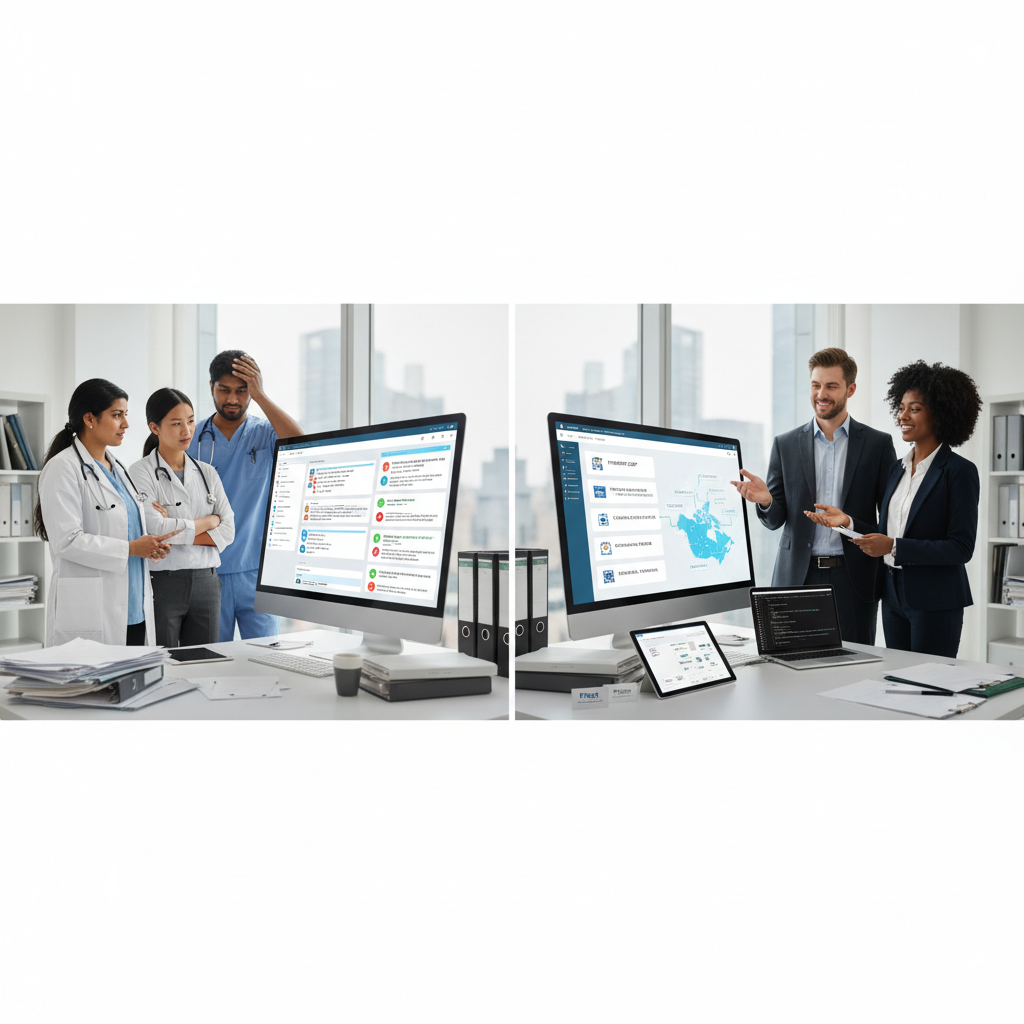
The initial promise of EMRs was to replace paper charts with a more efficient digital equivalent. While they succeeded in this primary goal, many healthcare organizations now find themselves constrained by the limitations of these generic platforms. The assumption that a single software solution could elegantly serve every specialty, clinic, and province has proven to be a significant miscalculation.
The Myth of One-Size-Fits-All: When Generic Workflows Clash with Clinical Reality
Off-the-shelf EMR systems are designed for the "average" clinic, but in healthcare, the average is a statistical fiction. The workflow of a high-volume family practice is vastly different from that of a cardiology specialist, a mental health clinic, or a distributed home care provider. Generic software often forces clinicians and administrative staff into awkward, inefficient workarounds. They must adapt their proven processes to the software's rigid structure, leading to frustration, lost productivity, and potential for errors. Customization options within these platforms are often superficial, limited to changing field names or basic templates, rather than fundamentally altering logic to match a unique care model.
Provincial Data Silos: Navigating Canada's Fragmented Regulatory Landscape
Canada does not have a single, unified healthcare system; it has a collection of provincial and territorial systems, each with its own funding models, regulations, and health data privacy laws (like Ontario's PHIPA or Alberta's HIA). EMR vendors must navigate this complex web, and their standard products are often designed to meet a baseline of compliance rather than optimize for cross-provincial data sharing. This creates significant barriers. For instance, a patient from Quebec receiving care in British Columbia may face delays as providers struggle to securely and legally access their records. A custom integration strategy is purpose-built to navigate these specific cross-jurisdictional rules, creating compliant pathways for data to flow where it's needed.
The Hidden Costs of Poor Interoperability and Manual Workarounds
The most obvious cost of disconnected systems is staff time. Every minute a nurse spends manually re-entering lab results from a hospital portal into the clinic's EMR is a minute not spent on patient care. Every time an administrator has to call another office to confirm a referral status, it represents an operational inefficiency. These small friction points add up to thousands of lost hours and significant payroll costs annually. Furthermore, this lack of interoperability hinders a practice's ability to perform meaningful data analytics for quality improvement, population health management, or complex provincial reporting requirements, forcing staff into tedious manual data extraction and spreadsheet manipulation.
Unlocking Medical Practice Efficiency with Custom EMR Software Integration Canada

Custom integration is the art and science of making disparate software systems communicate seamlessly. It involves creating a digital "nervous system" for a healthcare organization that connects EMRs, lab information systems (LIS), pharmacy software, billing platforms, and patient portals into a single, cohesive whole. The impact on efficiency and quality of care is transformative.
Creating a Unified Patient View: Integrating Hospital, Clinic, and Lab Data
The primary goal of EMR system customization and integration is to create a single source of truth for each patient. When a family physician can open their EMR and immediately see their patient's recent ER visit report, discharge summary, and the latest blood work from an external lab, without logging into another system, several things happen. Diagnostic accuracy improves, redundant tests are avoided, and care coordination becomes proactive rather than reactive. This unified view, powered by secure data exchange protocols, is the foundation of modern, patient-centric care.
Automating Administrative Tasks to Reclaim Clinician Time
A significant portion of a clinician's day is consumed by tasks that provide no direct patient value, such as managing referrals, processing prescription refills, and transcribing notes. A custom-integrated system can automate a huge portion of this workload. For example, an incoming e-referral can automatically create a patient shell in the EMR, a patient's booking confirmation can trigger an automated reminder, and structured data from a diagnostic report can be auto-populated into the patient's chart. This automation frees up highly-skilled medical professionals to focus on what they do best: diagnosing and treating patients.
Enhancing Clinical Decision Support with Real-Time Data Access
Effective clinical decision support (CDS) tools rely on complete and timely data. A generic EMR might alert a physician to a drug interaction based on the medications listed within that single system. An integrated system, however, can provide far more powerful support. It can cross-reference medications prescribed from multiple providers, flag a potential issue based on a new lab result from an external facility, or alert the physician that a patient is overdue for a screening based on guidelines matched against their comprehensive, multi-source health history. This level of real-time, data-rich decision support is impossible without deep system integration.
The Technical Blueprint: Core Components of a Successful EHR Integration Strategy
Achieving seamless interoperability is a complex technical challenge that requires a deliberate and expert approach. It’s not about simply "connecting" systems; it's about architecting secure, scalable, and standardized data flows. Success hinges on understanding the modern tools and standards governing healthcare data exchange.
Leveraging APIs and the Rise of FHIR (Fast Healthcare Interoperability Resources)
Application Programming Interfaces (APIs) are the fundamental building blocks of modern software integration. They define a set of rules and protocols that allow different applications to talk to each other. In healthcare, the most important emerging standard is FHIR (pronounced "fire"). FHIR is a new-generation standard from HL7 that defines healthcare data in small, logical, web-friendly chunks called "resources" (e.g., a Patient resource, a Medication resource). This modern, API-first approach makes it vastly easier for developers to build applications that can securely query and exchange specific pieces of health information, breaking down the monolithic data silos of older standards. Any forward-looking interoperability healthcare Canada strategy must be built around a deep understanding and implementation of FHIR.
The Role of Middleware and Integration Platforms as a Service (iPaaS)
Directly connecting every system to every other system (point-to-point integration) creates a brittle and unmanageable "spaghetti architecture." A more robust approach involves using a central integration engine or middleware layer. This hub-and-spoke model simplifies management and enhances security. Modern cloud-based solutions, known as Integration Platforms as a Service (iPaaS), provide pre-built connectors, data transformation tools, workflow orchestration, and monitoring dashboards specifically for this purpose. An iPaaS can act as the central translation layer, taking data from a legacy hospital system in one format, securely transforming it to the FHIR standard, and delivering it to a clinic's mobile application via a secure API.
Ensuring PHIPA Compliance and Data Security in Every Integration Point
In healthcare, security is not an afterthought; it is a primary design requirement. Every single integration point, every API call, and every data transformation must be architected with the stringent requirements of Canadian privacy legislation, such as the Personal Health Information Protection Act (PHIPA) in Ontario, in mind. This includes strong authentication and authorization controls (ensuring only the right people can access data), end-to-end encryption (protecting data in transit and at rest), and comprehensive audit logging (tracking every access and modification to personal health information). A breach resulting from a poorly secured integration can have devastating consequences, making expertise in Canadian healthcare IT and security paramount.
From Concept to Clinic: A Phased Approach to EMR System Customization
Implementing a custom integration solution is a significant project that requires more than just technical skill. It demands strategic planning, deep collaboration with clinical stakeholders, and a meticulous focus on change management to ensure adoption and success. A phased approach mitigates risk and aligns the final product with the real-world needs of the practice.
Phase 1: Deep Workflow Analysis and Strategic Scoping
Before a single line of code is written, the most critical work begins. This phase involves a partnership between software architects and healthcare professionals to map out existing workflows in minute detail. Where are the bottlenecks? Where does manual data entry occur? What information is needed at each step of the patient journey but is currently unavailable? This deep discovery process identifies the highest-impact integration opportunities and defines the project's scope, ensuring the solution is built to solve the most pressing business and clinical problems.
Phase 2: Agile Development, Prototyping, and Clinician Feedback Loops
Instead of disappearing for months to build a complete solution in a vacuum, effective development teams use an agile methodology. They build the solution incrementally, starting with a minimum viable product (MVP) that addresses a core pain point. This working prototype is then put in front of a pilot group of clinicians and administrative staff. Their feedback is not just solicited; it is essential. This iterative loop of build-measure-learn ensures the software evolves to be intuitive, useful, and genuinely supportive of clinical work, dramatically increasing the chances of successful user adoption.
Phase 3: Secure Deployment, User Training, and Change Management
The technical deployment of a new integrated system is only half the battle. Success is ultimately determined by user adoption. This requires a comprehensive change management plan. Formal training sessions are necessary, but so are "at-the-elbow" support during the go-live phase, clear documentation, and establishing "super-users" or champions within the clinic who can help their peers. The transition must be managed to minimize disruption to patient care, with clear communication and support channels to address the inevitable questions and challenges that arise with any new system.
Practical Business Takeaways for Canadian Healthcare Leaders
For clinic owners, hospital administrators, and healthcare IT managers, the path to an integrated digital environment can seem daunting. However, by focusing on a few core principles, you can steer your organization toward a more efficient and effective future.
- Audit Your Current "Data Friction" Points: Don't just think about software; think about workflows. Task a team to formally identify and quantify the time spent on manual data entry, searching for information in different systems, and other administrative workarounds. This data will form the bedrock of your business case.
- Prioritize Interoperability in All Future Technology Procurement: When evaluating any new software, from a patient scheduling tool to a new diagnostic machine, your first question should be: "What are its API capabilities, and does it support the FHIR standard?" Making interoperability a non-negotiable purchasing criterion will prevent you from adding more silos to your ecosystem.
- Build a Business Case Focused on ROI, Not Just Cost: A custom integration project is an investment, not just an expense. Frame your business case around the return on investment (ROI): reclaimed clinician hours, reduced operational waste from duplicate tests, improved billing accuracy, and the long-term value of enhanced data analytics capabilities.
- Champion Change from the Top Down: Technology projects that lack leadership buy-in and clinical champions are destined to fail. Leaders must articulate the "why" behind the change, consistently communicating the vision of improved patient care and reduced administrative burden to motivate staff through the transition period.
The PiTech Perspective: Engineering Integrated Digital Health Solutions
At PiTech, we view the challenges of healthcare interoperability not as insurmountable obstacles, but as complex engineering problems waiting for elegant solutions. We believe that technology should adapt to the clinician, not the other way around. Our approach to healthcare software development in Canada is rooted in a deep understanding of the unique clinical, regulatory, and business context of the Canadian system. We don't just connect systems; we architect data fluidity.
Our process begins with the "deep workflow analysis" described above. Our business analysts and solution architects immerse themselves in your clinic's or hospital's operations to understand the nuanced reality of your day-to-day work. From there, our Canadian-based development teams leverage their expertise in secure APIs, FHIR standards, and cloud-native architecture to build the custom integration layers you need. Whether it’s creating a unified dashboard that pulls data from your EMR and provincial lab systems, developing a PHIPA-compliant mobile app for clinicians, or integrating AI-powered automation to handle prescription refills, our solutions are purpose-built and secure.
We see custom integration as the key to unlocking next-generation capabilities. By creating a clean, consolidated data pipeline, we prepare your organization to leverage powerful technologies like AI and machine learning for predictive analytics, advanced clinical decision support, and population health management. PiTech acts as your long-term technology partner, helping you navigate the complexities of digital transformation and build a future-proof technology stack that enhances efficiency and, most importantly, improves patient outcomes.
Conclusion: Building a More Connected Future for Canadian Healthcare
The fragmented nature of Canada's digital health landscape is no longer a tenable situation. The costs in clinical efficiency, patient safety, and administrative waste are too high to ignore. While off-the-shelf EMRs were a necessary first step, they are not the final destination. The future of a sustainable, high-performing Canadian healthcare system lies in intelligent, secure, and seamless data flow.
This future will be built not by a single mega-vendor, but through the strategic and meticulous work of connecting the best-in-class systems that are already in place. It requires a commitment to open standards like FHIR, a deep respect for Canada's unique regulatory environment, and a focus on solving real-world clinical workflow problems. For healthcare leaders ready to move beyond the limitations of their current digital tools, investing in custom EMR software integration in Canada is the most powerful step they can take. It’s an investment in reclaiming clinician time, reducing operational costs, and ultimately, delivering the safe, coordinated, and data-driven care that all Canadians deserve.
Ready to Transform Your Business?
Let PiTech help you implement these strategies with proven technology solutions.
Get StartedRelated articles
- Custom Patient Portal Canada: The Key to Modern HealthcareOff-the-shelf EHR portals fail to meet Canada's unique healthcare challenges. Discover how a custom patient portal can drive engagement and efficiency.
- Custom API Integration for E-commerce in Canada: Your GrowthUnlock growth by eliminating data silos and automating workflows. Learn how custom API integration for e-commerce in Canada drives efficiency and revenue.
- Streamline Operations with Custom Patient Scheduling Software CanadaGeneric software failing your clinic? Discover how custom patient scheduling software in Canada streamlines operations, reduces wait times, and ensures PIPEDA compliance.
- Digital Triage Platform Canada: End Hospital Wait Times NowA custom digital triage platform is the key to solving Canada's healthcare crisis by reducing wait times, optimizing patient flow, and boosting efficiency.