

Custom CRM Canada: Unlock Growth for Your Service Business
Off-the-shelf software failing you? Discover how a custom CRM for Canadian service businesses slashes costs, boosts efficiency, and ensures compliance.
Published
Why Read This?
"Is your generic CRM holding your Canadian service business back? Discover how custom CRM solutions can transform your operations, boost efficiency, and unlock sustainable growth by finally aligning your technology with your unique needs and the Canadian market."
What if your Customer Relationship Management software was secretly managing you, dictating your workflows, forcing your team into inefficient processes, and capping your growth potential? For countless Canadian service businesses, this isn't a hypothetical question. It's the daily reality of wrestling with generic, off-the-shelf CRM platforms that were designed for a different country, a different industry, and a different business model. You pay for a suite of features you'll never touch, while your team spends hours creating manual workarounds for the critical functions you desperately need but don't have. This friction isn't just frustrating; it's a silent tax on your efficiency and a barrier to delivering the exceptional client experiences that define your brand.
The fundamental promise of a CRM is to centralize and streamline client relationships to drive growth. Yet, for many service-based companies in Canada, from specialized legal practices in Toronto to engineering consultants in Calgary and healthcare providers in Montreal, generic solutions often break this promise. They impose rigid structures that clash with nuanced service delivery, ignore Canadian-specific compliance needs, and fail to provide the tailored insights necessary for strategic decision-making in a complex market. The alternative, however, is no longer a prohibitively expensive or complex undertaking. The strategic adoption of custom CRM for Canadian service businesses has emerged as a powerful lever for unlocking sustainable growth, creating durable competitive advantages, and finally making technology a true extension of your unique business strategy.
The Strategic Disconnect: Why Generic CRMs Fall Short in Canada
The Canadian service economy is the backbone of the nation's GDP, characterized by its incredible diversity. It encompasses everything from professional services and skilled trades to complex B2B consulting and highly regulated healthcare fields. This diversity is its strength, but it also presents a significant challenge for one-size-fits-all technology solutions. Off-the-shelf CRM platforms, while powerful in their own right, are built for mass-market appeal, which inherently means they are optimized for no one in particular.
For a Canadian service business, this creates a strategic disconnect. Your unique client intake process, your multi-stage project delivery workflow, or your specific billing cycle doesn't fit neatly into the predefined "Lead > Opportunity > Closed/Won" pipeline that most CRMs enforce. You find yourself trying to hammer a square peg into a round hole. This leads to frustrated teams, compromised data integrity, and a cascade of inefficiencies that ripple through the entire organization.
Furthermore, the Canadian operational landscape has unique requirements that global SaaS providers often treat as an afterthought. Provincial privacy legislation like Quebec's Law 25, Alberta's PIPA, and the federal PIPEDA have stringent rules about data consent, residency, and security. Integrating with distinctly Canadian payment gateways, accounting software like QuickBooks Canada, or navigating bilingual communication requirements adds another layer of complexity that generic tools handle poorly, if at all. The result is a technology stack that creates more problems than it solves, holding your business back when it should be propelling it forward.
Custom CRM vs. Off-the-Shelf: A Strategic Showdown for Canadian Businesses
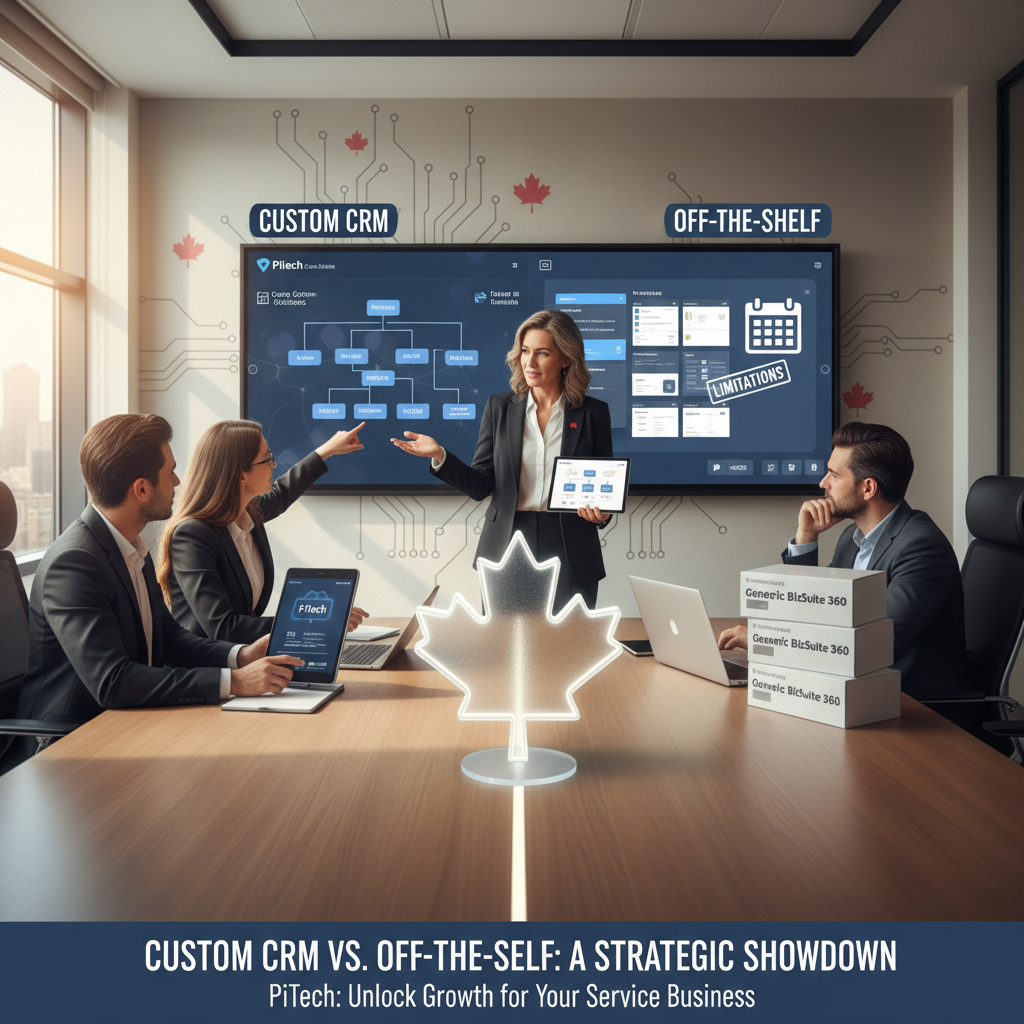
Choosing the right client management software is one of the most critical technology decisions a service business can make. It's not just a database; it’s the central nervous system of your client-facing operations. The debate between a generic, off-the-shelf solution and a bespoke one is not merely about features, but about fundamental business philosophy: should you adapt your processes to fit the software, or should the software be built to amplify your processes?
The Allure and Pitfalls of Generic SaaS CRM Platforms
Platforms like Salesforce, HubSpot, and Zoho have mastered the art of marketing. They promise a quick setup, a seemingly low monthly fee, and a vast ecosystem of features. For a startup or a small business just beginning its digital journey, this can be an attractive entry point. The allure is instant gratification; you can have a "CRM" up and running in a matter of hours.
However, the honeymoon period often ends quickly. The true cost of ownership begins to reveal itself through several common pain points:
* Per-User Pricing Spirals: The low introductory price balloons as your team grows. Every new user adds a significant monthly cost, disincentivizing company-wide adoption.
* Feature Bloat and Unused Complexity: You're paying for enterprise-level features designed for Fortune 500 sales teams, while the niche functionality your service business needs is either missing or locked behind a higher, more expensive tier.
* The "Workaround" Tax: Your team wastes countless hours exporting data to spreadsheets, using third-party tools to fill gaps, and manually performing tasks that should be automated, simply because the CRM's rigid structure won't allow it.
* Costly and Cumbersome Customization: While some customization is possible, it often requires expensive specialized consultants and can break with future software updates, creating a fragile and dependent system.
Defining "Bespoke CRM Solutions": Beyond Code to Business Process Alignment
The term "custom CRM" can be intimidating, often conjuring images of a multi-year, multi-million dollar project built entirely from scratch. While that is one possibility, the modern approach to bespoke CRM solutions is far more flexible and strategic. It's about achieving perfect alignment between your technology and your business processes, not just writing code.
A tailored CRM project can take several forms:
- Ground-Up Development: Building a completely new application when the business processes are truly unique and no existing platform comes close.
- Heavy Customization of Open-Source Platforms: Using a flexible, open-source CRM as a foundation and building custom modules and workflows on top of it, giving you a head start without the rigidity of proprietary SaaS.
- A "Headless" CRM Architecture: Creating a custom backend to manage all your data and business logic, which then feeds information to various best-in-class front-end tools (a custom dashboard for managers, a mobile app for field technicians, a client portal for customers).
The key differentiator is the starting point. Instead of starting with the software's features, a custom CRM project starts with a deep analysis of your business: your client journey, your operational workflows, your data needs, and your strategic goals. The technology is then designed and built to serve that strategy, not the other way around.
How Custom CRM Development Canada Addresses Unique Market Nuances
For Canadian companies, this tailored approach is particularly powerful because it can directly address market-specific challenges that global platforms overlook. A CRM development Canada project is built with the local context in mind from day one.
Consider the advantages:
* Built-in Compliance: Data residency can be guaranteed by hosting on Canadian servers. Workflows for obtaining and tracking client consent can be built-in to align with PIPEDA and provincial acts, making compliance automatic, not an administrative burden.
* Seamless Bilingualism: A custom UI can offer a flawlessly bilingual experience for both employees and clients, which is often clunky or poorly implemented in generic systems.
* Integrated Financial Workflows: The CRM can be designed to interface directly with Canadian tax structures (GST/PST/HST), Canadian-specific payment processors, and accounting software, eliminating manual reconciliation.
* Industry-Specific Functionality: A law firm can have a CRM that understands matter management and conflict checks. A healthcare clinic's CRM can be built to HIPAA/PHIPA standards. A skilled trades company can have a system that integrates job quoting, scheduling, dispatch, and invoicing in one seamless flow.
Quantifying the ROI: The Tangible Benefits of a Tailored Customer Relationship Management System

While the initial investment in a custom CRM is typically higher than a monthly SaaS subscription, the long-term Return on Investment (ROI) is often far greater. This ROI is realized not just in cost savings, but in significant gains across revenue generation, client retention, and strategic advantage. A tailored customer relationship management system is an asset that appreciates in value as it drives efficiency throughout your business.
Slashing Operational Overheads by Automating Repetitive Tasks
Every service business is plagued by low-value, repetitive administrative tasks that consume valuable employee time. A custom CRM is designed specifically to identify and eliminate these bottlenecks. Imagine the impact of automating workflows that are unique to your business:
* Automated Client Intake: A potential client fills out a form on your website, and the system automatically creates a client record, assigns them to the right team member based on their needs and location, and schedules an initial consultation, sending confirmation emails to both parties.
* Dynamic Document Generation: Create custom proposals, service agreements, or project reports populated with client and project data directly from the CRM with a single click, ensuring accuracy and brand consistency.
* Intelligent Follow-ups: The system can track the last contact date for all clients and automatically trigger reminders for your team to follow up, or even send out personalized check-in emails based on predefined rules.
These automations don't just save time; they reduce the risk of human error, improve response times, and free up your skilled professionals to focus on high-value, revenue-generating work.
Enhancing Client Lifetime Value Through Hyper-Personalized Engagement
In the competitive service industry, client retention is paramount. A custom CRM serves as a central repository for deep client intelligence, going far beyond basic contact information. You can track every interaction, milestone, preference, and piece of feedback.
This deep understanding allows for unprecedented levels of personalization:
* Proactive Service: If your CRM tracks project timelines for a B2B client, it can automatically alert their account manager a month before completion to discuss renewal or expansion opportunities.
* Personalized Communication: A wealth management firm could use its custom CRM to track clients' financial goals and life events (e.g., a child starting university), enabling advisors to provide timely, relevant advice that strengthens the relationship.
* Custom Client Portals: Offer your clients a secure, branded portal where they can view project progress, access important documents, communicate with your team, and pay invoices. This transparency and convenience dramatically enhance the client experience and build loyalty.
By systematically improving the client experience at every touchpoint, you convert satisfied customers into loyal advocates for your brand, dramatically increasing their lifetime value.
Gaining a Competitive Edge with Tailored, Actionable Business Intelligence
Generic CRMs offer generic reports. Their dashboards show standard metrics like leads generated or deals closed, which may not be the key performance indicators (KPIs) that truly drive your service business. A custom CRM, however, provides a command center with tailored business intelligence.
You can design dashboards and reports that answer your most critical strategic questions:
* Which service line has the highest profit margin?
* What is the average project completion time, and where are the most common bottlenecks?
* Which marketing channels in which Canadian provinces are generating the most valuable clients?
* What is our client satisfaction score, trended over time and segmented by service type or account manager?
This level of granular, relevant insight is impossible to achieve with an off-the-shelf system. It transforms data from a passive record into an active strategic asset, enabling you to make smarter, faster decisions that outmaneuver competitors.
Key Features Every Custom CRM for a Canadian Service Business Should Include
When embarking on a custom CRM project, the possibilities can seem endless. However, focusing on a core set of high-impact features is crucial for success. These features are designed to address the most common and critical needs of service-based businesses operating in Canada, delivering immediate and lasting value.
Seamless Integration with Your Existing Canadian Tech Stack
A CRM should not be an isolated island of data. Its true power is unleashed when it acts as the central hub of your entire technology ecosystem. A key priority should be building seamless, two-way integrations with the tools you already rely on. This includes accounting software like QuickBooks or Xero (specifically their Canadian versions), payment processors like Stripe or Moneris, marketing automation platforms, and internal communication tools like Slack or Microsoft Teams. This eliminates duplicate data entry, ensures data consistency across all platforms, and creates a single source of truth for all client and business information.
Advanced Client and Project Management Tailored to Service Delivery
For a service business, the "sale" is just the beginning. The core of your operation is service delivery, and your CRM must reflect that. Go beyond simple sales pipelines and build modules for project management. This could involve features for defining project milestones, assigning tasks to team members, tracking billable hours, managing project resources, and monitoring progress against deadlines. This client management software should mirror your real-world delivery process, providing clarity and accountability from project kickoff to completion.
Built-in Compliance and Data Security for Canadian Privacy Laws
In an era of heightened data privacy concerns, compliance cannot be an afterthought. Your custom CRM must be architected with Canadian privacy laws like PIPEDA and Quebec's stringent Law 25 in mind. This means more than just having a privacy policy. It involves features like granular user permissions to control data access, detailed audit logs to track who accessed or modified records, built-in tools for managing client consent, and straightforward processes for handling data access and deletion requests. Critically, it also involves ensuring all data is securely hosted on Canadian soil to meet data residency requirements.
Scalable Architecture: Building a CRM That Grows With Your Business
Your business is not static, and your CRM shouldn't be either. A well-designed custom CRM is built on a scalable architecture. This means it can handle a growing volume of data and users without a degradation in performance. It also means the system is modular, allowing you to easily add new features, workflows, or integrations as your business evolves, expands into new markets, or offers new services. This foresight prevents you from outgrowing your investment and ensures the CRM remains a valuable asset for years to come.
How PiTech Architects Growth-Focused Custom CRM Solutions for Canada
Understanding the potential of a custom CRM is the first step. The second, more critical step is execution. Building a successful bespoke CRM requires more than just technical skill; it demands a partner who understands business strategy, user experience, and the unique Canadian market context. At PiTech, we don't just build software; we architect growth engines. Our approach to CRM development in Canada is centered on a deep, collaborative partnership designed to deliver tangible business results.
Our process begins with a comprehensive Strategic Discovery phase. We immerse ourselves in your business to understand your distinct workflows, your client journey, your pain points, and your long-term goals. We map out your processes to identify the precise points where custom technology can deliver the greatest impact on business efficiency in Canada. This blueprint ensures that the final product is not just technically sound, but strategically aligned with your vision for growth.
We place an immense emphasis on User Experience (UX) and User Interface (UI) design. A powerful CRM is useless if your team won't use it. We work directly with your future users to design an interface that is intuitive, efficient, and even enjoyable to use. This user-centric approach is the key to driving adoption and ensuring you realize the full ROI of your investment. By leveraging agile development methodologies, we deliver value incrementally, allowing you to test features, provide feedback, and see progress quickly, mitigating risk and ensuring the project stays on track and on budget.
Our expertise extends to building complex, integrated business platforms. We understand that your CRM must be the heart of your operations, and we specialize in creating robust API integrations that connect your new CRM to your entire suite of software solutions in Canada. Furthermore, we integrate forward-thinking technologies like AI and machine learning to add predictive analytics for lead scoring, intelligent automation for client communication, and advanced reporting that uncovers hidden growth opportunities. Whether it's a web-based platform, a dedicated mobile app for your field team, or a secure client portal, PiTech builds holistic solutions that transform how you manage client relationships.
Conclusion: From Operational Tool to Strategic Asset
For too long, Canadian service businesses have been forced to compromise, contorting their unique operational models to fit the rigid confines of generic software. The era of "good enough" technology is over. In a marketplace that demands exceptional efficiency and deeply personalized client experiences, the software you use can no longer be a source of friction; it must be a source of competitive advantage.
Making the leap to a custom CRM for your Canadian service business is a strategic decision to invest in your own unique processes. It's a declaration that your way of doing business is your strength, and your technology should amplify it. By eliminating the hidden tax of manual workarounds, unleashing the power of your data through tailored insights, and ensuring seamless compliance with Canadian regulations, you transform your CRM from a simple operational tool into your most powerful strategic asset. This investment pays dividends not just in reduced costs and increased productivity, but in building a more resilient, scalable, and client-centric business poised for long-term, sustainable growth.
"https://pitech.ca/services/security" class="blog-internal-link">Security ServicesReady to Transform Your Business?
Let PiTech help you implement these strategies with proven technology solutions.
Get StartedRelated articles
- Custom Call Center Software Canada: The Efficiency BlueprintOff-the-shelf software failing your team? Discover how custom call center software in Canada solves compliance, bilingualism, and efficiency challenges for good.
- Custom CRM for Canadian Service Businesses: A Loyalty BlueprintTired of generic software? Discover how building a custom CRM for your Canadian service business can drive unparalleled customer loyalty and operational efficiency.
- Unlock Growth with Custom Lead Generation Software CanadaStruggling with generic CRMs? Discover how custom lead generation software helps Canadian SMBs reduce costs, increase qualified leads, and automate sales.
- Custom Booking Software Canada: The Key to Unlocking GrowthYour off-the-shelf booking tool is costing you money. Discover how custom booking software for Canadian businesses drives revenue and enhances customer experience.