

AI-Powered CRM: Your Guide to SaaS Sales Growth in Canada
Unlock SaaS sales growth with our guide to AI-powered CRM in Canada. Learn how AI tools optimize your sales funnel, automate tasks, and boost revenue.
Published
Why Read This?
This article is your essential guide to unlocking AI's power in Canadian SaaS sales, revealing how to transform leaky funnels into efficient growth engines. Discover actionable strategies to leverage AI-powered CRM, gain a competitive edge, and navigate Canada's unique business landscape for unprecedented sales success.
It’s 8 PM on a Tuesday, and a Toronto-based SaaS sales manager is staring at her CRM dashboard. Her team is working flat out, yet the sales funnel is leaking. High-quality leads are being missed in a sea of unqualified prospects, follow-ups are inconsistent, and her top competitor just closed another major account that was in her pipeline. She wonders what they're doing differently. The answer, increasingly, isn't just working harder. It's working smarter, with a sales process augmented by artificial intelligence.
This scenario is playing out across Canada’s booming but fiercely competitive software-as-a-service landscape. The days of winning on product features alone are fading. Success now hinges on operational excellence, hyper-efficiency, and a deeply personalized buyer journey. This is where the strategic integration of AI into your Customer Relationship Management (CRM) system transitions from a novel idea to a fundamental requirement for survival and growth. For Canadian businesses, leveraging AI-powered CRM in Canada is the key to automating the mundane, predicting the future, and empowering sales teams to do what they do best: build relationships and close deals.
This is not a far-off, futuristic concept. It's a practical, actionable strategy that leading Canadian SaaS companies are deploying today to gain an insurmountable competitive edge. This guide will demystify the process, providing a clear blueprint for transforming your sales funnel, selecting the right tools, and navigating the unique Canadian context, including our stringent data privacy laws.
The New Strategic Reality for Canadian SaaS Sales
The Canadian technology sector is no longer a nascent industry; it's a mature, globally recognized powerhouse. With this maturity comes heightened competition, not just from domestic rivals but from international giants targeting the Canadian market. In this environment, "good enough" sales processes are a liability. Economic pressures demand greater capital efficiency, forcing leaders to extract maximum value from every dollar spent and every salesperson hired.
Simultaneously, B2B buyers have evolved. They arrive in the sales process more educated and with higher expectations than ever before. They expect instant responses, deeply relevant content, and interactions that demonstrate a clear understanding of their specific business challenges. Generic email blasts and one-size-fits-all demos no longer suffice. This creates an enormous personalization challenge, especially for scaling SaaS companies trying to manage hundreds or thousands of leads.
This intersection of market pressure and buyer expectation is the strategic context where AI-powered CRM shines. AI provides the only viable way to deliver personalization at scale, automate low-value tasks without sacrificing quality, and arm your sales team with the predictive insights needed to focus their efforts on deals they are most likely to win. It stops sales from being a purely reactive numbers game and transforms it into a proactive, data-driven science.
Mapping Your Sales Funnel for AI Intervention

Optimizing your sales funnel with AI isn’t about a single "magic bullet" solution. It’s about strategically applying different AI capabilities at each stage of the buyer's journey. By mapping your existing funnel, from initial awareness to the final close, you can identify the biggest leaks and opportunities for AI-driven improvement.
Top of Funnel (ToFu): AI for Advanced Lead Generation and Qualification
The top of the funnel is often the messiest. It's where your sales team can waste the most time sifting through unqualified leads from contact forms, webinars, and content downloads. AI can bring order to this chaos.
* Predictive Lead Scoring: Traditional lead scoring relies on simple rules (e.g., job title + company size = score). AI-powered lead scoring analyzes thousands of data points, including firmographic data, technographic data (what tech the company uses), and behavioral data (website visits, content engagement). It learns from your historical win/loss data to identify the true characteristics of an ideal customer, dynamically scoring new leads and prioritizing them for your sales team. This ensures reps spend their valuable time on prospects with the highest probability of closing.
* Automated Data Enrichment: A new lead comes in with just an email address. Instead of a sales development rep spending 20 minutes on LinkedIn and Google, an AI tool can instantly enrich that contact record in your CRM. It pulls in the prospect’s full name, job title, company information, social profiles, and more, providing immediate context and saving countless hours of manual research.
Middle of Funnel (MoFu): AI-Driven Lead Nurturing and Engagement
Once a lead is qualified, the challenge shifts to keeping them engaged and moving forward. Many deals die in the MoFu due to inconsistent follow-up or generic messaging. AI-powered nurturing creates a persistent, personalized experience.
* Intelligent Sequencing and Cadence: AI sales automation tools can manage complex outreach sequences across email, social media, and phone calls. More importantly, they can adjust the cadence based on prospect engagement. If a lead opens an email three times or clicks a specific link, the AI can alert the sales rep for immediate, manual follow-up or automatically move them to a more aggressive nurture track. This ensures no lead goes cold simply because a rep got busy.
* Conversational AI and Chatbots: Modern AI chatbots are far from the frustrating, rule-based bots of the past. Integrated with your CRM, they can engage website visitors in real-time, answer common questions, qualify their intent, and even book meetings directly on a sales rep's calendar. For a Canadian SaaS company, this means offering 24/7 engagement to prospects from Vancouver to Halifax without needing a round-the-clock sales team.
Bottom of Funnel (BoFu): AI for Deal Acceleration and Closing
At the bottom of the funnel, where deals are won and lost, AI shifts from an automation engine to a strategic advisor for your sales reps.
* Conversation Intelligence: Tools like Gong.io or Salesloft listen to and analyze sales calls and meetings. The AI transcribes the entire conversation and identifies key topics, competitor mentions, customer sentiment, and even the talk-to-listen ratio of your sales reps. This provides invaluable coaching opportunities, helping reps refine their pitch and overcome objections. It also surfaces deal-level risks, such as a key decision-maker not being involved, allowing sales managers to intervene proactively.
* Predictive Forecasting and Deal Health: AI can analyze the activity, engagement, and progression of all open opportunities in your CRM to provide a far more accurate sales forecast than manual estimates. It can flag deals that are "stuck" or show signs of going cold, even if the rep has marked them as likely to close. This allows leadership to have a realistic view of the pipeline and focus coaching efforts where they will have the most impact.
Choosing the Right AI Sales Tools for Your Canadian CRM Stack
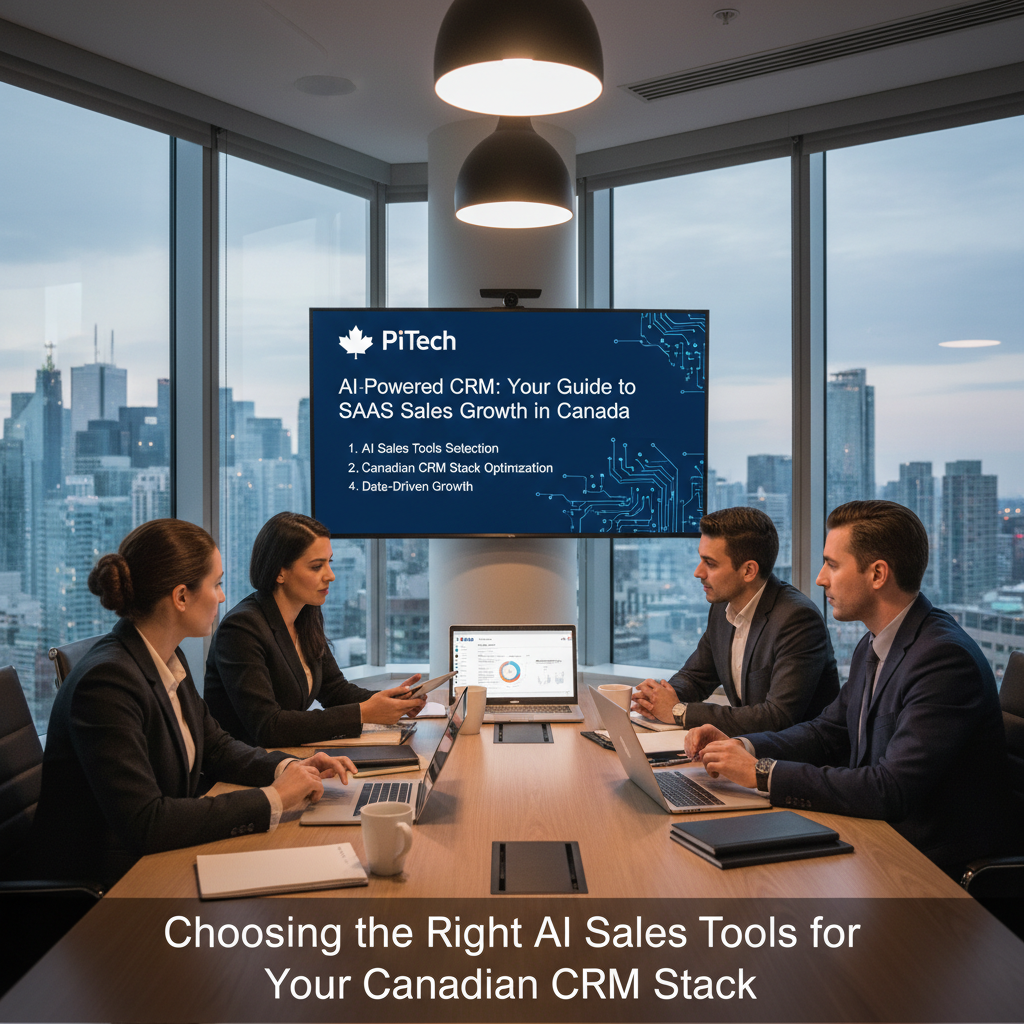
The market for AI sales tools is crowded and confusing. For a Canadian SaaS business, the decision involves not only feature sets and pricing but also integration capabilities and compliance with Canadian regulations.
Native vs. Third-Party AI Integrations: What's the Difference?
Your first major decision point is whether to use the AI features built into your CRM platform or to integrate specialized third-party tools.
* Native AI: Platforms like Salesforce (Einstein) and HubSpot (Sales Hub Enterprise) offer increasingly powerful built-in AI capabilities for lead scoring, forecasting, and automation. The primary benefit is seamless integration; the data and workflows are already connected. The downside can be a lack of specialization and "black box" algorithms that offer little transparency.
* Third-Party AI Tools: Companies like Outreach, Salesloft, Drift, and Apollo.io offer best-in-class solutions for specific functions (e.g., sales engagement, conversational AI). They often provide more advanced features and flexibility than native options. The key here is the quality of their integration with your CRM. A poor integration can create data silos and manual work, defeating the purpose of automation.
For most Canadian startups and scale-ups, a hybrid approach is often best. Start with the native AI features of your CRM and then strategically layer on specialized third-party tools to solve high-priority problems that the native AI doesn't address well.
Key AI Tool Categories: From Predictive Analytics to Conversational AI
As you evaluate the market, understand the main categories of tools and what problems they solve:
- Sales Engagement Platforms (e.g., Salesloft, Outreach): These automate and track multi-channel outreach sequences. Essential for MoFu nurturing.
- Conversational Intelligence (e.g., Gong, Chorus.ai): These record and analyze sales calls for coaching and deal insights. Crucial for BoFu performance.
- Conversational Marketing & AI Chatbots (e.g., Drift, Intercom): These engage website visitors in real-time to qualify and convert leads. Powerful for ToFu conversion.
- Predictive Analytics & Lead Scoring (e.g., built-in CRM tools, specialized platforms): These prioritize leads and forecast sales. Foundational for overall funnel efficiency.
- Data Enrichment & Prospecting (e.g., Apollo.io, ZoomInfo): These automatically add detailed information to your lead records. A huge productivity booster for SDRs.
A Vendor Vetting Checklist for Canadian SaaS Companies
When evaluating a potential AI vendor, go beyond the demo. Ask these critical questions:
* Integration Depth: How deep is the integration with our specific CRM? Is it a true bi-directional sync? Ask for a technical demonstration.
* Data Residency and Security: Where is our customer data stored? Do you have data centers in Canada? How do you ensure compliance with PIPEDA and Quebec's Law 25?
* Implementation and Onboarding: What does the implementation process look like? What training and support do you provide for our sales team?
* Scalability and Pricing: How does your pricing model scale as our team grows? Are there hidden costs for data usage or additional features?
* ROI and Case Studies: Can you provide case studies from other Canadian SaaS companies of a similar size and industry? How do you help us measure the ROI of your tool?
A Practical Framework for Integrating AI into Your CRM
Successful AI adoption is not a purely technical project; it's a change management initiative. Following a structured framework will dramatically increase your chances of success and ensure you generate a positive return on your investment.
Step 1: Conduct a Sales Process and Data Audit
Before you buy any software, look inward. Map your current sales process and identify the most significant points of friction and leakage. Is it poor lead qualification? Inconsistent follow-up? Inaccurate forecasting? This analysis will tell you which category of AI tool will deliver the most immediate impact. Simultaneously, audit your CRM data quality. AI is only as good as the data it learns from. If your CRM is filled with incomplete, outdated, or duplicate records, you must initiate a data cleanup project before implementing an AI solution.
Step 2: Implement a Pilot Program with a Focused Use Case
Don't try to boil the ocean. Instead of a company-wide rollout, start with a pilot program focused on solving one specific problem for a small group of users. For example, implement an AI lead scoring tool for two of your SDRs and measure the impact on their lead-to-opportunity conversion rate over 90 days. This approach minimizes risk, allows you to learn, proves the value of the technology with hard data, and creates internal champions who can advocate for a broader rollout.
Step 3: Train Your Team and Foster AI Adoption
Technology is useless if your team doesn't use it, or worse, doesn't trust it. Adoption requires more than a one-hour training session. Explain the "why" behind the new tool: how it will make their jobs easier, help them hit their targets, and increase their earning potential. Provide hands-on training that is integrated into their existing workflows. Crucially, establish a feedback loop where reps can share what’s working, what isn’t, and how the tool could be better configured to support them. Address concerns about AI being a "black box" by being as transparent as possible about how the algorithms work.
Step 4: Measure, Iterate, and Scale Your AI Implementation
Define your key performance indicators (KPIs) before you start the pilot and track them religiously. These could include:
* Lead response time
* Lead-to-opportunity conversion rate
* Sales cycle length
* Deal win rate
* Sales forecast accuracy
* Reps' time spent on administrative tasks vs. selling activities
Use this data to prove ROI and build the business case for scaling the solution to the rest of the team. The insights you gain will also help you refine your processes and the tool's configuration. AI implementation is not a one-time setup; it's a continuous cycle of measurement, learning, and optimization.
Navigating Data Privacy in Canada: AI, CRM, and PIPEDA Compliance
For any Canadian business, implementing new technology that handles customer data requires a sharp focus on privacy. This is particularly true for AI systems, which can process vast quantities of personal information. Neglecting this responsibility can lead to severe reputational damage and financial penalties.
Understanding Your Obligations Under PIPEDA and Law 25
Canada's federal privacy law, the Personal Information Protection and Electronic Documents Act (PIPEDA), governs how private-sector organizations collect, use, and disclose personal information in the course of commercial activities. In Quebec, the recently updated Law 25 introduces even more stringent requirements, including new consent rules and significant fines for non-compliance. When using AI in your sales process, you must ensure that your practices for collecting training data, processing lead information, and making automated decisions are compliant. This means being transparent with individuals about how their data is being used and obtaining appropriate consent.
Best Practices for Ethical AI and Data Management
Compliance is the minimum requirement; building trust requires a commitment to ethical AI.
* Transparency: Be clear with customers and your own team about where and how AI is being used in the sales process.
* Data Minimization: Only collect and feed the AI the data it absolutely needs to perform its function.
_Fairness and Bias Mitigation:_ Be aware that AI models can inherit and amplify biases present in historical data. Regularly audit your AI's outputs to ensure it is not unfairly discriminating against certain types of leads or customers.
* Human Oversight: Maintain a "human in the loop." Never allow an AI to make a significant negative decision about a customer (e.g., disqualifying a major lead) without human review and the ability to override it.
Questions to Ask AI Vendors About Their Data Handling Practices
Drill down on data privacy during your vendor vetting process. Ask pointed questions:
* "Can you provide your full data processing agreement for our legal team to review?"
* "How do you help us comply with data subject access requests under PIPEDA?"
* "Describe the security measures in place to protect our data, both in transit and at rest."
* "Do you have a designated Data Protection Officer, and can we speak with them?"
* "Where will our specific dataset be physically stored?" (Aim for Canadian data residency).
Practical Business Takeaways: Actionable Insights for Sales Leaders
Feeling overwhelmed? Don't be. You can start this journey today with small, impactful steps. Here are the key takeaways for any Canadian SaaS leader looking to leverage AI:
- Start with Your Biggest Pain Point: Don't chase shiny AI objects. Audit your sales funnel and identify the single biggest bottleneck. Is it lead quality? Follow-up consistency? Deal coaching? Pick one problem to solve first.
- Prioritize Data Hygiene: Your AI is only as smart as your data. Initiate a project to clean, de-duplicate, and enrich your existing CRM data before you implement any advanced tools. This alone will yield significant benefits.
- Run a Controlled Pilot: Select a small, motivated group of sales reps and a single, focused AI tool. Define clear success metrics and run a 90-day pilot. Use the results to build your business case.
- Put Privacy First: Make PIPEDA and Law 25 compliance a core requirement in your vendor selection process. Insist on data protection agreements and Canadian data residency where possible.
- Focus on Augmentation, Not Replacement: Frame AI as a tool that augments your sales team's abilities, freeing them from repetitive tasks to focus on high-value human interaction. This is key to getting buy-in and driving adoption.
The PiTech Perspective: From Off-the-Shelf Integration to Custom Advantage
Implementing off-the-shelf AI tools and integrating them with your CRM is a powerful first step that can deliver immense value. Platforms like HubSpot and Salesforce, combined with third-party tools like Salesloft or Gong, create a formidable tech stack for any Canadian SaaS business. However, as your company scales and your processes become more unique, you may find that pre-built solutions no longer perfectly fit your needs.
This is where the distinction between simple integration and true systems architecture becomes critical. You might discover a gap that no single vendor fills, or your proprietary business logic might require a level of automation that standard integrations can't provide. Perhaps you need to connect your AI sales tool not just to your CRM, but also to your product usage database and your customer support platform to create a truly unified in-house customer intelligence engine.
This is the point where a strategic technology partner like PiTech becomes invaluable. We specialize in moving beyond the limitations of pre-packaged software. Our expertise lies in:
* Custom AI Module Development: When an off-the-shelf tool doesn't exist for your specific need, we can design and build a bespoke AI model trained on your unique data to solve your specific business problem.
* Advanced Integration Layers: We build robust, custom APIs and middleware that create seamless, bi-directional data flows between your CRM, AI tools, and other critical business systems, breaking down data silos for good.
* Strategic AI Consulting: We help you navigate the entire journey, from initial process audits and vendor selection to creating a long-term AI roadmap that aligns with your business goals and ensures compliance with Canadian privacy laws.
The goal is to evolve your tech stack from a collection of separate tools into a single, cohesive, intelligent platform that powers your entire revenue engine. This creates a durable competitive advantage that is difficult for rivals to replicate.
Conclusion: The Future of Sales is Intelligent, Automated, and Canadian
The challenge for Canadian SaaS companies is clear: to thrive in a mature market, you must operate with unparalleled efficiency and deliver a superior customer experience. The manual, intuition-based sales processes of the past are no longer sufficient. The strategic adoption of AI-powered CRM in Canada is the most effective path to meeting this challenge.
By automating repetitive tasks, you empower your sales team to focus on building relationships. By leveraging predictive insights, you ensure their efforts are concentrated on the opportunities most likely to convert. And by enabling personalization at scale, you meet the demands of the modern B2B buyer. This transformation isn’t about replacing humans; it’s about augmenting them, turning your sales team into a hyper-efficient, data-driven force.
The journey begins not with a massive capital investment, but with a strategic decision to audit your process, identify your greatest need, and take the first step. The tools are available, the framework is clear, and the competitive rewards are significant.
Ready to build a more intelligent sales funnel? Schedule a Free Discovery Call with a PiTech Strategist to explore how custom AI and CRM integration solutions can accelerate your growth in the Canadian market.
Ready to Transform Your Business?
Let PiTech help you implement these strategies with proven technology solutions.
Get StartedRelated articles
- B2B SaaS Lead Generation in Canada: The Full-Funnel GuideYour Canadian B2B SaaS is generating leads, but revenue is flat. Discover why a full-funnel approach to lead generation is critical for sustainable growth.
- B2B Lead Nurturing Automation: A Canadian Guide to GrowthDiscover how to optimize B2B lead nurturing automation in Canada. This guide covers strategies, tools, and compliance for driving predictable revenue growth.
- AI-Powered Lead Forms: Canada's B2B Conversion Rate SecretStruggling with low-quality B2B leads in Canada? Discover how AI-powered lead forms optimize capture, enrich data, and supercharge your conversion rate.
- AI Sales Coaching Canada: A Guide to Boosting SaaS PerformanceDiscover how AI sales coaching in Canada can transform your SaaS team. Learn to leverage performance analytics and AI tools to boost revenue and efficiency.